Effect of Medication Album and Medical Adherence in Patients with Chronic Disease in Primary Care
Article Sidebar
Main Article Content
Abstract
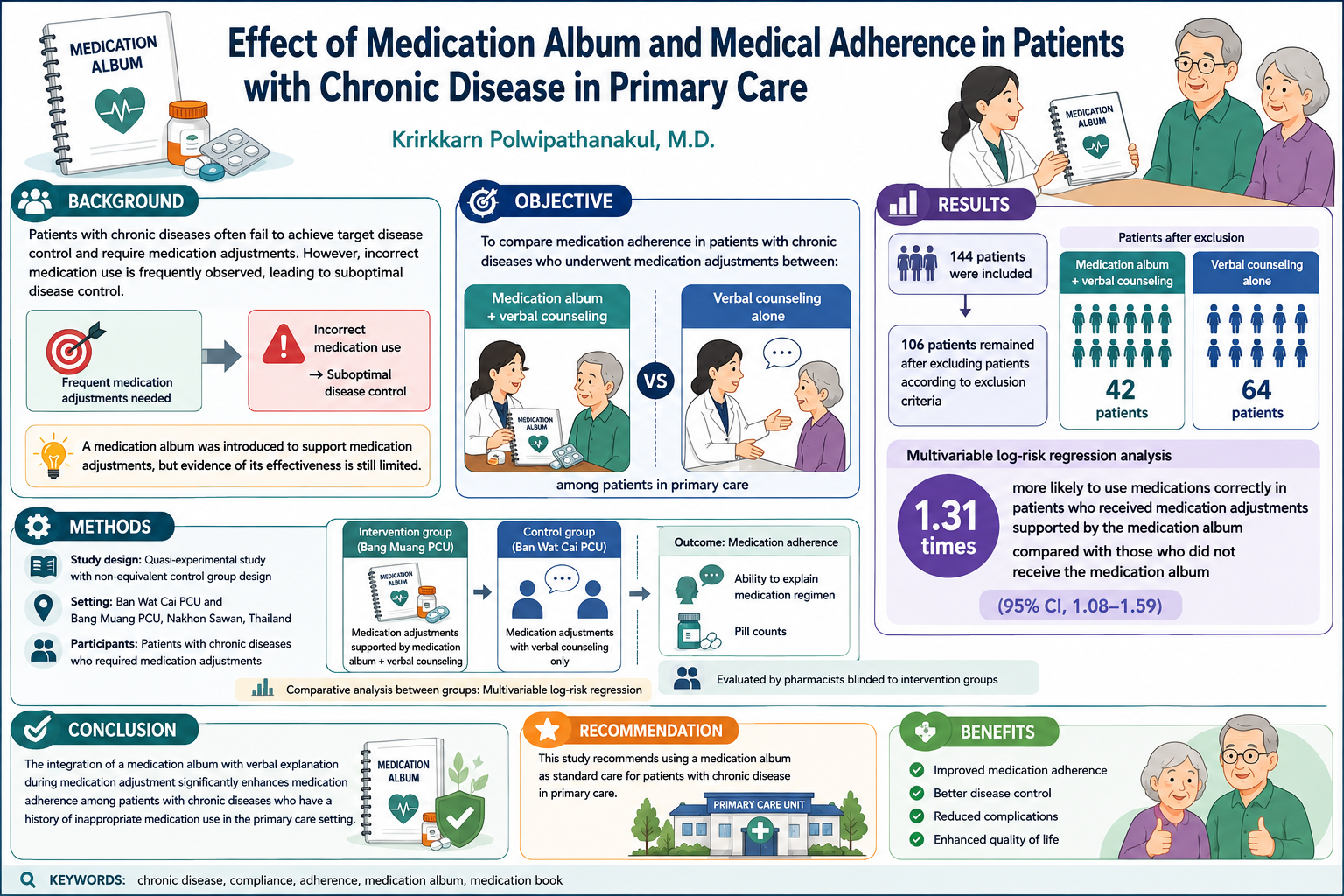
Background: Patients with chronic diseases who fail to achieve target levels of disease control in the service areas of Ban Wat Cai and Bang Muang Primary Care Units, Nakhon Sawan, Thailand, often require medication adjustments to optimize disease management. However, incorrect medication use following these adjustments has frequently been observed, resulting in suboptimal disease control. To address this issue, a medication album was introduced to support medication adjustments among patients with chronic diseases. Nevertheless, evidence regarding the effectiveness of this intervention remains limited. This study aimed to compare the medication adherence of patients with chronic diseases who underwent medication adjustments in a group that used a medication album supported by verbal counseling and a group that received medication adjustments with verbal counseling alone.
Methods: This study was conducted as a Quasi-experimental study with a non-equivalent control group design. Patients with chronic diseases receiving services at Bang Muang Primary Care Unit underwent medication adjustments supported by a medication album and verbal counseling, whereas those at Ban Wat Cai Primary Care Unit received medication adjustments with verbal counseling alone. Medication adherence was evaluated by assessing patients’ ability to explain their medication regimens and through pill counts. Evaluations were performed by pharmacists who were blinded to the intervention groups. Comparative analyses between groups were conducted using multivariable log-risk regression.
Result: A total of 144 patients with chronic diseases were included. After excluding patients according to the exclusion criteria, 106 patients remained. Of these, 42 patients received medication adjustments supported by the medication album, whereas 64 received medication adjustments without the medication album. Multivariable log-risk regression analysis demonstrated that patients who received medication adjustments supported by the medication album were 1.31 times more likely to use their medications correctly than those who did not receive the medication album (95% CI, 1.08–1.59).
Conclusion: Integrating a medication album with verbal explanation during medication adjustment significantly enhances medication adherence among patients with chronic diseases and a history of inappropriate medication use in primary care. This study recommends using a medication album as standard care for patients with chronic disease in primary care.
Downloads
Article Details

This work is licensed under a Creative Commons Attribution-NonCommercial-NoDerivatives 4.0 International License.
The content and information in articles published in the PCFM journal are solely the opinions and responsibilities of the authors. The journal's editorial board does not necessarily agree with or share any responsibility for them.
All articles, information, content, images, etc., published in the PCFM journal are the copyright of the PCFM journal. If any individual or organization wishes to reproduce, distribute, or use any part or the entirety of the content, they must obtain written permission from the PCFM journal beforehand.
References
สมาคมความดันโลหิตสูงแห่งประเทศไทย. แนวทางการรักษาโรคความดันโลหิตสูง ในเวชปฏิบัติทั่วไป พ.ศ. 2567. เชียงใหม่: โรงพิมพ์ทริค ธิงค์, 2567.
ราชวิทยาลัยอายุรแพทย์แห่งประเทศไทย ในพระบรมราชู-ปถัมภ์. แนวทางเวชปฏิบัติการบำบัดภาวะไขมันผิดปกติในเลือดเพื่อป้องกันโรคหัวใจและหลอดเลือด พ.ศ. 2567. กรุงเทพฯ: สำนักพิมพ์กรุงเทพเวชสาร, 2567.
ราชวิทยาลัยอายุรแพทย์แห่งประเทศไทย ในพระบรมรา-ชูปถัมภ์, สมาคมโรคเบาหวานแห่งประเทศไทย ในพระราชูปถัมภ์สมเด็จพระเทพรัตนราชสุดาฯ สยามบรมราชกุมารี, สมาคมต่อมไร้ท่อแห่งประเทศไทย, กรมการแพทย์ กระทรวงสาธารณะสุข, สำนักงานหลักประกันสุขภาพแห่งชาติ. แนวทางเวชปฏิบัติสำหรับโรคเบาหวาน 2566, กรุงเทพฯ: ศรีเมืองการพิมพ์. 2567.
สมาคมโรคไตแห่งประเทศไทย. คำแนะนำสำหรับการดูแลผู้ป่วยโรคไตเรื้อรังก่อนการบำบัดทดแทนไต พ.ศ. 2565 (ฉบับปรับปรุง). กรุงเทพฯ: ศรีเมืองการพิมพ์, 2565.
Gast A, Mathes T. Medication adherence influencing factors-an (updated) overview of systematic reviews. Syst Rev. 2019;8:112. PubMed PMID: 31077247
Lars Osterberg, Terrence Blaschke. Drug therapy Adherence to Medication, N Eng J Med 2005;353:487-97
Aremu TO, Oluwole OE, Adeyinka KO, Schommer JC. Medication Adherence and Compliance: Recipe for Improving Patient Outcomes. Pharmacy (Basel). 2022;10:106. PubMed PMID: 36136839
Cooper C, Carpenter I, Katona C, Schroll M, Wagner C, Fialova D, et al. The AdHOC Study of older adults’ adherence to medication in 11 countries. Am J Geriatr Psychiatry. 2005;13:1067-76. PubMed PMID: 16319299
Zedler BK, Kakad P, Colilla S, Murrelle L, Shah NR. Does packaging with a calendar feature improve adherence to self-administered medication for long-term use? A systematic review. Clin Ther. 2011; 33:62-73.
Oakley CI, Banks SA, Pinto MV, Setter DO, Clark SL, Keser Z, Klaas JP, Leep Hunderfund AN, Mustafa R. Improving Dual Antiplatelet Therapy Adherence Via Implementation of a Pocket Card: A Quality Improvement Pilot Program. J Am Heart Assoc. 2024;13:e037444. PubMed PMID: 39344636
Bionghi N, Daftary A, Maharaj B, Msibi Z, Amico KR, Friedland G, et al. Pilot evaluation of a second-generation electronic pill box for adherence to Bedaquiline and antiretroviral therapy in drug-resistant TB/HIV co-infected patients in KwaZulu-Natal, South Africa. BMC Infect Dis. 2018;18:171. PubMed PMID: 29642874
Li X, Dai J, Zhao S, Liu W, Li H. Comparison of the value of Mini-Cog and MMSE screening in the rapid identification of Chinese outpatients with mild cognitive impairment. Medicine (Baltimore). 2018;97:e10966. PubMed PMID: 29851846
ธรณินทร์ กองสุข, สุวรรณา อรุณพงค์ไพศาล, ศุภชัย จันทร์ทอง, สุพัตรา สุขาวห, จินตนา ลี้จงเพิ่มพูน. ความเที่ยงตรงตามเกณฑ์การวินิจฉัยโรคซึมเศร้า ของแบบประเมินอาการซึมเศร้า 9 คำถาม ฉบับปรับปรุงภาษากลาง. วารสารสมาคมจิตแพทย์แห่งประเทศไทย. 2561;63:321-34.
Prommaloon S, Wattanakitkrileart D, Charoenkitkarn V, Peerapatdit T. Factors influencing insulin adherence in patients with type 2 diabetes. J Nurs Sci. 2017;35:61-71.
Sella E, Carbone E, Vincenzi M, Toffalini E, Borella E. Efficacy of memory training interventions targeting metacognition for older adults: a systematic review and meta-analysis. Aging Ment Health. 2023;27:674-94.
Tse ZCK, Cao Y, Ogilvie JM, Chau BKH, Ng DHC, Shum DHK. Prospective memory training in older adults: a systematic review and meta-analysis. Neuropsychol Rev. 2023;33:347-72.
Paradela RS, de Oliveira Dias P, Detogni A, Sakaki TA, Secorun Inácio JF, Pellanda LC, et al. Cogmed cognitive training for working memory: a systematic review and meta-analysis. Neuroscience. 2025; 581:95-103.
