Factors Associated with Activities of Daily Living of Stroke Patients for Intermediate Care of Home Health Care Program in Sub-District Health Promoting Hospital of Mueang District, Suratthani, Questionnaire-Interview Study
Article Sidebar
Main Article Content
Abstract
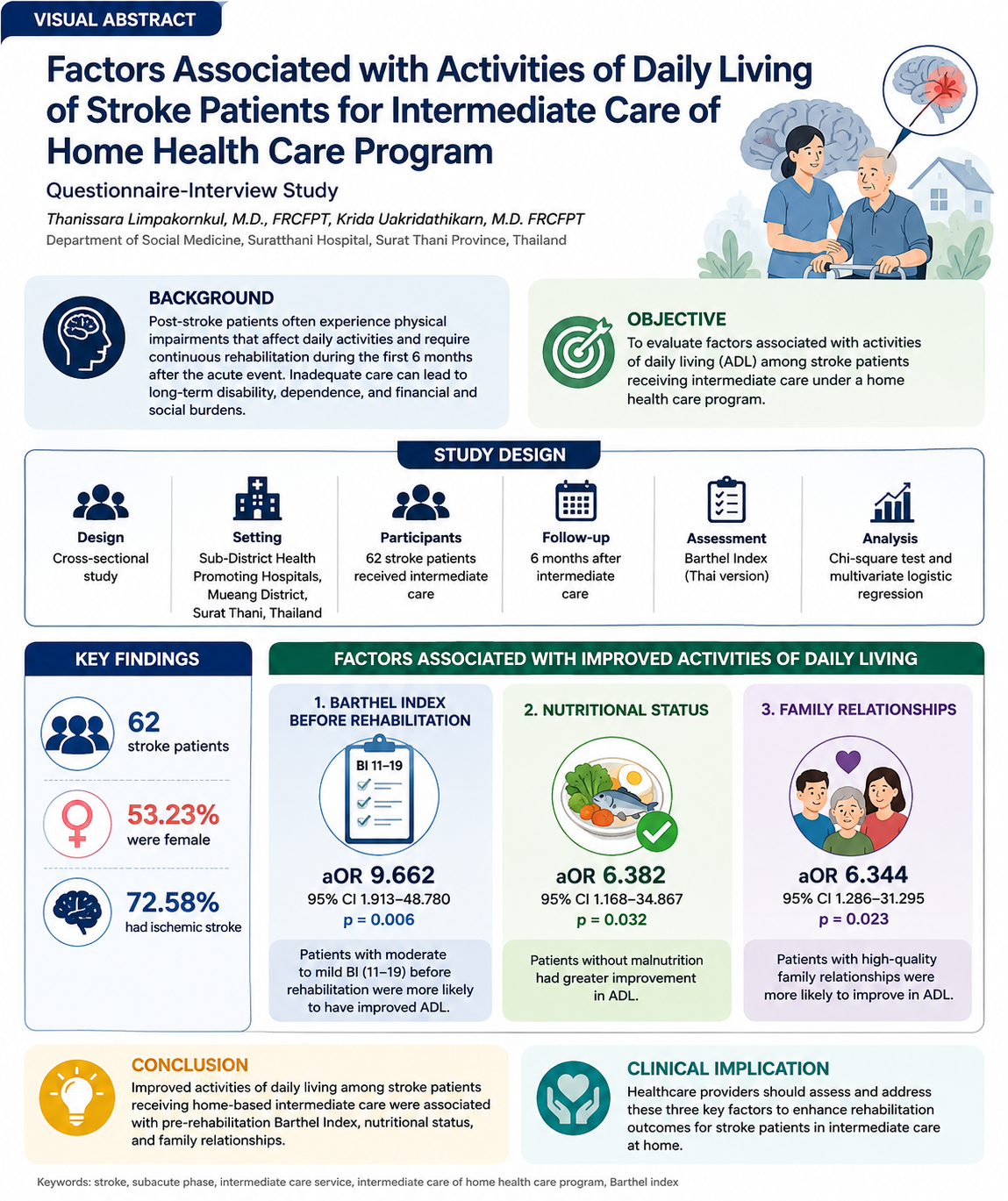
Background: Post-stroke intermediate care is crucial because most patients continue to experience physical impairments that affect their daily activities and require continuous rehabilitation during the first six months after the acute event. If not properly managed, this can lead to long-term disability or permanent dependence, resulting in financial and social burdens for both the patient and their family. Successful rehabilitation depends on multiple factors. Therefore, this study focuses on identifying factors associated with the ability of stroke patients to perform daily activities, in order to determine factors that should be promoted and factors that should be prevented to avoid deterioration. The goal is to develop an effective and sustainable rehabilitation model for post-stroke intermediate care. This study aimed to evaluate the factors associated with activities of daily living of stroke patients for intermediate care of home health care program.
Method: The descriptive study consisted of 62 stroke patients in the Sub-District Health Promoting Hospital of Mueang District, Suratthani, who were discharged from an intermediate care service and followed up for six months. Barthel Index Thai version and return to daily living activities were used for patients who received rehabilitation. Analytical statistics used in this study were Chi-Square and multivariate logistic regression.
Result: The result showed that 62 cases of stroke patients; 53.23% of patients were female. The majority, 72.58%, had ischemic stroke. The factors associated with the improvement activities of daily living of stroke patient for intermediate care were moderate to mild Barthel index before rehabilitation (BI = 11-19) (aOR = 9.662, 95%CI 1.913- 48.780, p = 0.006) non malnutrition (aOR = 6.382, 95%CI 1.168- 34.867, p = 0.032) and a high level of family relationships (aOR = 6.344, 95%CI 1.286- 31.295, p = 0.023)
Conclusion: Healthcare providers should be aware of and emphasize the Barthel index, malnutrition, and family relationships for consideration of rehabilitation.
Keywords: stroke, subacute phase, intermediate care service, intermediate care of home health care program, Barthel index
Downloads
Article Details

This work is licensed under a Creative Commons Attribution-NonCommercial-NoDerivatives 4.0 International License.
The content and information in articles published in the PCFM journal are solely the opinions and responsibilities of the authors. The journal's editorial board does not necessarily agree with or share any responsibility for them.
All articles, information, content, images, etc., published in the PCFM journal are the copyright of the PCFM journal. If any individual or organization wishes to reproduce, distribute, or use any part or the entirety of the content, they must obtain written permission from the PCFM journal beforehand.
References
World Stroke Organization. Global Stroke Fact Sheet 2022 [Internet] [cited 2023 Feb 10]. Available from: https://www.world-stroke.org/assets/downloads/WSO_Global_Stroke_Fact_Sheet.pdf
กรมควบคุมโรค กระทรวงสาธารณสุข. กรมควบคุมโรค รณรงค์วันหลอดเลือดสมองโลก ปี 2566 Together we are GreaterThan Stroke [อินเทอร์เน็ต]. นนทบุรี: กรมควบคุมโรค; 2566 [เข้าถึงเมื่อ 14 ก.ค. 2569]. เข้าถึงได้จาก: https://ddc.moph.go.th/brc/news.php?deptcode=brc&news=37914&news_views=4068&utm_source=chatgpt.com
วาริสา ทรัพย์ประดิษฐ, ขวัญประชา เชียงไชยสกุลไทย, นาพร สามิภักดิ์, ชัชวลัย สนธิกุล. จํานวนชั่วโมงกายภาพ บําบัดที่ส่งผลต่อการเปลี่ยนแปลงความสามารถในการทํากิจวัตรประจําวันในผู้ป่วยโรคหลอดเลือดสมองระยะกึ่งเฉียบพลัน. วารสารกายภาพบำบัด 2565;44:1-11.
จามจุรีย์ เลิศจันทร์. โครงการพัฒนาระบบบริการ การบริบาลฟื้นฟูผู้ป่วย ระยะกลาง (Intermediate Care) จังหวัดเชียงใหม่ [อินเทอร์เน็ต] 2564 [เข้าถึงเมื่อ 10 กุมภาพันธ์ 2566]. เข้าถึงได้จาก: https://thesecsi.net/SECSICMU/r_pdf/r2.pdf
สำนักอนามัยผู้สูงอายุ. คู่มือแนวทางการดำเนินงานการดูแลผู้สูงอายุและผู้ป่วยระยะกลางในชุมชน (Intermediate Care in Community). นนทบุรี: กรมอนามัย กระทรวงสาธารณสุข; 2563.
สถาบันประสาทวิทยา. แนวทางการฟื้นฟูสมรรถภาพผู้ป่วยโรคหลอดเลือดสมอง. กรุงเทพมหานคร: ธนาเพรส; 2559.
กณิฐา ตุ้ยดา, พัชราพร เกิดมงคล, ขวัญใจ อำนาจสัตย์ซื่อ,
ทัศนีย์ รวิวรกุล. ปัจจัยทำนายความสามารถในการปฏิบัติกิจวัตรประจำวันของผู้ป่วยโรคหลอดเลือดสมอง ในกรุงเทพ-มหานคร. วารสารพยาบาลสาธารณสุข 2560;31(พิเศษ):28-42.
Ghaffari A, Rostami HR, Akbarfahimi M. Predictors of instrumental activities of daily living performance in patients with stroke. Occup Ther Int. 2021;2021:6675680. PubMed PMID: 33727902
นันทพร ทองเต็ม, วิมลรัตน์ ภูวราวุฒิพานิช, ศรัณยา คูสิตามงคล. ปัจจัยที่ทำนายกิจกรรมการดำรงชีวิตประจำวันของผู้ป่วยโรคหลอดเลือดสมอง. วารสารพยาบาลศาสตร์แห่งประเทศไทย 2565;40:76-89.
Liu J, Dong J, Guo J. The effects of nutrition supplement on rehabilitation for patients with stroke: analysis based on 16 randomized controlled trials. Medicine (Baltimore). 2022;101(37):e29651. PubMed PMID: 36123946
รัตนพร สายตรี, ปุญญพัฒน์ ไชยเมล์, สมเกียรติยศ วรเดช. ความสามารถในการประกอบกิจวัตรประจำวันของผู้ป่วยโรคหลอดเลือดสมอง. วารสารวิชาการสาธารณสุขชุมชน. 2562; 5:1-13.
