A Systematic Synthesis of Proactive Teacher Development Approaches to Create Digital Innovations
Keywords:
Digital innovation, Proactive teacher development, Professional earning Community (PLC), TPACKAbstract
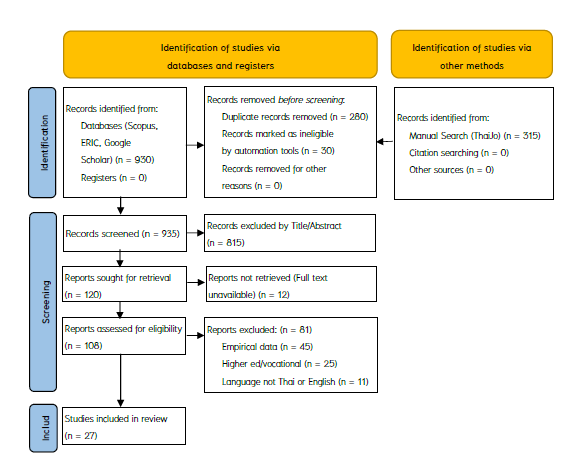
This research aimed to 1) synthesize proactive teacher development approaches for digital innovation creation from relevant domestic and international literature; 2) analyze key points of proactive teacher development approaches that lead to effective digital innovation creation; and 3) develop policy and practice recommendations for proactive teacher development for digital innovation creation that are appropriate for the educational context in Thailand. This research was a systematic narrative review. Research articles were selected from Scopus, ERIC, Google Scholar, and ThaiJo databases published between 2020 and 2025 according to the PRISMA 2020 (Reporting Guideline for Systematic Reviews and Meta-Analyses) reporting guidelines. A total of 27 articles passed the criteria and were analyzed for qualitative content.
The findings reveal that: 1) the synthesis of proactive teacher development approaches for digital innovation creation from domestic and international literature highlights a paradigm shift from passive training to self-directed learning, embedded in actual practice, and relying on collaborative networks; 2) the key issues for effective proactive teacher development leading to digital innovation: (1) a systematic and continuous development process embedded in practice, utilizing Professional Learning Communities (PLCs) as a core mechanism; (2) the fostering of teacher agency and TPACK competency through classroom action research and reflective practice; and (3) the provision of a robust support structure, particularly strong digital leadership from administrators and a conducive organizational culture; and 3) policy and practice recommendations for proactive teacher development for digital innovation creation are formulated into a three-phase teacher development model is proposed: Phase 1 focuses on building a foundation by shaping attitudes and establishing a fundamental understanding of the TPACK framework. Phase 2 emphasizes practical implementation and collaborative culture through PLCs and classroom action research. Phase 3 ensures sustainable support and scalability through the development of digital leadership, a robust mentorship system, and the allocation of necessary resources. This approach aims to transform teachers' roles from passive trainees to self-directed innovators, fostering sustainable professional growth to meet the educational challenges of the digital age.
References
ขอบฟ้า จันทร์เจริญ, วราภรณ์ ไทยมา และ ภัทราวดี มากมี. (2564). แนวทางการผลิตนักศึกษาวิชาชีพครูมหาวิทยาลัยราชภัฏในภาคตะวันออกเฉียงเหนือ ตามมาตรฐานความรู้วิชาชีพครูฐานสมรรถนะ. วารสารวิชาการคณะมนุษยศาสตร์และสังคมศาสตร์ มหาวิทยาลัยราชภัฏเทพสตรี, 12(1), 127–142. จาก https://so01.tci-thaijo.org/index.php/truhusocjo/article/view/243104.
เจตนิพัทธ์ ยางกลาง. (2568). การพัฒนากิจกรรมชุมชนแห่งการเรียนรู้ทางวิชาชีพ (PLC) เพื่อส่งเสริมภาวะผู้นำเชิงนวัตกรรม ของครูผู้สอนโรงเรียนต้นแบบทรูปลูกปัญญา สังกัดสำนักงานเขตพื้นที่การศึกษาประถมศึกษาอุดรธานี เขต 1. วารสารวิชาการมหาวิทยาลัยภาคตะวันออกเฉียงเหนือ, 15(3), 190–202. จาก https://so04.tci-thaijo.org/index.php/neuarj/article/view/281356.
ณัฐพล พันธุ์พงศ์, นเรศ ขันธะรี, พงษ์ธร สิงห์พันธ์, ชวนคิด มะเสนะ และ สมฤทัย เตาจันทร์. (2567). รูปแบบชุมชนแห่งการเรียนรู้ทางวิชาชีพเพื่อการจัดการเรียนรู้โดยใช้เทคโนโลยีดิจิทัลในสถานศึกษาขั้นพื้นฐาน. วารสารศิลปศาสตร์ มหาวิทยาลัยสงขลานครินทร์, 16(2), 1–14. จาก https://so03.tci-thaijo.org/index.php/journal-la/article/view/277052.
ธนากร ม่วงกล้วย, พัชระ นวลปาน, พงศ์ประพันธ์ พงษ์โสภณ และ จีระวรรณ เกษสิงห์. (2568). TPACK ในการศึกษาไทยช่วงปี 2020–2024. วารสารการศึกษาและนวัตกรรม, 27(2), 321–335. จาก https://so06.tci-thaijo.org/index.php/edujournal_nu/article/view/279312/189898.
มุจรินทร์ เพิดภูเขียว และ ไพโรจน์ กลิ่นกุหลาบ. (2568). โปรแกรมเสริมสร้างสมรรถนะการจัดการเรียนรู้โดยใช้เกมเป็นฐานสำหรับครู ในโรงเรียนสังกัดสำนักงานเขตพื้นที่การศึกษาประถมศึกษาขอนแก่น เขต 5. วารสารเสฏฐวิทย์ปริทัศน์, 5(2), 954–965. จาก https://so12.tci-thaijo.org/index.php/stw/article/download/2192/2861.
ศิรินาถ ลิ้มพิจำนงค์ และ ปานพิชญา ขันฉิว. (2566). รูปแบบการพัฒนาสมรรถนะดิจิทัลของครูในยุคการแปลงเป็นดิจิทัล สังกัดสำนักงานเขตพื้นที่การศึกษามัธยมศึกษาขอนแก่น. วารสารครุศาสตร์ จุฬาลงกรณ์มหาวิทยาลัย, 51(4), 1-16. จาก https://so02.tci-thaijo.org/index.php/EDUCU/article/view/258872.
สุวิมล ว่องวาณิช. (2565). การวิจัยปฏิบัติการในชั้นเรียน (พิมพ์ครั้งที่ 21). กรุงเทพฯ: สำนักพิมพ์แห่งจุฬาลงกรณ์มหาวิทยาลัย.
สุวิไล จันทร์สนอง และ ชนสิทธิ์ สิทธิ์สูงเนิน. (2566). การพัฒนารูปแบบชุมชนแห่งการเรียนรู้ทางวิชาชีพแบบผสมผสานร่วมกับการโค้ชเพื่อพัฒนาสมรรถนะการจัดการเรียนรู้ตามแนวทางสะเต็มศึกษา (STEM Education) และการสร้างนวัตกรรมของนักเรียนระดับมัธยมศึกษา. Journal of Roi Kaensarn Academi, 8(10), 327–348. จาก https://so02.tci-thaijo.org/index.php/JRKSA/article/view/263205.
เสาวลักษณ์ รัตนะ และ วัลลภา อารีรัตน์. (2567). แนวทางการพัฒนาสมรรถนะดิจิทัลสำหรับครูเพื่อการจัดการเรียนรู้เชิงรุกในโรงเรียนสังกัดองค์กรปกครองส่วนท้องถิ่นจังหวัดหนองคาย. วารสาร มจร อุบลปริทรรศน์, 9(3), 799-812. จาก https://so06.tci-thaijo.org/index.php/mcjou/article/view/274194.
Amemasor, S. K., Oppong, S. O., Ghansah, B., Benuwa, B.-B., & Essel, D. D. (2025). A systematic review on the impact of teacher professional development on digital instructional integration and teaching practices. Frontiers in Education, 10, Article 1541031. From https://doi.org/10.3389/feduc.2025.1541031.
Azimkhan, S., Abildinova, G., Khamzina, A., Karymsakova, A., & Karaca, C. (2025). Developing teacher digital competence through mobile and interactive technologies: A systematic review using the TPACK framework. International Journal of Engineering Pedagogy, 15(3), 33–59. From https://doi.org/10.3991/ijep.v15i3.51653.
Bass, B. M. (1985). Leadership and performance beyond expectations. New York: Free Press.
Bingham, A. J. (2021). How distributed leadership facilitates technology integration: A case study of “pilot teachers”. Teachers College Record, 123(7), 1–34. From https://eric.ed.gov/?id=EJ1349952.
Bjordal, F. (2025). Teachers' sense of agency in digitalised teaching environments. Nordic Journal of Digital Literacy, 20(3), 172–183. From https://doi.org/10.18261/njdl.20.3.4.
Chiu, T. K. F., Falloon, G., Song, Y., Wong, V. W. L., Zhao, L., & Ismailov, M. (2024). A self-determination theory approach to teacher digital competence development. Computers & Education, 214, Article 105017. From https://doi.org/10.1016/j.compedu.2024.105017.
Cong-Lem, N. (2021). Teacher agency: A systematic review of the international literature. Issues in Educational Research, 31(3), 718–738. From https://www.iier.org.au/iier31/cong-lem-abs.html.
Damşa, C., Langford, M., Uehara, D., & Scherer, R. (2021). Teachers’ agency and online education in times of crisis. Computers in Human Behavior, 121, Article 106793. From https://doi.org/10.1016/j.chb.2021.106793.
Dogan, S., Nalbantoglu, U. Y., Celik, I., & Dogan, N. A. (2025). Artificial intelligence professional development initiatives for teachers: A systematic review. Professional Development in Education. Advance online publication. From https://eric.ed.gov/?id=EJ1445678.
Emans, A., Oolbekkink-Marchand, H., Bakker, C., & De Bruijn, E. (2024). Teacher agency in the dynamics of educational practices: A theory synthesis. Frontiers in Education, 9, Article 1515123. From https://doi.org/10.3389/feduc.2024.1515123.
Engeness, I., & Gamlem, S. M. (2025). Agency in digital education: Empowering students and teachers in technology-rich learning environments. Education Sciences, 15(8), Article 1051. From https://doi.org/10.3390/educsci15081051.
Gallego Joya, A., Guillén-Gámez, F. D., & Mayorga-Fernández, M. J. (2025). Teacher digital competence: Keys for an educational future through a systematic review. Contemporary Educational Technology, 17(2), ep577. From https://doi.org/10.30935/cedtech/14608.
Godfrey, D., & Munoz-Chereau, B. (2024). Joint practice development through a peer-led school improvement partnership: Research-driven recommendations for policymakers and school leaders (ERIC Document Reproduction Service No. ED671285). Reading, England: Education Development Trust.
Handayani, A., Ciptaningrum, D. S., & Triastuti, A. (2025). Research on professional learning communities (PLCs) in English language education: A systematic review. Issues in Educational Research, 35(3), 970–986. From https://www.iier.org.au/iier35/handayani.pdf.
Ishak, R., Ismail, K., & Kamaruddin, S. H. (2020). Professional learning communities in Malaysian schools: A contemporary literature review. Universal Journal of Educational Research, 8(4), 1535–1541. From https://doi.org/10.13189/ujer.2020.080447.
Jiménez Sierra, Á. A., Ortega Iglesias, J. M., Cabero-Almenara, J., & Palacios-Rodríguez, A. (2023). Development of the teacher’s technological pedagogical content knowledge (TPACK) from the Lesson Study: A systematic review. Frontiers in Education, 8, Article 1078913. From https://doi.org/10.3389/feduc.2023.1078913.
Jin, F., Peng, X., Sun, L., Song, Z., Zhou, K., & Lin, C. H. (2025). Knowledge (co-)construction among artificial intelligence, novice teachers, and experienced teachers in an online professional learning community. Journal of Computer Assisted Learning, 41(2), e70004. From https://doi.org/10.1111/jcal.70004.
Kausar, S., Arif, M., & Sebgag, S. (2025). Characteristics of transformational leadership in the digital era (Preprint). ResearchGate. From https://doi.org/10.13140/RG.2.2.12345.6789.
Kolb, D. A. (1984). Experiential learning: Experience as the source of learning and development. Englewood Cliffs, New Jersey: Prentice-H.
Kristiawan, D., Carter, C., & Picard, M. (2023). Impact of CALL professional development for EFL materials on teacher agency and technological pedagogical content knowledge (TPACK) in Indonesian Islamic schools. Teaching English with Technology, 22(3–4), 20–42. From https://files.eric.ed.gov/fulltext/EJ1367619.pdf.
Lasrin, H., Rubini, B., & Novita, L. (2025). The effect of transformational leadership and teacher motivation on teacher innovation in secondary schools. International Journal of Research and Innovation in Social Science, 9(6), 5997–6007. From https://doi.org/10.47772/IJRISS.2025.906000459.
Liu, J., Aziku, M., Qiang, F., & Zhang, B. (2024). Leveraging professional learning communities in linking digital professional development and instructional integration: Evidence from 16,072 STEM teachers. International Journal of STEM Education, 11, Article 60. From https://doi.org/10.1186/s40594-024-00513-3.
Meletiou-Mavrotheris, M., & Paparistodemou, E. (2024). Sustaining teacher professional learning in STEM: Lessons learned from an 18-year-long journey into TPACK-guided professional development. Education Sciences, 14(4), Article 402. From https://doi.org/10.3390/educsci14040402.
Michos, K., Maria-Luisa, S., & Petko, D. (2023). Teachers' data literacy for learning analytics: A central predictor for digital data use in upper secondary schools. Education and Information Technologies, 28(11), 14453–14471. From https://doi.org/10.1007/s10639-023-11772-y.
Mishra, P., & Koehler, M. J. (2006). Technological pedagogical content knowledge: A framework for teacher knowledge. Teachers College Record, 108(6), 1017–1054. From https://doi.org/10.1111/j.1467-9620.2006.00684.x.
Paulus, M., Villegas, S. G., & Howze-Owens, J. (2020). Professional learning communities: Bridging the technology integration gap through effective professional development. Peabody Journal of Education, 95(2), 193–202. From https://doi.org/10.1080/0161956X.2020.1745610.
Schön, D. A. (1983). The reflective practitioner: How professionals think in action. New York:Basic Books.
Siregar, T. (2025). Classroom action research-based learning innovations: Kemmis and McTaggart models (Preprint). Preprints.org. From https://doi.org/10.20944/preprints202510.1440.v1.
Tao, J., & Gao, X. (2022). Teacher agency in technology integration: A systematic review of the literature. Computers & Education, 191, 104625. From https://www.google.com/search?q=https://doi.org/10.1016/j.compedu.2022.104625.
Trust, T., & Whalen, J. (2020). Should teachers be trained in emergency remote teaching? Lessons learned from the COVID-19 pandemic. Journal of Technology and Teacher Education, 28(2), 189-199. From https://www.learntechlib.org/primary/p/215995/.
Voogt, J., Fisser, P., Pareja Roblin, N., Tondeur, J., & van Braak, J. (2013). Technological pedagogical content knowledge – A review of the literature. Journal of Computer Assisted Learning, 29(2), 109–121. From https://doi.org/10.1111/j.1365-2729.2012.00487.x.
Xerri, D. (2025). Enhancing reflective practice in language teacher education: Technology as a critical reflective partner. Technology in Language Teaching & Learning, 7(2), Article 103214. From https://doi.org/10.29140/tltl.v7n2.103214.
Zahro, K., Andriani, D., & Raihan, P. D. (2024). Exploring vocational school principals' digital leadership in cultivating school digital culture. Jurnal Dinamika Manajemen Pendidikan, 10(1), 15–28. From https://journal.unesa.ac.id/index.php/jdmp/article/view/45393.
Zeng, M., Cheah, K. S. L., & Abdullah, Z. (2025). The influence of school principals' digital leadership on teachers' competency in integrating artificial intelligence: A systematic thematic review. Frontiers in Education, 10, Article 1655967. From https://doi.org/10.3389/feduc.2025.1655967.
Downloads
Published
How to Cite
Issue
Section
License
Copyright (c) 2026 Phayao University

This work is licensed under a Creative Commons Attribution-NonCommercial-NoDerivatives 4.0 International License.
Authors are responsible for the content of their manuscripts. The University of Phayao does not necessarily endorse or agree with the views expressed in published articles. Interested parties may reproduce or use the content; however, they must obtain prior written permission from the copyright holder and provide proper citation and acknowledgment.