Developing Self-Regulation Executive Function in Early Childhood Through Lively Arts Activities with Virtual reality Technology: An Action Research
Keywords:
Self-regulation executive functions, Living art activities through the application of 50 virtual reality technology, Action research, Relative developmentAbstract
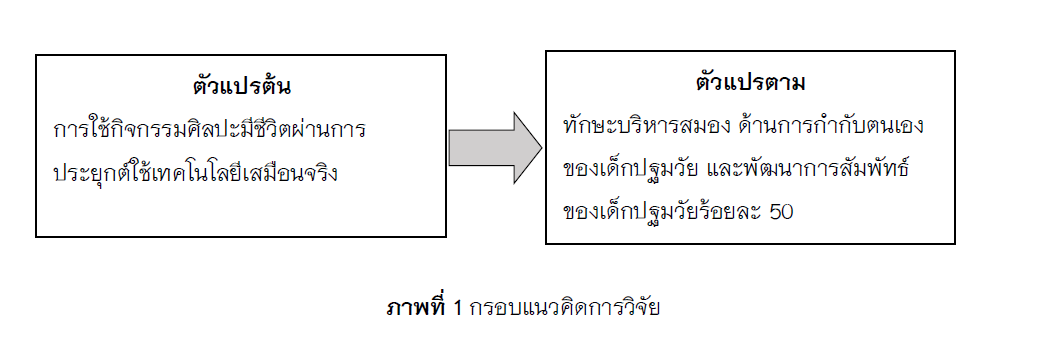
The objectives of this research were: (1) to study the development of executive function in self-regulation among preschool children after participating in Living Art Activities through the application of virtual reality technology using an action research process, and (2) to examine the relative developmental progress of preschool children’s self-regulation at the 50-percent developmental benchmark. Target group in this study consisted of 35 Kindergarten 1 children. The key informants included two early childhood teachers and 35 parents. The research was conducted through two action research cycles. The research tools included a self-regulation skills behavior recording form, which encompasses the ability to concentrate, control emotions, and self-assessment; and observation forms for early childhood children, teachers, and parents. Data analysis included frequency, percentage, relative developmental percentage, and descriptive analysis.
The results of developing executive function in self-regulation among preschool children after participating in “Living Art Activities” through virtual reality technology revealed that, overall, 32 children (91.43%) met the developmental criteria. Considering the relative developmental percentage above the 50% threshold, 32 children (91.43%) achieved the criterion in sustained attention, 30 children (85.71%) in emotional control, and 32 children (91.43%) in self-monitoring. The children demonstrated noticeable improvement in sustained attention by maintaining focus for longer periods and completing activities with greater continuity. They were also able to regulate their emotions more effectively and clearly reflect upon and evaluate their own actions.
References
กระทรวงศึกษาธิการ. (2560). หลักสูตรการศึกษาปฐมวัย พุทธศักราช 2560. กรุงเทพฯ: โรงพิมพ์ชุมนุมสหกรณ์การเกษตรแห่งประเทศไทย.
กิตติศักดิ์ สิงห์สูงเนิน และ พิษณุ พรประทาน. (2565). การพัฒนาบัตรคำศัพท์ภาษาอังกฤษ A-Zด้วยเทคโนโลยีความเป็นจริงเสริม. วารสารวิจัยและนวัตกรรมทางวิทยาศาสตร์และเทคโนโลยี, 3(4), 31-41.
ณัฐณิชา มณีพฤกษ์. (2565). การพัฒนาชุดกิจกรรมศิลปะที่บูรณาการเทคโนโลยีดิจิทัลเพื่อเสริมสร้างแรงจูงใจในการสร้างสรรค์งานศิลปะสำหรับเด็กปฐมวัย. (วิทยานิพนธ์ครุศาสตรมหาบัณฑิต สาขาวิชาศิลปศึกษา). กรุงเทพฯ: จุฬาลงกรณ์มหาวิทยาลัย.
ปลายฟ้า วงษ์เดช และ ฉัตรวิไล สุรินทร์ชมพู. (2567). ความสามารถในการใช้กล้ามเนื้อมัดเล็กที่ได้รับการจัดกิจกรรมศิลปะการปั้น. วารสารรามคำแหง ฉบับคณะศึกษาศาสตร์ (มนุษยศาสตร์และสังคมศาสตร์), 5(2), 76-88.
ภัทราพร เกษสังข์. (2566). การวิจัยปฏิบัติการ Action research (พิมพ์ครั้งที่ 3). กรุงเทพฯ: สำนักพิมพ์จุฬาลงกรณ์มหาวิทยาลัย.
วิชุดา ช่วยพิชัย. (2566). การสนับสนุนการเรียนรู้ด้วย AR (Augmented Reality) ในด้านการศึกษา. วารสารมหาจุฬานาครทรรศน์, 10(6), 324–334.
วัชรีญา ธรรมสอน, สถิตรัชต แก้วมุกดา และ ชนกนาถ ชูพยัคฆ์. (2667). การพัฒนาผลสัมฤทธิ์ทางการเรียนในวิชาการงานอาชีพเรื่องขนมไทย โดยใช้สื่อเสมือนจริง (Augmented Reality-AR) ของระดับชั้นมัธยมศึกษาปีที่ 3 โรงเรียนเตรียมอุดมศึกษาน้อมเกล้า. พัฒนาเทคนิคศึกษา, 36(130), 17-22.
Best, J. R., & Miller, P. H. (2010). A developmental perspective on executive function. Child Development, 81(6), 1641-1660.
Blasco, P. M., Saxton, S., & Gerrie, M. (2014). The little brain that could: Understanding executive function in early childhood. Young Exceptional Children, 17(3), 3-18.
Denton, C. A., Montroy, J. J., Zucker, T. A., & Cannon, G. (2021). Designing an intervention in reading and self-regulation for students with significant reading difficulties, Including dyslexia. Learning Disability Quarterly, 44(3), 171-185.
Diamond, A. (2013). Executive functions. Annual review of psychology, 64(1), 135-168.
Kemmis, S., & McTaggart, R. (1988). The action research planner. Victoria: Deakin University.
McCoy, D. C. (2019). Measuring young children’s executive function and self-regulation in classrooms and other real-world settings. Clinical child and family psychology review, 22 (1), 63-74.
Nurjanah, I., Mawardah, M., Purnamasari, S. D., Oktaviani, N., & Yulianingsih, E. (2023). Art and craft activities for early children to improve fine motor ability. Abdi Dosen: Jurnal Pengabdian Pada Masyarakat, 7(2), 577-584.
Omar, A. C., Yusof, N., Abd Muin, M. A., Aziz, N., & Nizam, M. F. A. M. (2023). Expert review on augmented reality mobile application for promoting asnaf Care. Journal of Advanced Research in Applied Sciences and Engineering Technology, 33(3), 17-27.
Surinchompoo, C. (2023). The effects of applying fairy tales to promote the executive functions (EF) of
early childhood children, Basic cognitive skills. Journal of Organizational Innovation & Culture, 14(1), 89-108.
Vygotsky, L. S. (1978). Mind in society: The development of higher psychological processes. Cambridge, MA: Harvard University Press.
Williams, A., Fossey, E., Farhall, J., Foley, F., & Thomas, N. (2021). Impact of jointly using an e–mental health resource (self-management and recovery technology) on interactions between service users experiencing severe mental illness and community mental health workers: grounded theory study. JMIR Mental Health, 8(6), e25998.
Downloads
Published
How to Cite
Issue
Section
License
Copyright (c) 2026 Phayao University

This work is licensed under a Creative Commons Attribution-NonCommercial-NoDerivatives 4.0 International License.
Authors are responsible for the content of their manuscripts. The University of Phayao does not necessarily endorse or agree with the views expressed in published articles. Interested parties may reproduce or use the content; however, they must obtain prior written permission from the copyright holder and provide proper citation and acknowledgment.