Student Mobility and the Internationalization of Higher Education in Thailand: Institutional Capacities and Population Dynamics
Keywords:
International student mobility, Non-Immigrant “ED” visa, Institutional capacity, Governance, Students of Chinese nationality and CLMV nationalities (Cambodia, Laos, Myanmar, Vietnam)Abstract
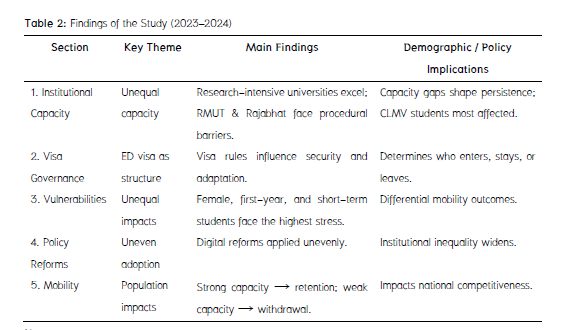
This study examines how immigration governance and the institutional capacities of Thai higher education institutions influence the experiences, regulatory compliance, and satisfaction levels of international students from China and CLMV countries studying in Thailand between 2023 and 2024. Secondary data from 2020–2025 are incorporated to illustrate national and institutional trends, while primary data collected during 2023–2024 provide empirical evidence on students lived experiences.
The research has three objectives: (1) to compare the visa management processes of research universities (Mahidol University and Chulalongkorn University), the nine Rajamangala University of Technology (RMUT) campuses, Rajabhat Universities, and specialized programs within the RMUT/Rajabhat network; (2) to analyze the effects of digital systems, staff professionalism, and communication clarity on students’ visa compliance and stress levels; and (3) to identify characteristics of at-risk student groups, such as female students, first-year students, and learners
in short-term programs. A Convergent Parallel mixed-methods design was employed. Quantitative data were collected from 400 international students (100 per institution) using a Likert-scale questionnaire with content validity ranging from IOC = 0.67–1.00 and internal reliability α = 0.84–0.91. Qualitative data were obtained from 36 in-depth interviews and four focus groups. The researcher applied Thematic Analysis following Braun and Clarke’s (2020: 328-352) Reflexive Thematic Analysis approach, which emphasizes deep interpretation and the researcher’s reflexive role in constructing themes from qualitative data.
The findings indicate that enhancing governance models, designing digital structures that align with the context of each institution, and continuously strengthening staff competencies can significantly improve visa management and support services for international students. These improvements also contribute to greater student satisfaction and reinforce institutional credibility in the long term.
References
Bennett, M. J. (2013). Basic concepts of intercultural communication: Paradigms, principles, and practices. Boston, MA: Intercultural Press. 62–75.
Borgatti, S. P., & Halgin, D. S. (2011). On network theory. Organization Science, 22(5), 1168–1181. Form https://doi.org/10.1287/orsc.1100.0641.
Braun, V., & Clarke, V. (2020). One size fits all? What counts as quality practice in (reflexive) thematic analysis?. Qualitative Research in Psychology, 18(3), 328–352. Form https://doi.org/10.1080/14780887.2020.1769238.
Immigration Bureau. (2022). Annual report on student visa management 2020–2022 (pp. 5–6). Royal Thai Police Immigration Bureau. Retrieved February 10, 2025, From https://www.immigration.go.th/annual-report-2022.
Immigration Bureau. (2023). Digital transformation in immigration services: The case of e-Extension and 90-day reporting. Immigration Bureau Royal Thai Police. 2–3. Retrieved February 10, 2025, From https://www.immigration.go.th/digital-report-2023.
Jampaklay, A., Penboon, S., & Lucktong, A. (2022). Internationalization of higher education in Thailand: Promises and reality. Kasetsart Journal of Social Sciences, 43(1), 183–193. From https://doi.org/10.34044/j.kjss.2022.43.1.25.
Khaosod English. (2025, May 26). Thailand balances international education growth with immigration control. Retrieved February 10, 2026, From https://www.khaosodenglish.com/featured/2025/05/26/thailand-balances-international-education-growth-with-immigration-control/.
Knight, J., & de Wit, H. (2018). Internationalization of higher education: Past, present, and future directions. Journal of Studies in International Education, 95, 2–4. From https://doi.org/10.6017/ihe.2018.95.10715.
Lee, E. S. (1966). A theory of migration. Demography, 3(1), 47–57. From https://doi.org/10.2307/2060063.
Ministry of Foreign Affairs. (2023). Thailand’s education diplomacy and soft power strategy (p. 4). Retrieved February 10, 2025, From https://www.mfa.go.th/education-softpower-2023.
Nation Thailand. (2025, February 10). Immigration reforms and their impact on international education in Thailand (p. 2). Retrieved February 10, 2025, From https://www.nationthailand.com/news/2025/02/10/edu-reforms.
Nguyen, A., & Chen, L. (2021). Regional competition in higher education hubs: Policy lessons from ASEAN. Higher Education Policy, 34(1), 55–72. From https://doi.org/10.1057/s41307-020-00199-7.
Praphamontripong, P., & Chalamwong, Y. (2020). Education and labor market transitions in Thailand. Journal of Asian Public Policy, 13(1), 110–125. From https://doi.org/10.1080/17516234.2020.1724235.
United Nations Network on Migration in Thailand. (2024). Thailand migration report 2024 (pp. 122–175). International Organization for Migration. From https://thailand.iom.int/sites/g/files/tmzbdl1371/files/documents/2024-12/thailand-migration-report-2024.pdf.
Wongchai, P. (2023). Institutional capacity and student visa compliance: Comparing flagship and regional universities in Thailand. Asian Education Review, 12(2), 50–65. From https://doi.org/10.1080/asiaed.2023.12045.
Wright, C., & Schartner, A. (2020). “I can't… I'm stressed”: The impact of social networks on international student experiences. Journal of International Students, 10(1), 120–138. From https://doi.org/10.32674/jis.v10i1.773.
Ye, J. (2017). International students’ use of new media for cross-cultural adaptation: A social network approach. Journal of Social Networking, 6(2), 145–160. From https://doi.org/10.4236/sn.2017.62012.
Zhang, J., & Goodson, P. (2011). Predictors of international students’ psychosocial adjustment to life in the United States: A systematic review. International Journal of Intercultural Relations, 35(2), 281–292. From https://doi.org/10.1016/j.ijintrel.2010.08.011.
Zhong, X., Li, Y., & Chen, H. (2025). Transitioning from education to labor migration: Evidence from CLMV students in Thailand. Educational Process International Journal, 14(2), 242–255.
Downloads
Published
How to Cite
Issue
Section
License
Copyright (c) 2026 Phayao University

This work is licensed under a Creative Commons Attribution-NonCommercial-NoDerivatives 4.0 International License.
Authors are responsible for the content of their manuscripts. The University of Phayao does not necessarily endorse or agree with the views expressed in published articles. Interested parties may reproduce or use the content; however, they must obtain prior written permission from the copyright holder and provide proper citation and acknowledgment.