Factors Affecting Mathematical Literacy as Assessed by PISA Among Grade 9 Students in Princess Chulabhorn Science High Schools
Keywords:
Factors affecting, Mathematical literacyAbstract
This study aimed to 1) Examine the relationship between student-related factors, school-related factors, and family-related factors and mathematical literacy based on the PISA assessment framework for Grade 9 students from Princess Chulabhorn Science High School; and 2) Analyze factors affecting mathematical literacy based on the PISA assessment framework among these students. The sample consisted of 192 Grade 9 students from Princess Chulabhorn Science High School in the 2024 academic year, selected through multi-stage random sampling. Data were collected using a questionnaire with a 5-point Likert scale, consisting of 42 items. Data analysis included Basic statistics, Pearson’s correlation coefficient and Multiple Regression Analysis.
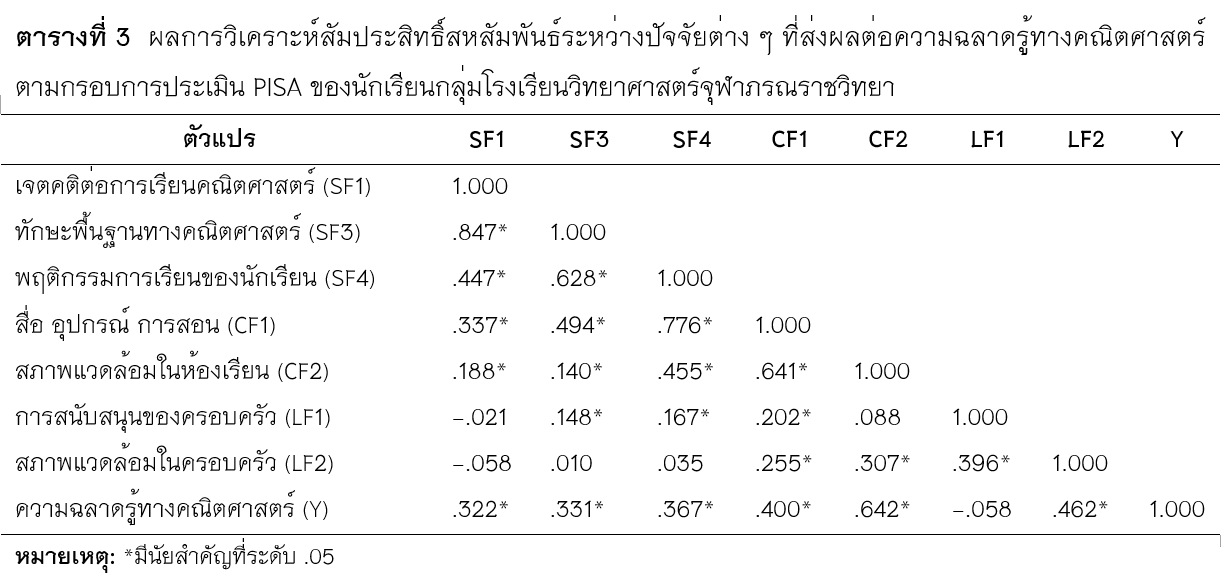
Results revealed that various factors showed correlations with mathematical literacy based on the PISA assessment framework ranging from .322 to .642, indicating a low to high level of correlation, with statistical significance at the .05 level for all except for the family support factor (LF1). Six factors significantly affected mathematical literacy at the .05 level, in descending order: classroom environment (CF2) (β = .638) family environment (LF2) (β = .480) instructional media (CF1) (β = -.398) basic mathematics skills (SF3) (β = .356) family support (LF1) (β = -.309) student learning behaviors (SF4) (β = 1.97)
References
กฤธยากาญจน์ โตพิทักษ์. (2558). ระเบียบวิธีวิจัยทางสังคมศาสตร์ (Social Research Methodology). สงขลา: เหรียญทองการพิมพ์.
จันทร์มณี พฤฒิสาร, ดารุณี ทิพยกุลไพโรจน์ และ กมลทิพย์ ศรีหาเศษ. (2567). การเปรียบเทียบปัจจัยที่มีความสัมพันธ์กับผลสัมฤทธิ์ทางการเรียนวิชาคณิตศาสตร์ของนักเรียน ชั้นมัธยมศึกษาปีที่ 3 จำแนกตามขนาดโรงเรียน. วารสารสหวิทยาการวิจัยและวิชาการ, 4(2), 1-16.
นิษรา พรสุริวงษ์. (2564). ปัจจัยที่ส่งผลต่อสัมฤทธิ์ทางการเรียนวิชาคณิตศาสตร์ของนักศึกษา มหาวิทยาลัยนอร์ทกรุงเทพ. วารสารวิจัยวิชาการ, 4(2), 177–186.
ภัทรนันท์ คํามี. (2559). ปัจจัยเชิงสาเหตุพหุระดับที่ส่งผลต่อผลสัมฤทธิ์ทางการเรียนคณิตศาสตร์ของนักเรียนชั้นประถมศึกษาปีที่ 6. (วิทยานิพนธ์การศึกษามหาบัณฑิต). ชลบุรี: มหาวิทยาลัยบูรพา.
ลัดดาวัลย์ เพชรโรจน์ และ อัจฉรา ชำนิประศาสน์. (2562). ระเบียบวิธีการวิจัย (Research Methodology) (พิมพ์ครั้งที่ 2). กรุงเทพฯ: โรงพิมพ์เจริญมั่นคงการพิมพ์.
วชิรภรณ์ เทียนเพชร์. (2562). ปัจจัยที่มีอิทธิพลและแนวทางการส่งเสริมการรู้เรื่องคณิตศาสตร์ในศตวรรษที่ 21 ของนักเรียนชั้นมัธยมศึกษาปีที่ 3 สังกัดสำนักงาน เขตพื้นที่การศึกษามัธยมศึกษา เขต 26. วารสารการวัดผลการศึกษา, 26(2), 1-17.
ศูนย์ดำเนินงาน PISA แห่งชาติ สถาบันส่งเสริมการสอนวิทยาศาสตร์และเทคโนโลยี. (2567). ผลการประเมิน PISA 2022 : บทสรุปสำหรับผู้บริหาร. สืบค้น 25 พฤศจิกายน 2567, จาก https://pisathailand.ipst.ac.th/pisa2022-summary-result/.
ศูนย์ดำเนินงาน PISA แห่งชาติ สถาบันส่งเสริมการสอนวิทยาศาสตร์และเทคโนโลยี. (2568). ผลการประเมิน PISA 2022 คณิตศาสตร์ การอ่าน และวิทยาศาสตร์ ศูนย์ดําเนินงาน PISA แห่งชาติ สถาบันสงเสริมการสอนวิทยาศาสตร์และเทคโนโลยี. สืบค้น 25 พฤศจิกายน 2567, จาก https://pisathailand.ipst.ac.th/pisa2022-fullreport/.
ศูนย์ดำเนินงาน PISA แห่งชาติ สถาบันส่งเสริมการสอนวิทยาศาสตร์และเทคโนโลยี. (2563). ข้อค้นพบจาก PISA 2018: ปัจจัยที่มีความสัมพันธ์กับผลการประเมินด้านการอ่าน. สืบค้น 25 พฤศจิกายน 2567, จาก https://pisathailand.ipst.ac.th/.
สุรเดช ขามพลา และ นันทิมา นาคาพงศ์ อัศวรักษ์. (2566). ปัจจัยที่ส่งผลต่อความฉลาดรู้ด้านคณิตศาสตร์ของนักเรียน ชั้นมัธยมศึกษาปีที่ 1 สังกัดเทศบาลนครสวรรค์. วารสารการบริหารนิติบุคคลและนวัตกรรมท้องถิ่น, 9(8), 1110-1121.
Paudel, K. C. (2023). Impact of classroom environment on high school students' mathematics anxiety. Academic Journal of Mathematics Education, 6(1), 33-39.
Schumacker, R. E., & Lomax, R. G. (2010). A beginner’s guide to structural equation modeling (3rd Ed.). New York: Taylor and Francis Group.
Hair Jr., J. F., Black, J. W., & Anderson, E. R. (2014). Multivariate data analysis (7th Ed). Edinburgh: Pearson Educational Limited.
Downloads
Published
How to Cite
Issue
Section
License
Copyright (c) 2025 Phayao University

This work is licensed under a Creative Commons Attribution-NonCommercial-NoDerivatives 4.0 International License.
Authors are responsible for the content of their manuscripts. The University of Phayao does not necessarily endorse or agree with the views expressed in published articles. Interested parties may reproduce or use the content; however, they must obtain prior written permission from the copyright holder and provide proper citation and acknowledgment.