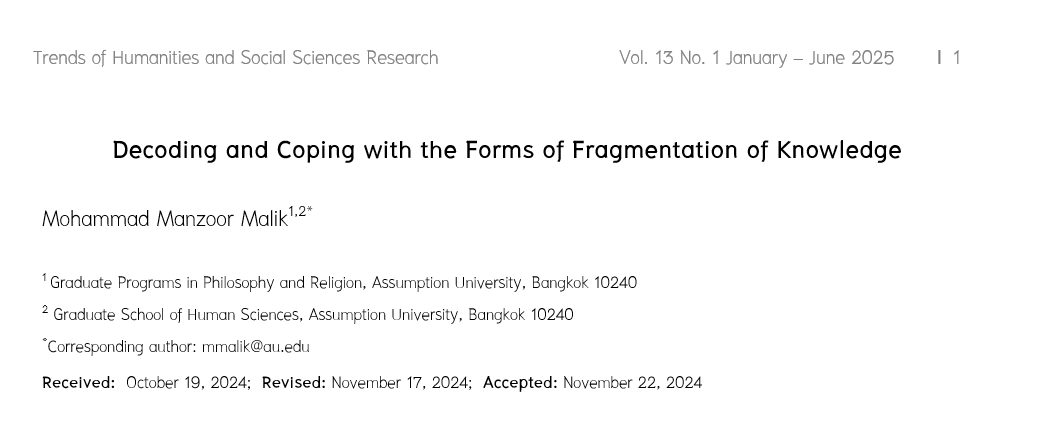
Decoding and Coping with the Forms of Fragmentation of Knowledge
Keywords:
Holistic knowledge, Fragmentation, Eurocentrism, Epistemology, ReligionAbstract
This paper identified reductionism, hasty conceptual generalization, Eurocentrism, and epistemological bias as forms of the fragmentation of knowledge. The fragmentation of knowledge goes against the philosophically Greek-based Western pattern of knowledge which was mainly in the hands of polymaths. The polymathic spirit remained until the emergence of Modernity. The emergent fragmentation of knowledge received criticism from thinkers such as Friedrich Nietzsche, Michel Foucault, Ivan Illich, Howard Gardner, Jürgen Wolfgang Habermas, and Chris B. Heilig. The division of knowledge into specializations has two-fold effects: positive such as deep specialization and negative as the loss of holistic understanding and fragmentation. There are four forms of fragmentation: (1) reductionism, (2) hasty conceptual generalization, (3) Eurocentrism, and (4) epistemological bias. Reductionism is epistemological and theoretical. Epistemological reductionism suggests that all knowledge can be reduced to a single form of explanation, whereas theoretical reductionism suggests that one theory can be reduced to or explained by another, more fundamental theory. Hasty conceptual generalization happens when a concept is extended beyond its appropriate scope, leading to the loss of the essence of the phenomenon to which the concept is applied. Eurocentrism is mainly to understand and interpret the world from a European perspective. Epistemological bias is the criticism of many epistemological errors that can be corrected by adopting mixed methods, proper hermeneutics, reflexivity, observer participation, and erosion of gender bias.
References
Allen, D. (2010). Phenomenology of religion. In J. R. Hinnells (Ed.), The Routledge companion to the study of religion (2nd ed.). Routledge.
Berger, P. L., & Luckmann, T. (2011). The social construction of reality: A treatise in the sociology of knowledge. Open Road Media.
Diogenes Laertius. (1853). The lives and opinions of eminent philosophers (C. D. Yonge, Trans.). H. G. Bohn.
Durkheim, E. (1915). The elementary forms of religious life (J. W. Swain, Trans.). Free Press.
Eurocentrism. (2024, September 11). New dictionary of the history of ideas. Encyclopedia.com. form https://www.encyclopedia.com/history/dictionaries-thesauruses-pictures-and-press-releases/eurocentrism.
Feyerabend, P. K. (2010). Against method (4th ed.). Verso.
Foucault, M. (1972). The archaeology of knowledge (A. M. Sheridan Smith, Trans.). Pantheon Books.
Frazer, J. (1890). The golden bough: A study in magic and religion. Macmillan.
Freud, S. (2008). The future of an illusion. Penguin Books Limited.
Geertz, C. (1973). The interpretation of cultures: Selected essays. New York: Basic Books.
Johnson, P. (2000). The Renaissance: A short history. Modern Library Chronicles.
Juergensmeyer, M. (1993). Why religious nationalists are not fundamentalists. Religion, 23(1), 85–92.
Kirby, W. C. (2022). The modern original: The University of Berlin. In Empires of ideas: Creating the modern university from Germany to America to China (pp. 26–62). Harvard University Press. Form https://doi.org/10.2307/j.ctv2kzv0dc.6.
Kuhn, T. S. (2012). The structure of scientific revolutions (4th ed.). University of Chicago Press.
Merriam-Webster.com Dictionary. (2024). Eurocentric (s.v.). Accessed October 12, 2024. Form https://www.merriam-webster.com/dictionary/Eurocentric.
Munson, H. (1995). Not all crustaceans are crabs: Reflections on the comparative study of fundamentalism and politics. Contention, 4(1), 151-166.
Munson, H. (2012). Fundamentalism. In R. A. Segal (Ed.), The Blackwell companion to the study of religion. Wiley-Blackwell.
Ricoeur, P. (1970). Freud and philosophy: An essay on interpretation (D. Savage, Trans.). Yale University Press.
Snow, C. P. (2012). The two cultures. Canto Classics. Cambridge University Press.
Stark, R. (1997). The rise of Christianity: How the obscure, marginal Jesus movement became the dominant religious force in the Western world in a few centuries. HarperSanFrancisco.
Tylor, E. B. (1871). Primitive culture. John Murray.
Verger, J. (1992). Universities in the Middle Ages. Cambridge University Press.
Wilson, E. O. (1999). Consilience: The unity of knowledge (Reprint ed.). Vintage Books.
Downloads
Published
How to Cite
Issue
Section
License
Copyright (c) 2025 Phayao University

This work is licensed under a Creative Commons Attribution-NonCommercial-NoDerivatives 4.0 International License.
Authors are responsible for the content of their manuscripts. The University of Phayao does not necessarily endorse or agree with the views expressed in published articles. Interested parties may reproduce or use the content; however, they must obtain prior written permission from the copyright holder and provide proper citation and acknowledgment.