
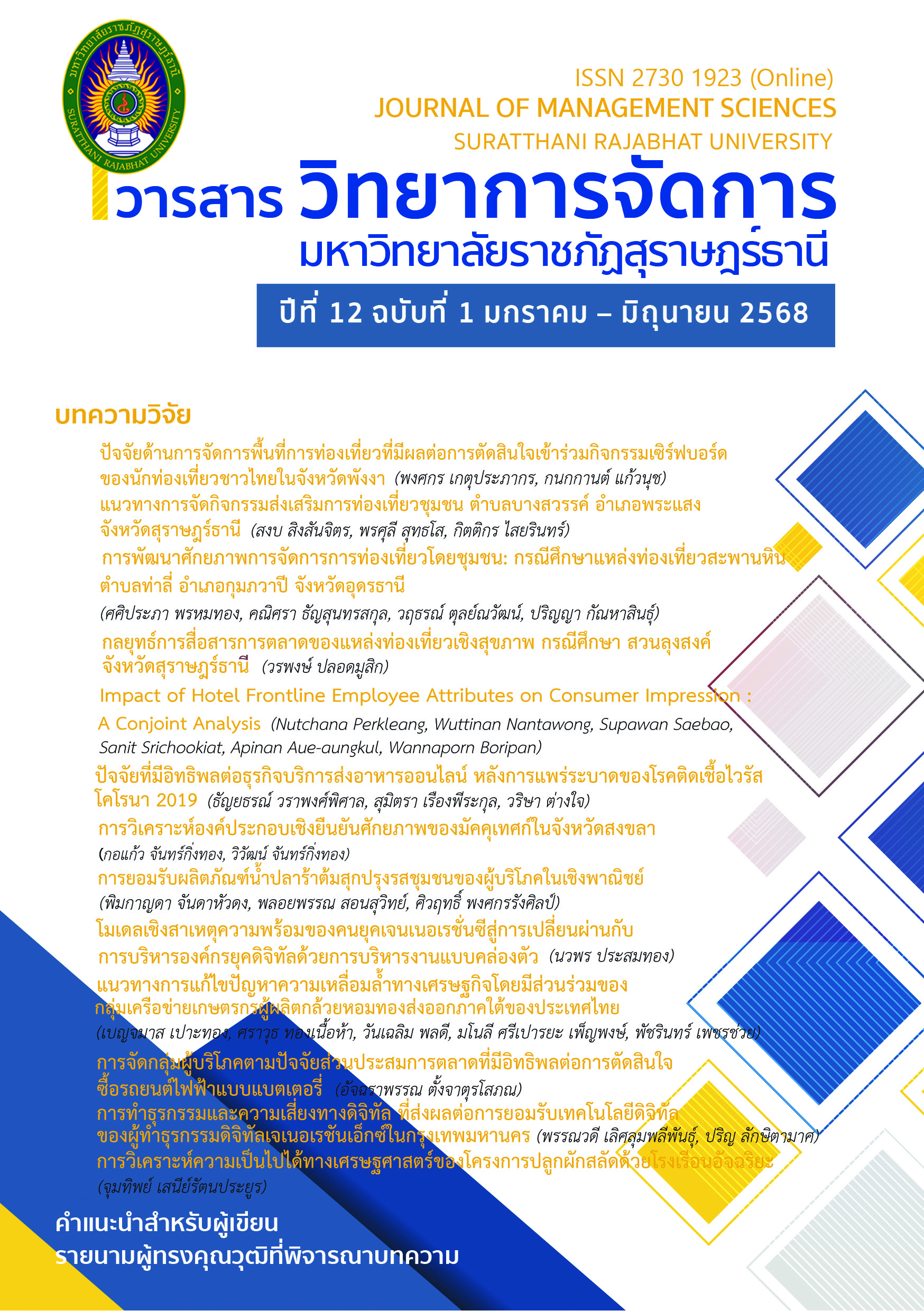
การวิเคราะห์องค์ประกอบเชิงยืนยันศักยภาพของมัคคุเทศก์ในจังหวัดสงขลา
Article Sidebar
Main Article Content
บทคัดย่อ
การวัดศักยภาพของมัคคุเทศก์มีการใช้แบบวัดที่หลากหลาย โดยแบบวัดส่วนใหญ่มีจำนวนข้อที่ค่อนข้างมาก การศึกษานี้มีวัตถุประสงค์เพื่อวิเคราะห์องค์ประกอบของศักยภาพมัคคุเทศก์ในจังหวัดสงขลา เก็บข้อมูลกับมัคคุเทศก์ทั้งที่จดทะเบียนกับกรมการท่องเที่ยวและมัคคุเทศก์ที่ไม่ได้จดทะเบียน ได้แก่ มัคคุเทศก์ทั่วไป มัคคุเทศก์เฉพาะ และมัคคุเทศก์ชุมชน จำนวน 385 คน เก็บข้อมูลด้วยแบบสอบถาม จำนวน 18 ข้อ มีค่าความเชื่อมั่นอยู่ระหว่าง 0.90-0.96 และทำการตรวจสอบความสอดคล้องกลมกลืนของโมเดลศักยภาพของมัคคุเทศก์ในจังหวัดสงขลากับข้อมูลเชิงประจักษ์ ด้วยการวิเคราะห์องค์ประกอบเชิงยืนยันอันดับสอง ผลการวิจัย พบว่า ศักยภาพของมัคคุเทศก์ในจังหวัดสงขลา มี 3 องค์ประกอบหลัก คือ 1) ความรู้ 2) ทักษะการปฏิบัติงาน และ 3) จริยธรรมในวิชาชีพ โดยทุกองค์ประกอบหลักมี 6 องค์ประกอบย่อย อีกทั้งยังพบว่า องค์ประกอบหลักทั้ง 3 องค์ประกอบมีความสอดคล้องกลมกลืนกับข้อมูลเชิงประจักษ์ โดยมีค่าดัชนีความกลมกลืน คือ (df=132) 338.69 sig=0.00, /df=2.57, CFI=0.97, NNFI=0.96, RMSEA=0.06, SRMR=0.05 ในส่วนขององค์ประกอบหลักทั้ง 3 ตัว และองค์ประกอบย่อยทั้ง 18 ตัว มีค่าสัมประสิทธิ์องค์ประกอบคะแนนมาตรฐานอยู่ระหว่าง .84–1.00 และ .36-.71 ตามลำดับ โดยทุกองค์ประกอบมีนัยสำคัญทางสถิติที่ระดับ .05 แต่เนื่องจากการวิเคราะห์องค์ประกอบเชิงยืนยันในบทความนี้เป็นการวิเคราะห์โดยดัดแปลงมาจากแบบวัดศักยภาพของมัคคุเทศก์เฉพาะในประเทศไทย ซึ่งยังไม่เคยมีการวิเคราะห์ในลักษณะนี้ ดังนั้นการนำแบบวัดศักยภาพไปใช้จึงเหมาะสมกับบริบทของประเทศไทย และแม้ว่าแบบวัดในครั้งนี้มีจำนวนข้อที่ไม่มาก แต่ผลการวิจัยก็สามารถยืนยันได้ว่าแบบวัดดังกล่าวมีคุณภาพ ซึ่งหน่วยงานภาครัฐที่เกี่ยวข้องและผู้ที่สนใจสามารถนำไปใช้วัดศักยภาพของมัคคุเทศก์ได้
Article Details

อนุญาตภายใต้เงื่อนไข Creative Commons Attribution-NonCommercial-NoDerivatives 4.0 International License.
เอกสารอ้างอิง
Ananthakhan, S. (2020). Guidelines for the development of tourist guides potential in Satun province [Master’s thesis, National Institute of Development Administration]. National Institute of Development Administration Library. https://repository.nida. ac.th/handle/662723737/5586.
Ananthakhan, S., & Monpanthong, P. (2021). Guidelines for potential development of a tourist guide in Satun province. Dusit Thani College Journal, 15(1), 384-400.
Bollen, K. A. (1989). Structural equations with latent variables. Wiley.
Chalaechorn, N., & Wongphan, C. (2019). The desirable characteristics of Thai tourist guide to enter the ASEAN Community in perspective of tourism business operators in Bangkok. Journal of Rattana Bundit University, 14(1), 1-14.
Cochran, W. G. (1977). Sampling techniques (3rd ed.). Wiley.
Department of Tourism. (2016). Tourist guide standard. Department of Tourism, Ministry of Tourism and Sport.
Diamantopoulos, A., & Siguaw, J. A. (2000). Introducing Lisrel: A guide for the uninitiated. Sage.
Division of Tourism Business and Guide Registration. (2020). Number of guides in Songkhla province. Division of Tourism Business and Guide Registration, Department of Tourism.
Hair, J. F., Black, W. C., Babin, B. J., & Anderson, R. E. (2014). Multivariate data analysis (7th ed.) Pearson Education.
Jankingthong, W., Jankingthong, K., Oonadirakekul, W., & Sakunchannarong, N. (2018). The guidance for potential development of business entrepreneurs in Songkhla province and linkage areas for cultural tourism. National Research Council of Thailand.
Ministry of Tourism & Sports. (2019, September 9). Direction of the development of Thailand's community-based tourism network towards sustainability. https://www.mots.go.th/News-view.php?nid=11994.
Mongkolsirikiate, S., Jittithavorn, C., Phonkaew, S., & Kamolrat, P. (2022). The practical ethics behaviors and the desirable characteristics of Thai tourist guides. Journal of Legal Entity Management and Local Innovation, 8(9), 37-52.
Phamornsiritrakul, P. (2018). Competency development guidelines of tour guides for creative tourism service in Thailand [Master’s thesis, National Institute of Development Administration]. National Institute of Development Administration Library. https://repository.nida.ac.th/handle
/662723737/4988.
Phumee, P., Tibjoi, W., & Suwannawong, N. (2016). Empowering local guides in Nong Han Kumphawapi wetland, Udon Thani province. Journal of Community Development and Life Quality, 4(2), 249-260.
Pongyat, C. (2019). The correlation between the tourist guide’s performance and the Vietnamese tourist’s preference in Ubonratchathani province, Thailand [Master’s thesis, Mahasarakham University]. Mahasarakham University Library. http://202.28.34.124/dspace/handle123456789/91.
Saechan, W. (2017). The skills of Thai tour guides who take care Chinese tourists’in case study Phra Nakhon Si Ayutthaya Province. In The 4th NEU national and international conference 2017, Khon Kaen, Thailand.
Schumacker, R. E., & Lomax, R. G. (2010). A beginner’s guide to structural equation modeling (3rd ed.). Taylor & Francis.
Songkhla Provincial Office. (2021, October 22). Songkhla provincial development plan (2018-2022) review edition 2022. https://www.songkhla.go.th/news_develop_plan.
Songkhla Provincial Public Relations Office. (2019, September 9). Songkhla tourist attraction information. https://www.songkhla.go.th/frontpage.
Srijongsang, S., Somnuek, P., & Ruengkamnerd, A. (2015). Developing the potential of local tour guides in the South Isaan area of Thailand to increase competitiveness in the ASEAN Economic Community (AEC). The Thailand Research Fund.
Sujarinpong, P. (2016). Guide (4th ed.). Kasetsart University Press.
Suwannapimol, K. (2013). Principles of tour guide (3rd ed.). Saengdao.
Wannathanom, C. (2019). Principle of tourist guide and tour leader (3rd ed.). Saeangdao.
Weaver, D. B., & Lawton, L. J. (2014). Tourism management (5th ed.). John Wiley & Sons.
Wongsawat, S. (2014). Guidelines of the tourist guide potential development toward Thai tourist guide standard and ASEAN Common Competency Standards for Tourism Professionals: ACCSTP (A case study of Koh Samui, Surat Thani) [Master’s thesis, Prince of Songkla University]. Prince of Songkla University Library. https://kb.psu.ac.th/psukb/bitstream/2010/10042/1/391282.pdf.
