
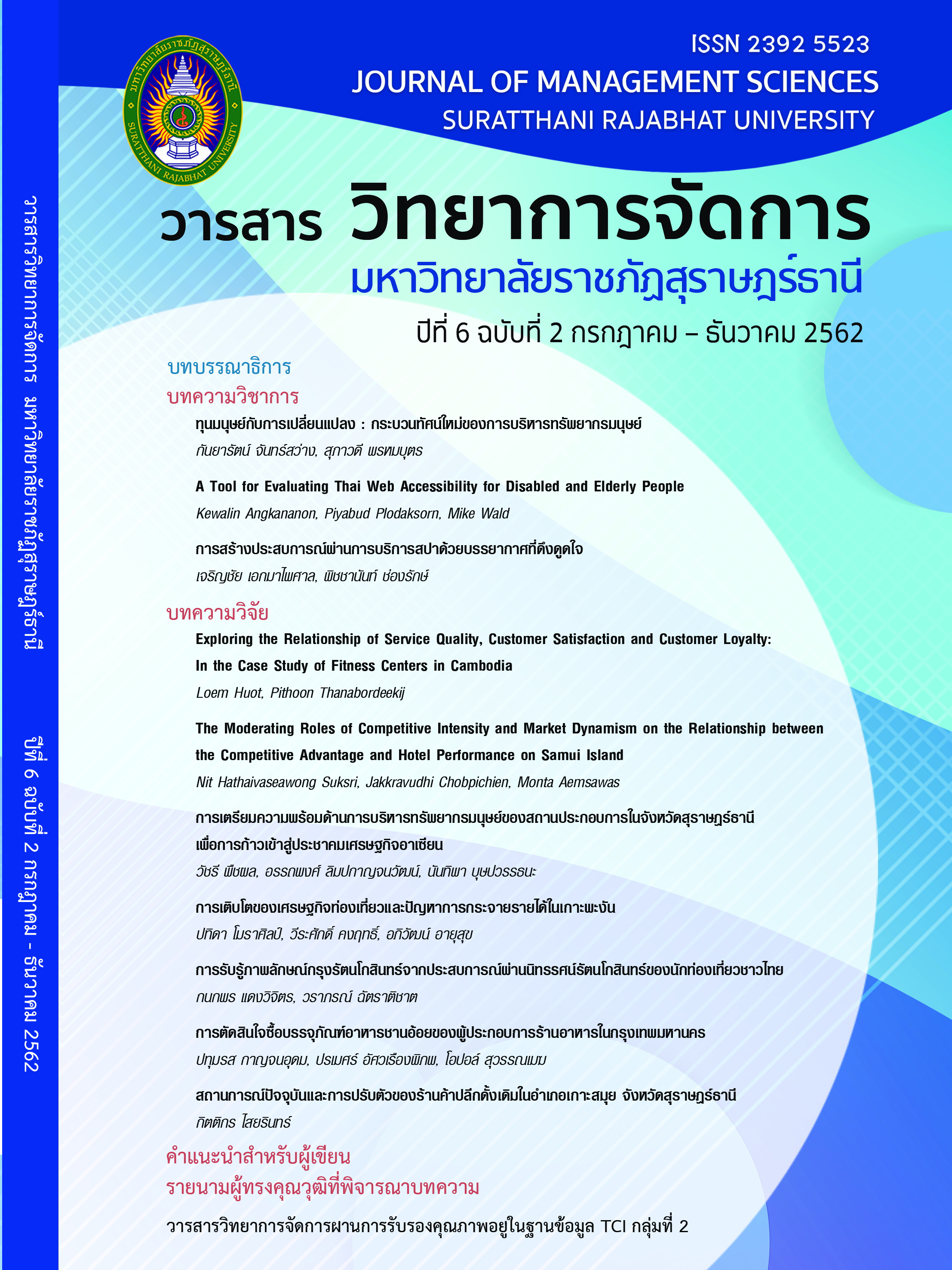
ความรุนแรงในการแข่งขันและการเปลี่ยนแปลง/การเคลื่อนไหวทางการตลาดที่มีผลกดดันต่อความสัมพันธ์ระหว่างการได้เปรียบในการแข่งขันกับผลการดำเนินงานของโรงแรมบนเกาะสมุย
Article Sidebar
Main Article Content
บทคัดย่อ
การศึกษานี้ได้ตรวจสอบบทบาทของความรุนแรงในการแข่งขันและการเปลี่ยนแปลง/การเคลื่อนไหวทางการตลาดที่มีผลกดดันต่อความสัมพันธ์ระหว่างการได้เปรียบในการแข่งขันกับผลการดำเนินงานของโรงแรม ภายใต้กรอบทฤษฎีของความสัมพันธ์ระหว่างสิ่งแวดล้อม กลยุทธ์ และผลการดำเนินงาน ประชากรที่ศึกษาระหว่างเดือนกันยายน 2556 ถึงธันวาคม 2556 ประกอบด้วย โรงแรมบนเกาะสมุย จำนวน 246 โรงแรมและผู้จัดการโรงแรม จำนวน 154 คน ผลการวิจัยได้ชี้ให้เห็นว่า ในด้านหนึ่งนั้นพบว่าความรุนแรงในการแข่งขันไม่มีนัยสำคัญทางสถิติในการกดดันความสัมพันธ์ระหว่างการได้เปรียบในการแข่งขันกับผลการดำเนินงานของโรงแรม ในอีกด้านหนึ่ง พบว่า การเปลี่ยนแปลง/การเคลื่อนไหวทางการตลาด มีนัยสำคัญทางสถิติในการกดดันความสัมพันธ์ระหว่างการได้เปรียบในการแข่งขันกับผลการดำเนินงานของโรงแรม ยกเว้นผลการดำเนินงานด้านสิ่งแวดล้อม นอกจากนี้ บทบาทการกดดันของการเปลี่ยนแปลง/การเคลื่อนไหวทางการตลาด เป็นประเภทควอไซด์ มอดิเรเตอร์
Article Details
เอกสารอ้างอิง
Azzone, G., & Bertele, U. (1994). Exploiting green strategies for competitive advantage. Long Range Planning, 27(6), 69 - 81.
Banerjee, S. B., Iyer, E. S., & Kashyap, R. K. (2003). Corporate environmentalism: Antecedents and influence of industry type. Journal of Marketing, 67(2), 106 - 122.
Barnett, W. P. (1997). The dynamics of competitive intensity. Administrative Science Quarterly, 42, 128 - 160.
Berman, S. L., Wicks, A. C., Kotha, S., & Jones, T. M. (1999). Does stakeholder orientation matter? The relationship between stakeholder management models and firm financial performance. Academy of Management Journal, 42(5), 488 - 506.
Bhat, V. N. (1996). The Green Corporation: The Next Competitive Advantage. Quorum Books, Westport, CT.
Cui, A. S., Griffith, D. A., Cavusgil, S. T., & Dabic, M. (2006). The influence of market and cultural environmental factors on technology transfer between foreign MNCs and local subsidiaries: A Croatian illustration. Journal of World Business, 41, 100 - 111.
Hair, J. F., Jr., Black, W. C., Babin, B. J., Anderson, R. E., & Tatham, R. L. (2006). Multivariate data analysis (6th ed.). Englewood Cliffs, NJ: Pearson/Prentice Hall.
Hofer, C. W. (1975). Toward a contingency theory of business strategy. Academy of Management Journal, 18(4), 784 - 810.
Jaworski, B. J., & Kohli, A. K. (1993). Market orientation: Antecedents and consequences. Journal of Marketing, 57(3), 53 - 70.
Judge, W. Q., & Douglas, T. J. (1998). Performance implications of incorporating natural environmental issues into the strategic planning process: An empirical assessment. Journal of Management Studies, 35(2), 241 - 262.
Leonidou, L. C., Leonidou, C. N., Fotiadis, T. A., & Zeriti, A. (2013). Resources and Capabilities as drivers of hotel environmental marketing strategy: Implications For competitive advantage and performance. Tourism Management, 35, 94 - 110.
Luo, Y., & Park, S. H. (2001). Strategic alignment and performance of market-seeking MNCs in China. Strategic Management Journal, 22, 141 - 155.
Lyon, T.P. (2003). ‘Green’ firms bearing gifts. Regulation, 26(3), 36 - 40.
Man, L. W. (2010). Corporate environmentalism and environmental strategies: The relationship between resources, capabilities, strategies and performance in Chaina’s Pearl River Delta. ProQuest Dissertations and Theses.
Mangena, M., & Pike, R. (2005). The effect of audit committee shareholding, financial expertise and size on interim financial disclosures. Accounting and Business Research, 35(4), 327 - 349.
McCloskey, J., & Maddock, S. (1994). Environmental management: Its role in corporate Strategy. Management Decision, 32(1), 27 - 32.
Menon, A., & Menon, A. (1997). Enviropreneurial marketing strategy: The emergence of corporate environmentalism as market strategy. Journal of Marketing, 61(1), 51 - 67.
Miles, M. P., & Covin, J. G. (2000). Environmental marketing: a source of reputational, competitive, and financial advantage. Journal of Business Ethics, 23(3), 299 - 311.
Miles, R. E., & Snow, C. C. (1978). Organizational strategy, structure and process. New York: McGraw-Hill.
Miller, D., & Friesen, P. H. (1983). Strategy-making and environment: The third link. Strategic Management Journal, 4(3), 221 - 235.
Moorman, C., & Rust, R. T. (1999). The role of marketing. Journal of Marketing, 63 (Special issue), 180 - 197.
Muller, D., Judd, C.M., & Yzerbyt, V.Y. (2005). When moderation is mediated and mediation is moderated. Journal of Personality and Social Psychology, 89(6), 852 - 863.
Murphy, P. R., Poist, R. F., & Braunscchweig, C. D. (1995). Role and relevance of Logistics to corporate environmentalism: An empirical assessment. International Journal of Physical Distribution & Logistics, 25(2), 5 - 19.
Nunnally, J. C. (1978). Psychometric theory. (2nd ed.). New York: McGraw-Hill, Inc.
Orsato, R.J. (2006). Competitive environmental strategies: When does it pay to be green? California Management Review, 48(2), 127 - 43.
Polonsky, M.J., Carlson, L., Grove, S., & Kangun, N. (1997). International environmental marketing claims. International Marketing Review, 14(4), 218 - 32.
Porter, M. E., & van der Linde, C. (1995). Green and competitive: Ending the stalemate. Harvard Business Review, 73(5), 120 - 134.
Russo, M. V., & Fouts, P. A. (1997). A resource-based perspective on corporate environmental performance and profitability. Academy of Management Journal, 40(3), 534 - 559.
Sarin, S., & Mahajan, V. (2001). The effect of reward structures on the performance of crossfunctional product development teams. Journal of Marketing, 65(2), 35 - 53.
Vorhies, D. W., & Morgan, N. A. (2005). Benchmarking marketing capabilities for sustainable competitive advantage. Journal of Marketing, 69(1), 80 - 94.
Zhou, K. Z., Brown, J. R., & Dev, C. S. (2009). Market orientation, competitive advantage, and performance. Journal of Business Research, 62(11), 1063 - 1070.
Zorn, T.E., & Collins, E. (2006). Green is the new black: Are CSR and sustainable business just fads?. Conference paper presented at the Australia-New Zealand Academy of Management Conference, Rockhampton.
