
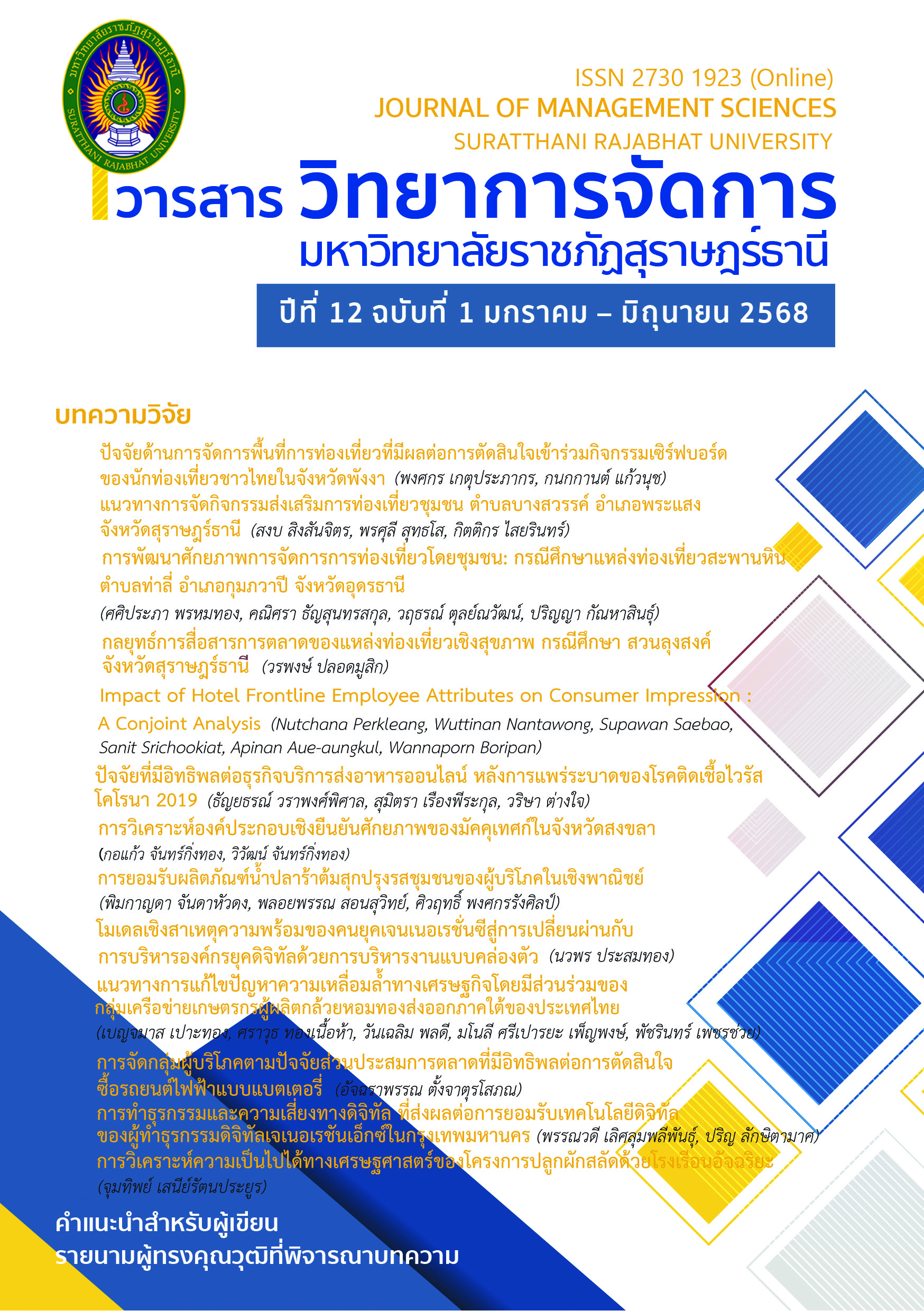
Cluster Analysis Consumer by Marketing Factors Buying Decision of Battery Electric Vehicles
Article Sidebar
Main Article Content
Abstract
Nowadays, battery electric vehicles are gaining more and more attention from the public, as evidenced by sales and the number of electric cars running on the roads. This research aims to study personal data, purchase decision behavior, marketing mix factors, and consumer classification of those interested in battery electric vehicles. A purposive sampling method was used with questionnaires distributed to a sample of 400 people. Descriptive statistical analysis including percentage, frequency, mean, and standard deviation, and cluster analysis were considered in this research using hierarchical cluster techniques.
The results found that the majority of the sample were single women aged under 35 years. They held a bachelor's degree, had an average income between 15,001–25,000 baht, and worked as government officers or state enterprise employees. They drove battery electric vehicles approximately 21–50 kilometers per day and decided to purchase a sedan car with a budget of 400,000–800,000 baht. They made decisions by themselves with consideration of price and value for money. They used online media, the Internet, and social media channels to obtain information about battery electric vehicles to support their decisions. Marketing mix factors affected the decision to purchase battery electric vehicles. Consumer classification can be divided into four types: Group 1: Consumer group that emphasizes value for money; Group 2: Consumer group that focuses on marketing activities; Group 3: Consumer group that focuses on product quality; and Group 4: Consumer group that focuses on value for money and marketing activities. The research results can be used as guidelines for determining marketing activities that are appropriate for consumer groups, and can also be used in production planning to develop products to meet the needs of diverse consumers.
Article Details

This work is licensed under a Creative Commons Attribution-NonCommercial-NoDerivatives 4.0 International License.
References
Ambak, K., Harun, N. E., Rosli, N., Daniel, B. D., Prasetijo, J., Abdullah, M. E. and Rohani M. M. (2016). Driver intention to use electric cars using technology acceptance model. Smart Drivig Research Centre, University Tun Hussein Onn Malaysia.
Boowankullapa, B. (2015). The attitude and intention of consumers in buying economic cars in Bangkok Area. Siam Academic Review, 15(2), 68-79.
Cochran, W. G. (1991). Sampling techniques (3rd ed.). John Wiley and Sons.
DD property. (2020). Get to know Korat in depth. http:// https://www.ddproperty.com/areainsider.
Electric Vehicles Association of Thailand. (2016). EV Technology. http://www.evat.or.th/15708266/ev technology.
Emsenhuber, E. M. (2012). Determinants of the acceptance of electric vehicles. Department of business administration, Aarhus University.
Hawkins, D. I., & Mothersbaugh, D. I. (2013). Consumer Behavior: Building Marketing Strategy (12th ed.). McGraw-Hill.
Jabeen, F., Olaru, D., Smith, B., Braunl, T., and Speidel, S. (2012). Acceptability of electric vehicles: Findings from a driver survey. School of Electrical and Computer Engineering, University of Western Australia.
Junquera, B., Moreno, B. & Alvarez, R. (2016). Analyzing consumer attitudes towards electric vehicle purchasing intentions in Spain: Technological limitations and vehicle confidence. Technological Forecasting & Social Change, 109, 6-14.
Juska, J. M. (2018). Integrated marketing communication: Advertising and promotion in a digital world. Routledge.
Kotler, P. (2003). Marketing Management (11th ed.). Prentice Hall.
Kotler, P., & Keller, K. L. (2009). Marketing Management (13th ed). Pearson Prentice Hall.
Kotler, P., & Keller, K. L. (2012). Marketing Management: The millennium (14th ed.). Prentice-Hall Inc.
Kotler, P., & Keller, K. L. (2016). Marketing Management: The millennium (15th ed.). Pearson.
Kumnerdpetch, K. (2020). Factors affecting consumers, decision to buy battery electric vehicles in Bangkok and Metropolitan Area. Journal of Community Development Research (Humanities and Social Sciences), 13(3), 82-95.
Lamb, C. W., Hair J. F., & McDaniel, C. (2012). Essentials of marketing (7th ed.). South-Western Cengage Learning.
Larson, P. D., Viafara, J., Parsons, R. V. & Elias, A. (2014). Consumer attitude about electric cars: Pricing analysis and policy implication. Transportation Research Part A, 69, 229-314.
Leelaphatthanawong, P., & Pinvanichkul, T. (2019) Factors influencing the acceptance of innovation and technology: A case study of electric vehicles (not more than 7 Passengers). KMUTT Research & Development Journal, 42(2), 129-144.
Ling, Z., Cherry, C. R. & Wen, Y. (2021). Deterring the factors that influence electric vehicle adoption: A stated preference survey study in Beijing, China. Sustainability, 13(21), 1-22.
Manktelow, J. (2021). The marketing mix and the 4Ps of marketing. http://www.mindtools.com/pages/article/newSTR_94.htm.
Matthews, L., Lynes, J., Riemer, M., Matto, T. D. & Cloet, N. (2017). Do we have a car for you encouraging the uptake of electric vehicles at point of sale. Energy Policy, 100, 79-88.
MReport. (2023, March 9). Global EV Sale 2022. https://www.mreport.co.th/news/statistic-and-ranking/208 Global-EV-Sales-2022.
National News Bureau of Thailand: NNT. (2023). 100% electric cars are hot. The government moves forward to support their use - produced in Thailand, hoping to reduce oil use - reduce environmental problems. National News Bureau of Thailand (NBT World).
Nunnally, J. C. (1978). Psychometric theory (2nd ed.). McGraw-Hill.
Pankla, S., & Keawpromman, C. (2020). Factors affecting to consumers, purchasing plug-in hybrid electric vehicle of consumer in Bangkok Metropolitan. Journal of the Association of Researchers, 25(2), 99-112.
Panson, T., & Chukjarukul, K. (2019). Behavioral acceptance of electric vehicles in Bangkok. Journal of Transportation and Logistics, 12(1), 68-90.
Rovinelli, R. J., & Hambleton, R. K. (1997). On the use of content specialists in the assessment of criterion referenced test item validity. Tijdschrift voor Onderwijs Research, 2(2), 49-60.
Sareerat, S. (2007). Consumer Behavior. Theerafilm and Sitext.
Schiffman, L. G, & Kanuk, L. L. (1994). Consumer Behavior (5th ed.). Prentice-Hall.
Schiffman, L. G. & Kanuk, L. L. (2007). Consumer Behavior (9th ed.). Prentice Hall.
Sirimaskasem, S. (2013). Factors affecting purchase intention of automobiles of consumers in Bangkok [Unpublished master’s thesis]. Bangkok University.
Solomon, R. M. (2013). Consumer behavior: Buying, having, and being (10th ed.). Pearson Education.
Srikhwancharoen, N., Sirikijpanichkul, A., & Boonsiripant, S. (2019). Influencing factor on electric vehicle (EV) purchasing decision. In proceeding of 57th Kasetsart University Annual Conference: Education, Economics and Business Administratin, Humanities and Social Sciences (pp. 441-447). The Thailand Research Fund, Bangkok.
Suttirak, T. (2022). Marketing factors affecting decision making process of electric vehicles. Journal of MCU NakhonDhat, 10(1), 98-112.
Suwanachote, T., & Nonthanathorn, P. (2020). The attributes of electric vehicles that affect the purchasing decision of consumers in Bangkok Metropolitan. Journal of the Association of Researchers. 25(2). 296-307.
Technocell Faly Limited. (2023). Things to know before buying an electric car. https://www.laminafilms.com/th/article/EV-car-battery.
Thandettakij. (2023, January 5). Thailand and being an important center for producing EV cars in the world. https://www.thansettakij.com/business/552265.
Tokham, P., Tarichkul, W., & Anywatnapong, M. (2022). The Influence of factors on purchasing decision process for battery electric vehicles of consumers in Bangkok Metropolis. Journal of Business Administration and Social Sciences Ramkhamhaeng University, 5(1), 53-72.
Vanichbuncha, K. (2012). Statistical for research (6th ed.). Tammasan.
Vongkittiwat, P. (2017). The factors affecting electric vehicle, purchase decision of working age consumers in Bangkok [Unpublished master’s thesis]. Bangkok: Bangkok University.
Wang, Z., Zhao, C., Yin, J., & Zhang, B. (2017). Purchasing intentions of Chinese citizens on new energy vehicles: How should one respond to current preferential policy. Journal of Cleaner Production, 161, 1000-1010.
Xu, G., Wang, S., Li, J. & Zhao, D. (2020). Moving towards sustainable purchase behavior: Examining the determinates of consumer intentions to adopt electric vehicles. Environmental Science and Pollution Research, 27, 22535-22546.
