
Digital Transaction and Risks Affecting Digital Technology Acceptance of Generation X Digital Transactors in Bangkok
Article Sidebar
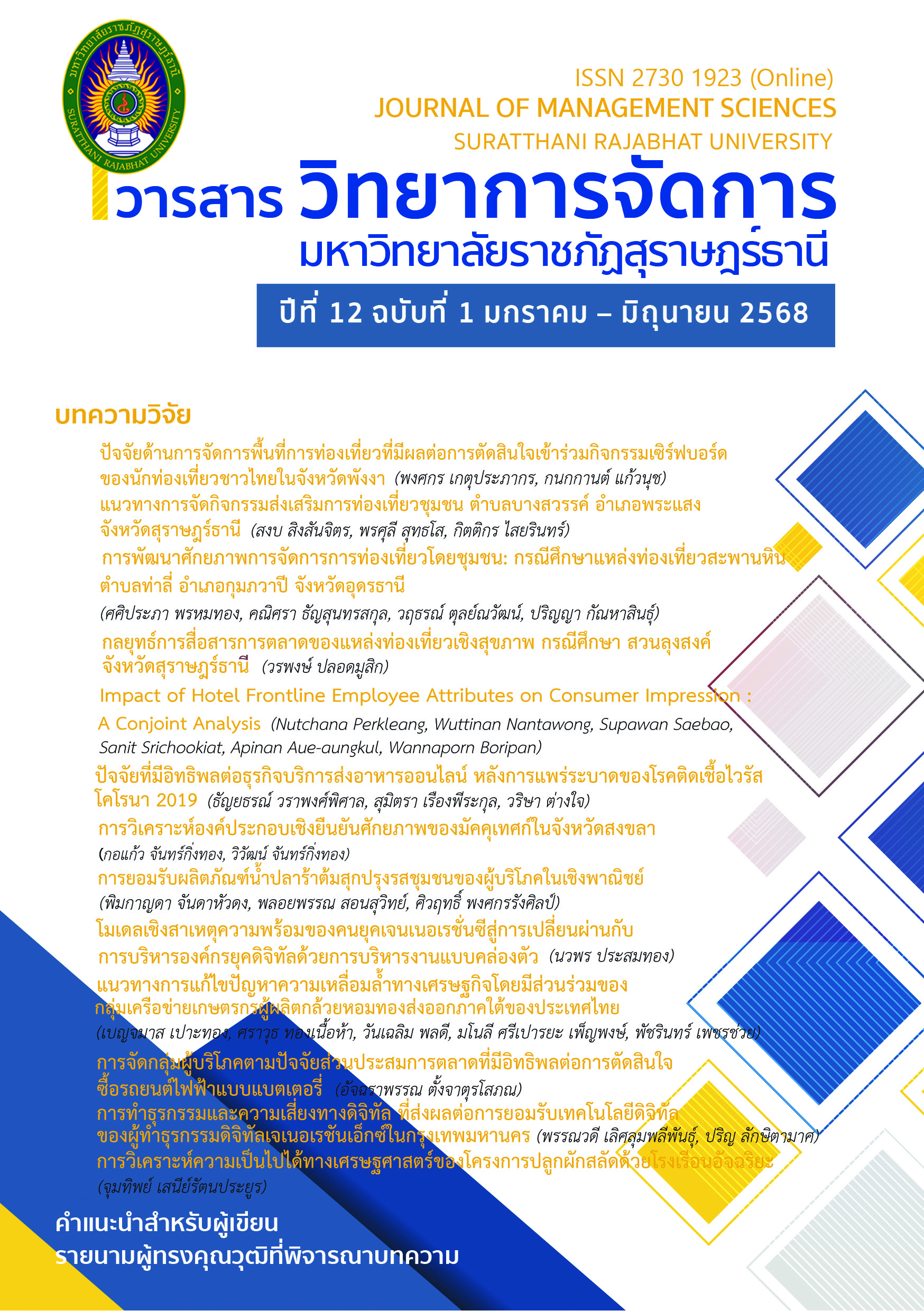
Main Article Content
Abstract
Digital technology has become an important fundamental factor for the economic system. It has been applied as a channel for trading goods and services to achieve efficiency in important digital transactions. Therefore, the objectives of this study were to study 1) the level of opinions on digital transactions and risks, and the acceptance of digital technology transactors, and 2) the influence of digital transactions and risks on the acceptance of digital technology transactors. The sample group used in this research was 400 Generation X digital transactors in Bangkok. This research is quantitative research collecting data through an online questionnaire, sampling from 6 districts of Bangkok. Data were analyzed using descriptive statistics and Structural Equation Model Analysis (SEM). The results of the research found that the sample group of Generation X digital transactors in Bangkok had the highest opinion on online market channel transactions ( =4.35), had the highest opinion on digital risks ( =3.68), and had the highest opinion on digital technology acceptance ( =4.03), In addition, digital transactions and risks were related to the acceptance of digital technology among Generation X digital transactors in Bangkok. The results of this study provided data on digital marketing strengths that led to technological competition to attract Generation X consumers to conduct more digital transactions. This research is different from previous studies by focusing on Generation X, which has high economic potential and has transaction behavior and technology acceptance that are different from the younger generation. It also analyzes digital risks along with transactions in a holistic manner to obtain a more comprehensive causal analysis, which is useful for developing digital marketing strategies that match the characteristics of this consumer group in Bangkok.
Article Details

This work is licensed under a Creative Commons Attribution-NonCommercial-NoDerivatives 4.0 International License.
References
Amirtha, R., Sivakumar, J., & Hwang, Y., (2020). Influence of perceived risk dimensions on e-shopping behavioural intention among women a family life cycle stage perspective. JTAER, 16, 320–355. https://doi.org/10.3390/jtaer16030022.
Amit, S. (2015). A Study on the impact of online shopping upon retail trade business. Journal of Business and Management, 2, 74-78.
Athit, W. (2017). The influence of marketing mix factors and online marketing communication tools on consumers' perception in making purchasing decisions through online stores [Unpublished master's thesis]. Silpakorn University.
Carlos, R. J., José, G. J., & José, V. J. (2009). The importance of perceived trust security and privacy in online trading systems. Information Management & Computer Security, 17(2), 96-113.
Carlson, J., O’Cass, A., & Ahrholdt, D. (2015). Assessing customers’ perceived value of the online channel of multichannel retailers: A two country examination. Journal of Retailing and Consumer Services, 27(6), 90–102.
Davis, F. D. (1989a). A Technology adoption model for empirically testing new end users information systems: Theory and result [Unpublished doctoral dissertation]. Massachusetts Institute of Technology.
Davis, F. D. (1989b). Perceived usefulness, perceived ease of use, and user acceptance of information technology. MIS Quarterly, 13(3), 319–340. https://doi.org/10.2307/249008.
Demirdogen, O., Yaprakli, S., Yilmaz, M.K., & Husain, J. (2010). Customer risk perceptions of internet banking - A study in Turkey. The Journal of Applied Business Research, 26, 57-65.
Hair, J. F., Babin, B. J., Anderson, R. E., & Black, W. C. (2010). Multivariate data analysis (8th ed.). Pearson Prentice.
Jinukul, K. (2019). Perceived Risk and Trust Affecting the Intention to Make Financial Transactions via Mobile Banking of Customers of Krungthai Bank Public Company Limited in Songkhla Province. [Unpublished master's thesis]. Prince of Songkla University.
Khiawratana, C. (2020). Factors of technology acceptance that influence the decision to use QR Code services via smartphones: A case study of Bangkok Bank customers in Hat Yai District, Songkhla Province [Unpublished master's thesis]. Prince of Songkhla University.
Kline, R. B. (2016). Principles and practice of structural equation modeling. The Guilford Press.
Klungjaturavet, C. (2020). E-marketplaces increase market efficiencies by attracting a large user-base and improveing data access. Research Intelligence, Krungsri Research.
Krueakaew, W. (2019). Acceptance of Electronic Financial Transaction Technology of Import and Export Entrepreneurs in Bangkok Area [Unpublished master's thesis]. Dhurakij Pundit University.
Mahattanalai, T. (2023, March 28). Business/Industry Trends 2023-2025: Digital Services and Software Business. https://www.krungsri.com/th/research/industry/industry-outlook/services/digital-software/io/io-digital-software-2023-2025.
Namahoot, K. S. (2018). Analysis of the acceptance of digital banking services using the theory of innovation diffusion. Journal of Behavioral Science, 24(2), 43-64.
Ng, B. Y., Kankanhalli, A., & Xu, Y. (2009). Studying users’ computer security behavior: A health belief perspective. Decision Support System, 46(4), 815-825.
Pao-in, W. (2022). Development of guidelines for improving security, confidentiality and privacy of personal data for hospitals. Journal of the Thai Medical Informatics Association, 1, 1-13.
Payakkongphong, A. (2017). Technology acceptance model in marketing competition. Thonburi University Academic Journal, 11(5), 128-136.
Pornphan, T. (2016). The influence of digital marketing on the purchasing decision of consumers in the e-commerce business group in Bangkok [Unpublished master's thesis]. Bangkok University.
Pranpriya, D. (2022). A study of the adoption of technology affecting Gamefi investment decisions of social media consumers in Thailand [Unpublished master’s thesis]. Mahidol University.
Prasitratsin, S. (2008). Material type: Material Type Label (6th ed.). Samlada Press.
Prateepusanon, A. & Kalayanamit, T. (2017). Development guidelines. Royal Thai Armed Forces on cyber security. Journal of the National Defense Studies Institute, 8(3), 11-23.
Quan, N. H., Chi, N., Nhung, D., Ngan, N., & Phong, L. (2019). The influence of website brand equity, e brand experience on e-loyalty: The mediating role of e-satisfaction. Journal of Management Science Letters, 10(1), 63-76.
Rahmisyari, Aditi, B., Darojat, T. A., Kholik, K., & Saragih, M. G. (2020). Privacy and security analysis of e commerce on customer re-purchase intention with trust as an intervening variable. International Journal of Advanced Science and Technology, 29(5), 1578-1589.
Rogers, E. M. (2003). Diffusion of Innovations (5th ed.). Free Press.
Sappayakhom, S. & Pomsathit, A. (2020). Analysis of cyber security of Commercial banks according to the Cyber Security Act 2019. National Academic Conference 2020, 1196-1208.
Shukla, P. (2012). Impact of interpersonal influences, brand origin and brand image on luxury purchase intentions: Measuring tetrafunctional interactions and a cross national comparison. Journal of World Business, 46(2), 242-252.
Sombatcharoenmuang, P. (2021). The study of behavior and factors affecting dietary supplements purchasing decision on application for different generations: Gen X and Gen Y. [Unpublished master's thesis]. Mahidol University.
Sriket, T. (2014). Consumers and problems with purchasing products through online networks. The Secretarial of the House of Representatives.
Stockdale, R. (2009). Exploring the role of social community within an E-Marketplace. In Paper presented at the 20th ACIS International Conference on Information Systems, ACIS 2009 Processing, Melbourne, Australia.
Techakasemsuk, C. (2020). The acceptance of digital marketing technology and communication that affects the decision to buy online shoes of Generation X consumers in Bangkok [Unpublished master's thesis]. Bangkok University.
Thai Electronic Commerce Entrepreneurs Association. (2022, January 9). Thai E-Commerce market in 2022 has Trend of growth not less than 30%. https://kmc.exim.go.th/detail/economy-news/20211230082019#:~:text=Commercial Entrepreneurs Association, with various brands.
Thongsuk, W. (2023, November 11). Techniques to win the hearts of Gen X, How should brands plan strategies to be successful?. https://talkatalka.com/blog/strategies-for-gen-x/.
Wiratchai, N. (1999). Linear Structural Relationship (LISREL): An analytical statistic for research in the social and behavioral sciences. Chulalongkorn University Press.
Wiwattananukul, B. (2021). Get to know the B2C e-Commerce business: business model, payment format and methods for following market conditions. Bank of Thailand.
Xu, H., Wang, H., & Teo, H. H. (2005). Predicting the usage of P2P sharing software: The role of trust and perceived risk. In Paper presented at 38th Annual Hawaii International Conference on System Sciences, Hawaii, USA.
