
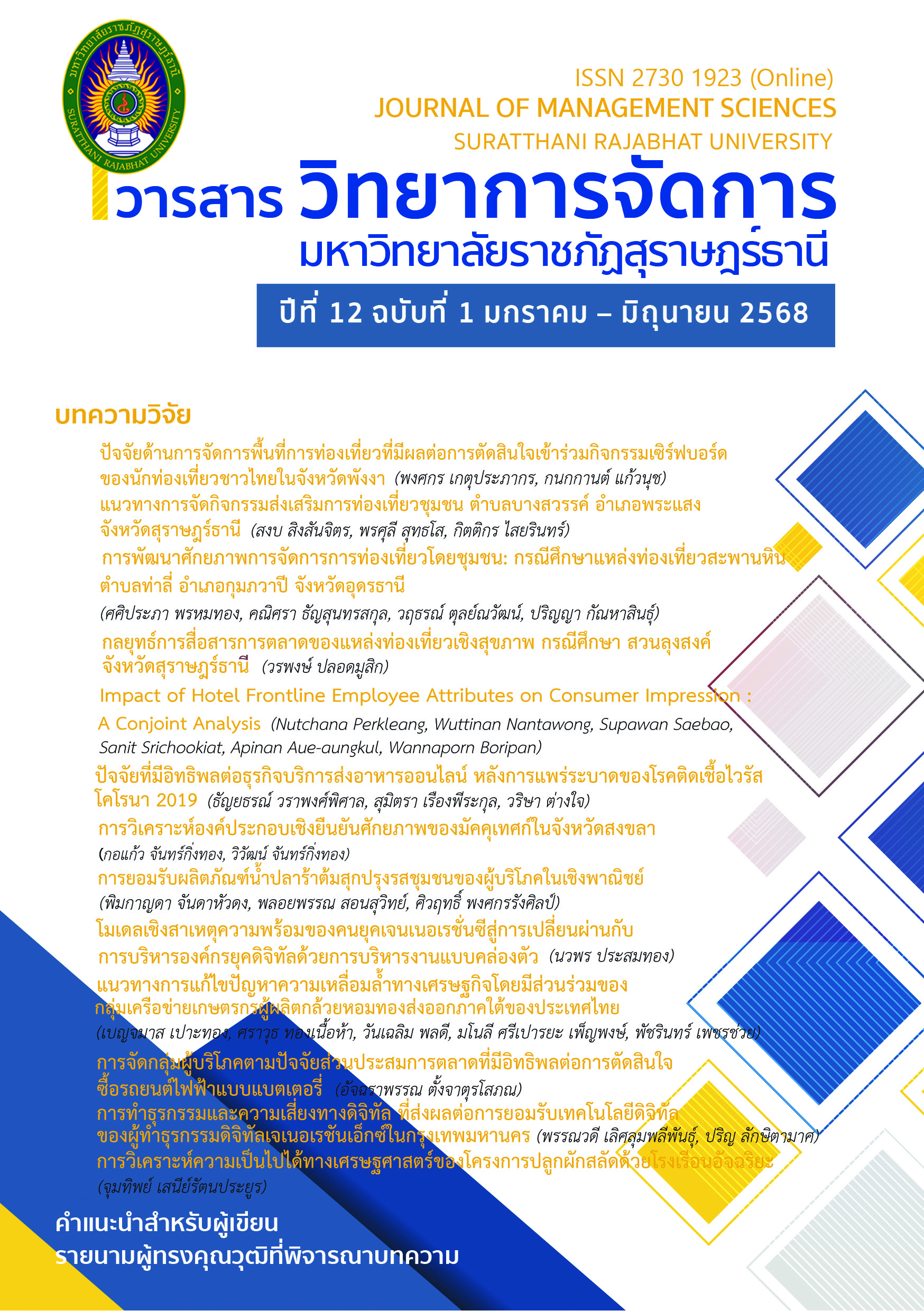
Solving Economic in Equality Problems Approach with the Participation of Farmers Group of Homtong Bananas Producers in the Southern of Thailand
Article Sidebar
Main Article Content
Abstract
Economic inequality is a structural problem of Thailand that spreads throughout the country, including the southern region where Homtong banana producer networks face inequality challenges. This study aimed to examine the economic inequality problem of the Homtong banana producer network group for export in the southern region and find solutions. A mixed-methods approach was employed, starting with quantitative research collecting data from 250 group members using descriptive statistics, followed by qualitative research using in-depth interviews, focus groups, and brainstorming sessions. Content analysis was conducted to identify solutions to economic inequality problems.
The findings revealed that the southern Homtong banana producer network experienced economic inequality. The average household values were: income 22,973.28 baht per month, expenditure 16,702.24 baht per month, and wealth 2,835,238.70 baht, all lower than national averages of 26,018.42 baht, 21,329 baht, and 3,603,897 baht, respectively. The researcher organized community forums to raise awareness about inequality problems and proposed four main approaches to address inequality: increasing income, reducing expenses, reducing debt, and increasing assets. Key solutions discovered included household accounting knowledge to track income and expenditure for financial planning, efficient income allocation and debt management, enhancing marketing skills and knowledge, agricultural product processing to add value, optimizing unused agricultural land, and collaborative efforts across all sectors as the key to solving economic inequality problems for farmers.
This research differs from previous studies as no prior research has employed a mixed-methods approach to study economic inequality in this specific area and population.
Article Details

This work is licensed under a Creative Commons Attribution-NonCommercial-NoDerivatives 4.0 International License.
References
Advani, A., Bangham G., & Leslie, J. (2021). The UK’s wealth distribution and characteristics of high wealth households. Fiscal Studies, 42, 397–430. https://doi.org/10.1111/1475-5890.12286.
Boonchuay, S. (2020). Reduction of inequality in Thai Society in a sustainable manner: building policies on strengthening local administrative organization. Journal of Community Development Research (Humanities and Social Sciences), 13(4), 155-169.
Boyce, C., & Neale, P. (2006). Conducting in-depth interviews: A guide for designing and conducting in depth interviews for evaluation input. Pathfinder International.
Chaiyanon, P., & Sanguanwongse, V. (2021). Debt analysis and related factor to debt agriculture of cooperative member in the Northern of Thailand. Journal of Lampang Rajabhat University, 10(1), 63-75.
Forbes, S., & Grosskinsky, S. (2022) A study of UK household wealth through empirical analysis and a non-linear Kesten process. PLoS ONEl, 17(8), 1-16. https://doi.org/10.1371/journal.pone. 0272864.
Hengpatana, S., Patamasiriwat, D., & Ratchatapibhunphob, P. (2019). Income and asset distribution in Thailand: An analysis of inequality classified by socioeconomic class. Journal of Applied Economics and Management Strategy, 6(1), 35-48.
Intarapak, S., & Supapakorn, T. (2020). Application of logistic regression analysis to household debt of Bangkok and Metropolitan area of Thailand. WSEAS Transactions on Business and Economics, 17, 676-681. https://doi.org/10.37394/23207.2020.17.65.
Issaradet, T., & Limrattanaphattarakun, W. (2020). Community and inequality management for sustainable development case study: Nhong Sarai Sub-District. Journal of Buddhist Anthropology, 5(11), 375-388.
Kesdee P., (2020). Factors affecting poverty and inequality of low income earners: Case study in Mueang District Phetchabun. Research and Development Journal, Loei Rajabhat University, 17(61), 26-35.
Life for community in Nongbua Lamphu Province by the King's Philosophy. Journal of Buddhist Anthropology, 6(10), 249–262.
Mueathaisong, A., & Phanpool, A. (2021). The reduction of inequality and development of quality of life for community in Nongbua Lamphu Province by the Kings Philosophy. Journal of social science and Buddhistic anthropology, 6(10), 249-262.
National Statistical Office. (2020). The 2020 Household Socio-Economics survey. Statistical Forecasting Division, National Statistical Office of Thailand.
Office of Agricultural Economics (2022). Statistics on the import and export of bananas in Thailand. https://regional.moc.go.th/th/file/get/file/20231225f002dcaa90f702dcda8d20c10e82ce9b090442.pdf.
Office of the National Economic and Social Development Council. (2017). Summary The Twelfth National Economic and Social Development Plan (2017–2021). Office of the National Economic and Social development Board Office of the Prime Minister.
Pohtong, B., Sarawut, T., Phenpong. S. M., Patcharin, P., & Pholdee, W. (2022). The study of context and ways to solve the economic inequality with the participation of farmers, a group of banana exporters in the southern region of Thailand. Thailand Science Research and Innovation (TSRI).
Prasertsri, P., Seesang, S., & Saranrom, P. (2019, November 29). An Extension of Gros Michel Banana production and marketing for export by farmers in Chaiya District of Surat Thani Province [Paper presentation]. the 9th STOU National Research Conference. Sukhothai Thammathirat Open University. National Research Conference. Nonthaburi, Thailand.
Sajjawattana, K. (2017). Area-Based Collaborative Research: A Novel Strategy to Challenge a Research Paradigm of Thailand. Area Based Development Research Journal, 9(1), 3-7.
Strzelecka, A., & Zawadzka, D. (2020). Why households borrow money? socio-economic factors affecting households debts: A model approach. European Research Studies Journal, 23(2), 820-839. https:2//doi.org/10.35808/ersj/1900.
Suriya, O. (2017). Appropriate pattern for supply chain management of the organic banana: Case study of Bannasan district, Surat Thani Province. [Unpublished Master’s thesis]. Sukhothai Thammathirat Open University.
Techaniyom, K., Kittisaknawan, C., Arakpothchong, W., & Pinit, W. (2021). The causal factors affecting income inequality: A case study of middle and low income level countries. Journal of Economics and Management Strategy, 8(2), 76-91.
The Treasury Department. (2021). Evaluation report (Fiscal years 2019–2022) Surattani Povince. Surat Thani Provincial Land Office.
Thiamthaisong, W. (2018). Satisfaction of organic golden banana farmers on the performance of Ban Lat Agricultural Cooperative Ltd., Ban Lat District, Phetchaburi Province [Unpublished Master’s thesis]. Sukhothai Thammathirat Open University.
Wonhsuwan, N., & Siriwan, I. (2017). The Participative Management. Mahachula Academic Journal, 4(1), 176-185.
