
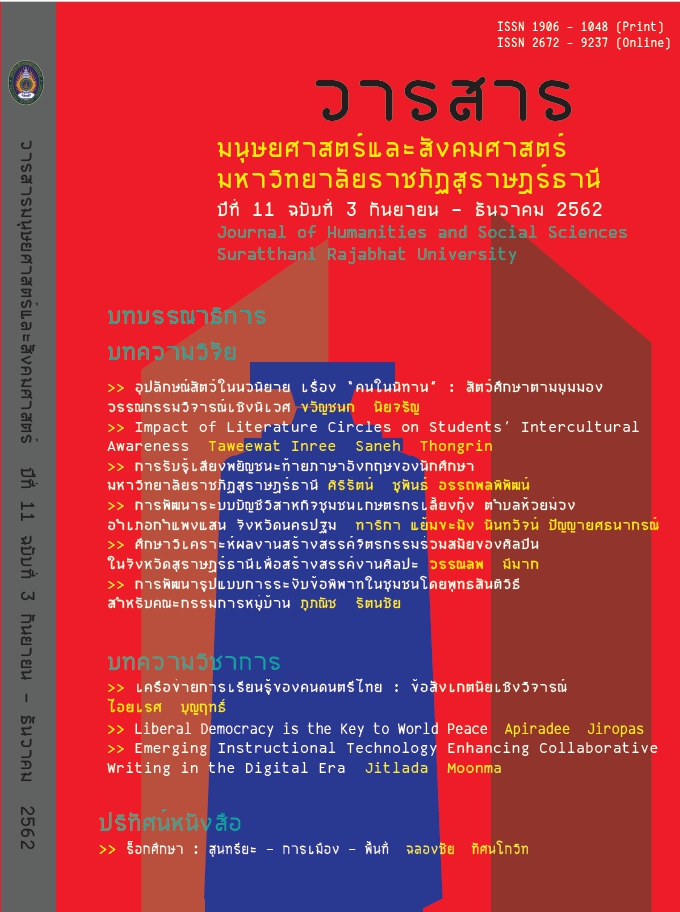
ผลของวงจรวรรณกรรมต้อความตระหนักรู้ระหว่างวัฒนธรรมของนักศึกษา
Article Sidebar
Main Article Content
บทคัดย่อ
การวิจัยนี้มีวัตถุประสงค์เพื่อศึกษาผลของการใช้วงจรวรรณกรรมต่อ
ความตระหนักรู้ระหว่างวัฒนธรรมของนักศึกษา กลุ่มตัวอย่าง คือ นักศึกษาจำนวน 26 คนและเป็นการวิจัยเชิงคุณภาพ เก็บข้อมูลโดยใช้การสัมภาษณ์แบบกึ่งโครงสร้างและการเขียนบันทึก ผลการวิจัยพบว่าการอ่านวรรณกรรมเด็กรวมกับวงจรวรรณกรรมสามารถช่วยพัฒนาความตระหนักรู้ระหว่างวัฒนธรรมของศึกษาทั้งในด้านความตระหนักรู้ วัฒนธรรมตัวเองและความตะหนักรู้วัฒนธรรมที่แตกต่าง
Article Details

อนุญาตภายใต้เงื่อนไข Creative Commons Attribution-NonCommercial-NoDerivatives 4.0 International License.
ต้นฉบับทุกเรื่องที่พิมพ์เผยแพร่ได้รับการตรวจสอบความถูกต้องทางวิชาการโดยผู้ทรงคุณวุฒิ (Peer Peview) เฉพาะสาขามนุษยศาสตร์และสังคมศาสตร์ การตีพิมพ์บทความซ้ำต้องได้รับการอนุญาตจากกองบรรณาธิการเป็นลายลักษณ์อักษร
เอกสารอ้างอิง
Baker, W. (2012). From Cultural Awareness to Intercultural Awareness: Culture in ELT, ELT Journal Volume, 66(1), 62-70.
Bastos, M. & Sá, H.A. (2015). Pathways to Teacher Education for Intercultural Communicative Competence: Teachers’ Perceptions.
The Language Learning Journal, 43(2), 131–147.
Bickley, C., Rossiter, M. J., & Abbott, M. L. (2014). Intercultural Communicative Competence: Beliefs and Practices of Adult English as a Second Language Instructors. Alberta Journal of Educational Research, 60(1), 135-160.
Bishop, J. (2018). Iguana Boy Saves the World with a Triple Cheese Pizza. London: Hodder and Stoughton.
Bista, K. (2012). Multicultural Literature for Children and Young Adults. The Educational Forum, 76, 317-325.
Byram, M. (1997). Teaching and Assessing Intercultural Communicative Competence. Clevedon: Multilingual Matters, Ltd.
Chen, G.M. & Starosta, W.J. (2005). Foundations of Intercultural Communication. New York; University Press of America.
Daniels, H. (2002). Literature Circles: Voice and Choice in Book Clubs and Reading Groups. 2nd Edition. Portland, ME: Stenhouse.
Farris, P.J., Nelson, P.A., & L’Allier, S. (2015). Using Literature Circles with English Language Learners at the Middle Level. Middle School
Journal, 38(4), 38-42.
Gómez, L.F. (2014). Relational Teaching: A Way to Foster EFL Learners’ Intercultural communicative Competence through Literary Short Stories. Colombian Applied Linguistics Journal, 16(2), 135-150.
Herrera, L.J.P. & Kidwell, T. (2018). Literature Circles 2.0: Updating a Classic Strategy for the 21st Century. Multicultural Education, 17-22.
Iwai, Y. (2015). Using Multicultural Children’s Literature to Teach Diverse Perspectives. Kappa Delta Pi Record, 51(2), 81-86.
Mian, Z. (2019). Planet Omar Accidental Trouble Magnet. London: Hodder.
Osorio, S.L. (2018). Multicultural Literature as a Classroom Tool. Multicultural Perspectives, 20(1), 47-52.
Rasinski, T. & Padak, N. ( 2004). Effective Reading Strategies: Teaching Children Who Find Reading Difficult. 3rd Edition. New Jersey:
Pearson Education, Inc
.
Smith, A. M. (2018). Hari and His Electric Feet. Edinburgh: Barrington Stoke Ltd.
Strickland, D.S., Galda, L.,& Cullinan, B.E. (2004). Language Arts: Learning and Teaching. Victoria: Wadsworth Publishing.
Ur, P. (2012). A Course in English Language Teaching (2nd edition). Cambridge; Cambridge University Press.
Young, C., & Mohr, K.A.J. (2018). Exploring Factors that Influence Quality Literature Circles. Literacy Research and Instruction, 57(1), 44-58.
Zhang, R. & Steele, D. (2012). Improving Intercultural Awareness: A Challenging Task for Japan. Social and Behavioral Sciences, 47, 52-63.
