Thai-Javanese Multiculturalism in a Creative Bathing Dance Performance Pra Bu Nu Asun Taengtua
Article Sidebar
Main Article Content
Abstract
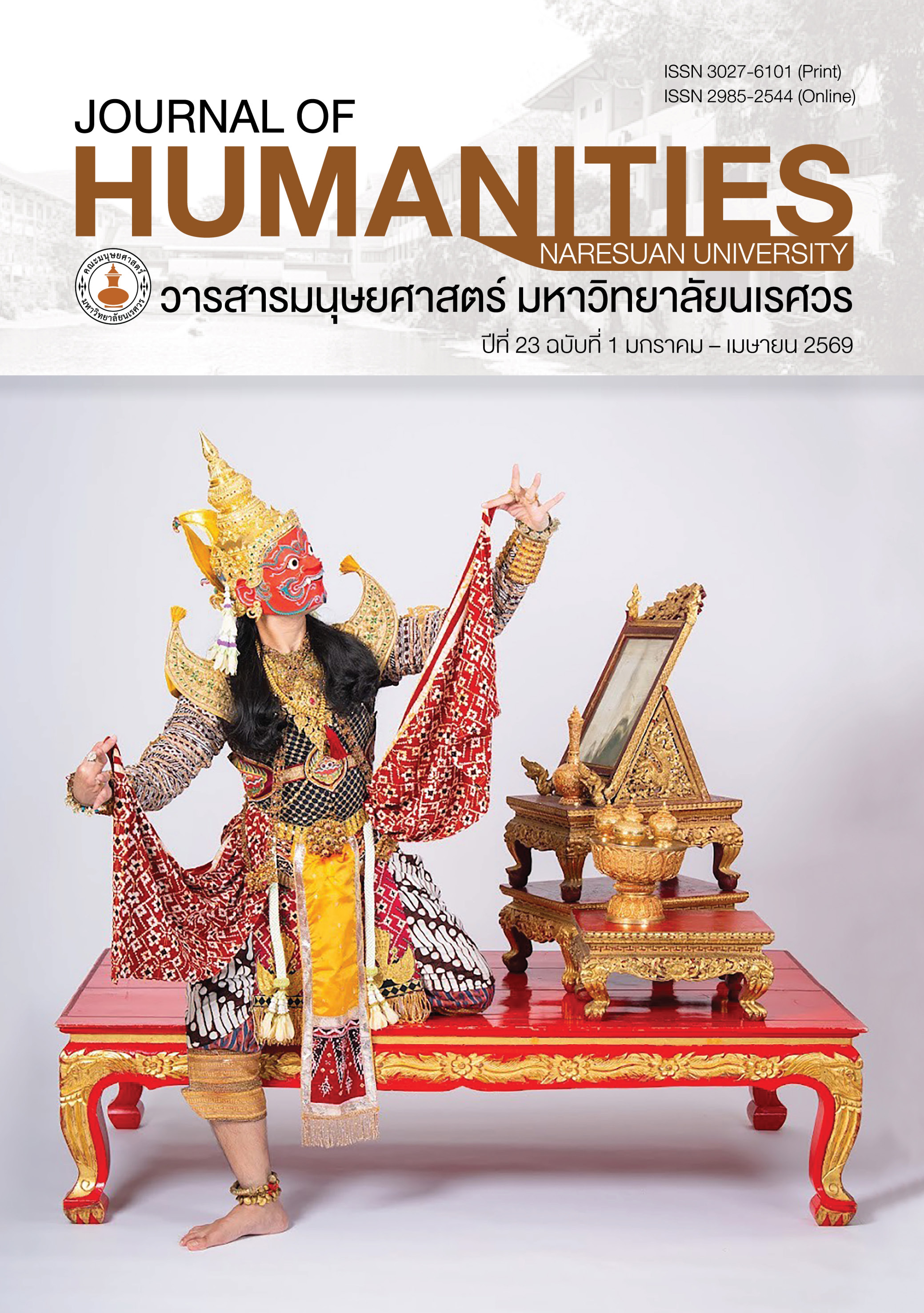
The objective of this research is to create the dance performance “Pra Bu Nu Asun Taengtua” by combining Thai and Javanese dance. It employs a qualitative research methodology, collecting data through document studies and interviews with experts in Thai and Javanese dance. All data is then analyzed for content, leading to the concept for this work. The research findings indicate that “Pra Bu Nu Asun Taengtua” is a creative dance performance that balances Thai and Javanese dance elements. It is presented as a dance drama inspired by the “bathing” ritual in Thai and Javanese dance. The main character is Prapunu Asun, a majestic giant king who is dressed up to lead his army to reclaim the woman he loves, based on the Panji mask dance drama. The performance is divided into key stages: the bathing ritual with the song “Long Song Tone” interspersed with slow, mournful refrains, and the kris dance with the song “Saramah,” which adapts the Javanese dance’s use of the kris as a personal weapon for the giant in Thai dance. The music design incorporates some gamelan instruments blended with Thai instruments, and the costume design incorporates Javanese dance costume elements into the Thai standing costume, resulting in a new dance performance that blends two art forms. This performance has a cross-cultural hybrid style, and no previous performance has combined the Thai-Javanese giant bathing ritual in such a holistic manner. The results of this research will serve as a guideline for studying and creating dance for those interested in further creative work.
Article Details

This work is licensed under a Creative Commons Attribution-NonCommercial-NoDerivatives 4.0 International License.
ข้อความรู้ใดๆ ตลอดจนข้อคิดเห็นใดๆ เป็นของผู้เขียนแต่ละท่านโดยเฉพาะ คณะมนุษยศาสตร์ มหาวิทยาลัยนเรศวร และกองบรรณาธิการวารสารมนุษยศาสตร์ฯ ไม่จำเป็นต้องเห็นพ้องด้วย
References
Jatuthasri, T. (2009). Inao of King Rama II: The making of the Panji cycle into a masterpiece of Thai court drama literature [Doctoral dissertation, Chulalongkorn University]. CUIR. http://cuir.car.chula.ac.th/handle/123456789/59107
Kediribertutur. (2017, February 3). Melihat makna gaya rambut pendek Panji Asmorobangun. https://kediribertutur.wordpress.com/2017/02/03/melihat-makna-gaya-rambut-pendek-panji-asmorobangun/
Saisunee, K. (2022). Long Song Natadontree: Creative dance of Long Song from Thai classical dance - drama to Li-kay. Bunditpatanasilpa Institute. https://media.bpi.ac.th/admin/attach/w2/f20231109152314_nTuZsXqMnJ.pdf
Saisunee, K., Vingvorn, S., & Chansuwan, S. (2022). Katayani dance drama: A dramatic creation inspired by Indian Bharatanatyam and Thai classical dance. Journal of Studies in the Field of Humanities, Kasetsart University, 30(1), 1-19. https://so04.tci-thaijo.org/index.php/abc/article/view/255612
Sooksom, V. (2002). Long Song tone: Dance patterns in Lakhon Nai-Inao [Master’s thesis, Chulalongkorn University]. CUIR. http://cuir.car.chula.ac.th/handle/123456789/5138
Vadetya, M. (2023, August 26). Peternakan era majapahit, untuk kebutuhan pertanian hingga tunggangan perang. Jawa Pos Radar Mojokerto. https://radarmojokerto.jawapos.com/sejarah-mojopedia/822881694/peternakan-era-majapahit-untuk-kebutuhan-pertanian-hingga-tunggangan-perang
Vanessa, A. D. R., & Candraningrum, D. (2023). Teaching multiculturalism to fight against racism in The Freedom Writer by Richard LaGravenese. Jurnal Ilmiah Mandala Education, 9(3), 1782-1792. https://doi.org/10.58258/jime.v9i3.5509
Virulrak, S. (2004). Lak kan sadaeng nat ya sin parithat [Principles of performing arts presentation]. Chulalongkorn University Press.
