
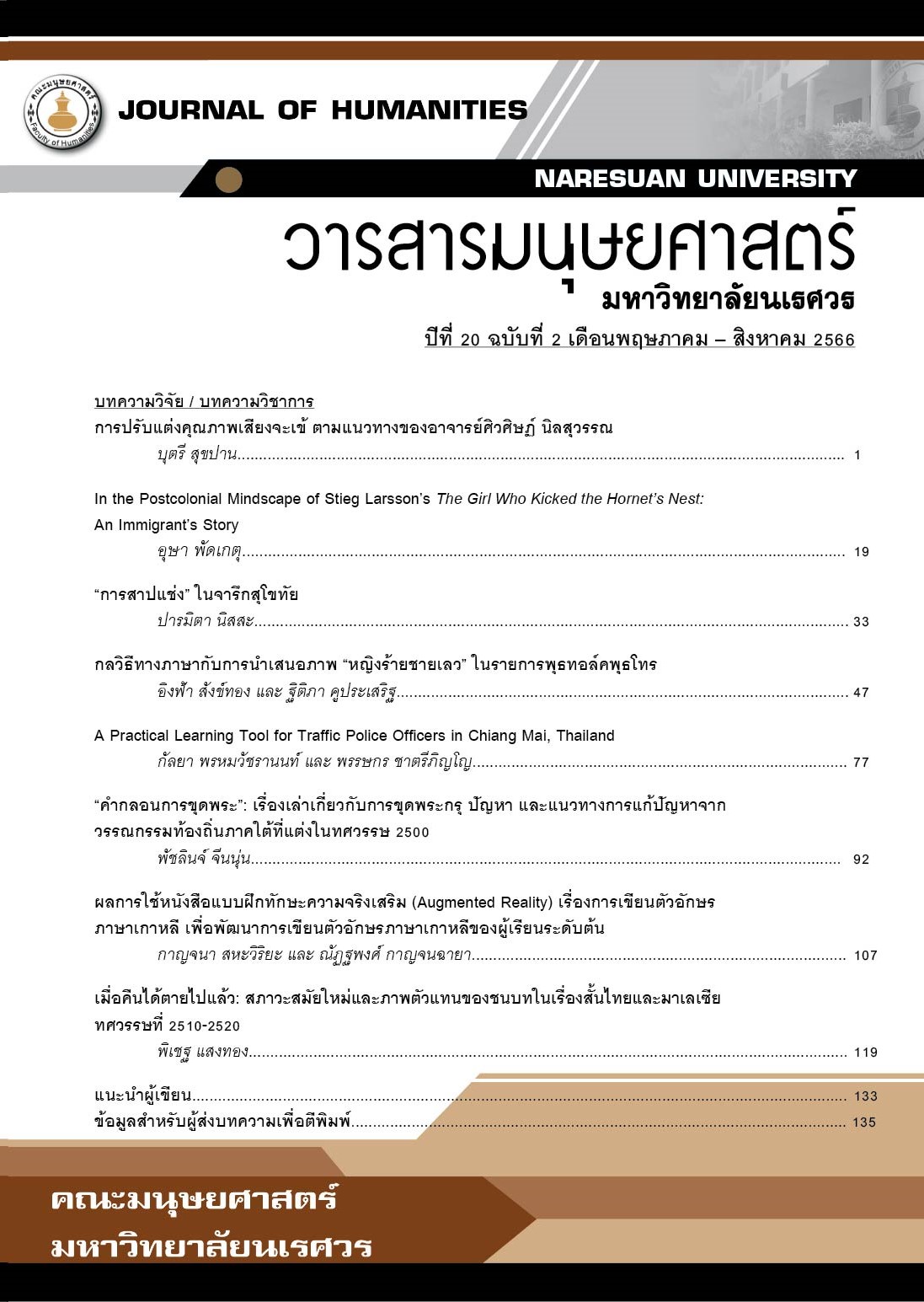
Effects of an Augmented Reality Practice Book on Development of Korean Alphabet Writing for Beginners
Article Sidebar
Main Article Content
Abstract
This present research aims to 1) develop the augmented reality practice book on Korean alphabet for beginners, 2) study the effect of using the augmented reality practice book on Korean alphabet for beginners, and 3) explore the students’ satisfaction of the effect of using the augmented reality practice book on Korean alphabet for beginners. The present study consists of 100 participants who are the learners of Korean language for beginner in the secondary school. The research instruments were 1) the quality assessment form of the augmented reality practice book, 2) the augmented reality practice book, and 3) the lesson plan which followed the augmented reality practice book, 4) the normal lesson plan, 5) the writing ability test on Korean alphabet and 6) the evaluation of satisfaction with learning in the course of the augmented reality practice book.
The research analysis tools were percentage, mean, standard deviation and t-test. The results of the research were found that: first, the quality and efficiency of the augmented reality practice book in general were at good at the mean of 4.34, the standard deviation of 0.39 and the effectiveness index was 81.95/80.25. Second, the results of applying the augmented reality practice book revealed that the post-study score of the experimental group was significantly higher than the control group at .01 level. To elaborate, the post-study score of the experimental group were at the mean of 92.57 and the standard deviation of 4.70, whilst, the post-study score of the control group were at the mean of 82.76 and the standard deviation of 3.57. Third, the satisfaction results toward the application of the augmented reality practice book shown that the satisfaction was at the highest level with the mean of 4.75 and the standard deviation of 0.44.
Article Details

This work is licensed under a Creative Commons Attribution-NonCommercial-NoDerivatives 4.0 International License.
ข้อความรู้ใดๆ ตลอดจนข้อคิดเห็นใดๆ เป็นของผู้เขียนแต่ละท่านโดยเฉพาะ คณะมนุษยศาสตร์ มหาวิทยาลัยนเรศวร และกองบรรณาธิการวารสารมนุษยศาสตร์ฯ ไม่จำเป็นต้องเห็นพ้องด้วย
References
กอบกุล มาเวียง. (2545). การเปรียบเทียบการสอนภาษาเกาหลีระหว่างการสอนที่ใช้สื่อผสม (การฟังกับการดู) กับการสอนที่ใช้สื่อเดียว (การฟังหรือการดูอย่างเดียว). มหาสารคาม: มหาวิทยาลัยมหาสารคาม.
กาญจนา สหะวิริยะ, และณัฏฐพงศ์ กาญจนฉายา. (2564). การพัฒนาหนังสือแบบฝึกทักษะความจริงเสริม (Augmented Reality) เรื่องการเขียนตัวอักษรภาษาเกาหลีเพื่อผู้เรียนระดับต้น. ปัตตานี: มหาวิทยาลัยสงขลานครินทร์ วิทยาเขตปัตตานี.
จิตราภรณ์ ชัยเฉลิมศักดิ์, และวิวัฒน์ มีสุวรรณ์. (2555). การพัฒนาหนังสืออ่านเพิ่มเติมร่วมกับเทคโนโลยีโลกเสมือนผสานโลกจริง เรื่อง อุปกรณ์คอมพิวเตอร์ สำหรับนักเรียนชั้นมัธยมศึกษาปีที่ 1 โรงเรียนหล่มเก่าพิทยาคม จังหวัดเพชรบูรณ์. สืบค้น 8 พฤศจิกายน 2562, จาก http://wiwatmee.blogspot.com/2012/09/1.html
ชูชาติ มงคลเมฆ. (2553). การเปรียบเทียบทักษะปฏิบัติดนตรีสากลและความรับผิดชอบต่อหน้าที่ของนักเรียนช่วงชั้นที่ 3 ได้รับการจัดการเรียนรู้โดยใช้สื่อวีดิทัศน์ มีครูแนะนะกำกับการศึกษาวีดิทัศน์ด้วยตนเอง (วิทยานิพนธ์ครุศาสตร์มหาบัณฑิต). พระนครศรีอยุธยา: มหาวิทยาลัยราชภัฏพระนครศรีอยุธยา.
ณัฐนันท์ คงประพันธ์. ครู ค.ศ.1 โรงเรียนวรนารีเฉลิม จังหวัดสงขลา หัวหน้าศูนย์เครือข่ายพัฒนาการเรียนการสอนภาษาเกาหลีภาคใต้. (7 ตุลาคม 2562). สัมภาษณ์.
นงลักษณ์ มีแก้ว, สุรเดช เอ่งฉ้วน, และวัชรี เกษพิชัยณรงค์. (2557). Augmented Reality Technology (AR) เมื่อเทคโนโลยีสามารถเชื่อมโลกเสมือนมาบรรจบกับโลกเสมือนมาบรรจบกับโลกของความจริงและการประยุกต์ใช้ในการจัดการศึกษา. จุลสารนวัตกรรม, 9(34), 8-16.
นฤเทพ สุวรรณธาดา. (2556). การวิเคราะห์การเรียนรู้รูปแบบผสมผสาน โดยใช้สื่อการเรียนการสอน แบบโลกเสมือนผสานโลกจริง. วารสารวิชาการและวิจัย มทร.พระนคร, 7(1), 115-121.
บุษบา ชูคำ. (2550). ผลของการใช้บทเรียนการ์ตูนคณิตศาสตร์แบบ E-Book เรื่องโจทย์ปัญหาสมการเชิงเส้นตัวแปรเดียวที่มีผลต่อผลสัมฤทธิ์ทางการเรียนและความพึงพอใจในวิชาคณิตศาสตร์ ของนักเรียนชั้นมัธยมศึกษาปีที่ 2 (สารนิพนธ์การศึกษามหาบัณฑิต). กรุงเทพฯ: มหาวิทยาลัยศรีนครินทรวิโรฒ.
ปิยธิดา สังฆะโณ. (2550). การพัฒนาบทเรียนสำเร็จรูปการ์ตูนเรื่องสำนวน สุภาษิต และคำพังเพยของนักเรียนชั้นมัธยมศึกษาปีที่ 1 โรงเรียนมหาวชิราวุธ จ.สงขลา (สารนิพนธ์การศึกษามหาบัณฑิต). กรุงเทพฯ: มหาวิทยาลัยศรีนครินทวิโรฒ.
พรทิพย์ ปริยวาทิต, และวิชัย นภาพงศ์. (2559). ผลของการใช้บทเรียน Augmented Reality Code เรื่องคำศัพท์ภาษาจีนพื้นฐาน สำหรับนักเรียนชั้นประถมศึกษาปีที่ 3 โรงเรียนเทศบาล 2 วัดตานีนรสโมสร. วารสารวิทยบริการ มหาวิทยาลัยสงขลานครินทร์, 27(1), 9-17.
รักษพล ธนานุวงศ์. (2556). สื่อเสริมการเรียนรู้โลกเสมือนผสมโลกจริง (Augmented Reality) ชุดการจมและการลอย. นิตยสาร สสวท, 41(181), 28-31.
วรุณนภา ศรีโสภาพ, วิวัฒน์ มีสุวรรณ์, อรชลิดา พรหมปั้น, อังศุมาลิน แช่มสกุล, และภาณุวัฒน์ อยู่ดี. (2556). การพัฒนาหนังสือเสริมบทเรียนสามมิติด้วยเทคนิคภาพเสมือนผสานโลกจริง เรื่อง อุปกรณ์ที่ใช้ในการเคลื่อนที่ของผู้ป่วยไขสันหลังบาดเจ็บ. วารสารศึกษาศาสตร์ มหาวิทยาลัยนเรศวร, 15(1), 24-32. สืบค้น 9 สิงหาคม 2562, จาก https://so06.tci-thaijo.org/index.php/edujournal_nu/article/view/9298
ศุภกานต์ ผามั่ง. (2560). การพัฒนาความสามารถในการสื่อสารภาษาเกาหลีเบื้องต้นของนักเรียนชั้นมัธยมศึกษาปีที่ 6 โดยใช้วิธีการสอนตามแนวการสอนภาษาเพื่อการสื่อสาร. พิษณุโลก: มหาวิทยาลัยราชภัฏพิบูลสงคราม.
สุพรรณพงศ์ วงษ์ศรีเพ็ง. (2554). การประยุกต์ใช้เทคนิคความจริงเสมือนเพื่อใช้ในการสอนเรื่องพยัญชนะภาษาไทย. กรุงเทพฯ : มหาวิทยาลัยเทคโนโลยีพระจอมเกล้าพระนครเหนือ.
อุษา วงษาสม, และทัศนีย์ บุญเติม. (2553). ผลการเรียนรู้ตามแนววัฏจักรการเรียนรู้ 4 MAT เรื่องระบบในร่างกายสำหรับนักเรียน ชั้นมัธยมศึกษาปีที่ 2. วารสารศึกษาศาสตร์ ฉบับวิจัยบัณฑิตศึกษา, 4(3), 156-162.
Kandikonda, K. (2011). Using Virtual Reality and Augmented Reality to Teach Human Anatomy (Master’s thesis). Toledo, OH: The University of Toledo.
Lee, M. H. (2017). Hyo-yul-jeog-in gyo-su mo-hyeong gye-bal-eul wi-han han-gug-eo-gyo-jae-ui han-geul gyo-su dan-won yeon-gu [A Study of the Unit of Hangeul in Korean Textbook for Development an Efficient Teaching Model]. The Linguistic Science Society, 42, 81-105. [in Korean]
Oh, K. K. (2008). Gi-cho dan-gye-ui han-gug-eo ja-mo gyo-yug (Jolt-gih-chyong-jyae) - Tong-hab gyo-jae-leul jung-sim-eu-lo - [Teaching Korean Alphabets for Basic Level Learners of KFL - Focusing on ‘Integrated Textbooks' -]. Hanminjok Emunhak, 53, 181-208. [in Korean]
Vilkoniene, M. (2009). Influence of augmented reality technology upon pupils’ knowledge about human digestive system: The results of the experiment. US-China Education Review, 6(1), 36-43.
Yang, M. H. (2009). Oe-gug-in hag-seub-ja-leul wi-han han-geul ja-mo-wa bal-eum gyo-yug bang-beob-e dae-ha-yeo [A study on the standardization of the education of the Korean alphabet and its pronunciation]. The Society of Chung-Ang Lang. & Lit., 41, 5-27. [in Korean]
