
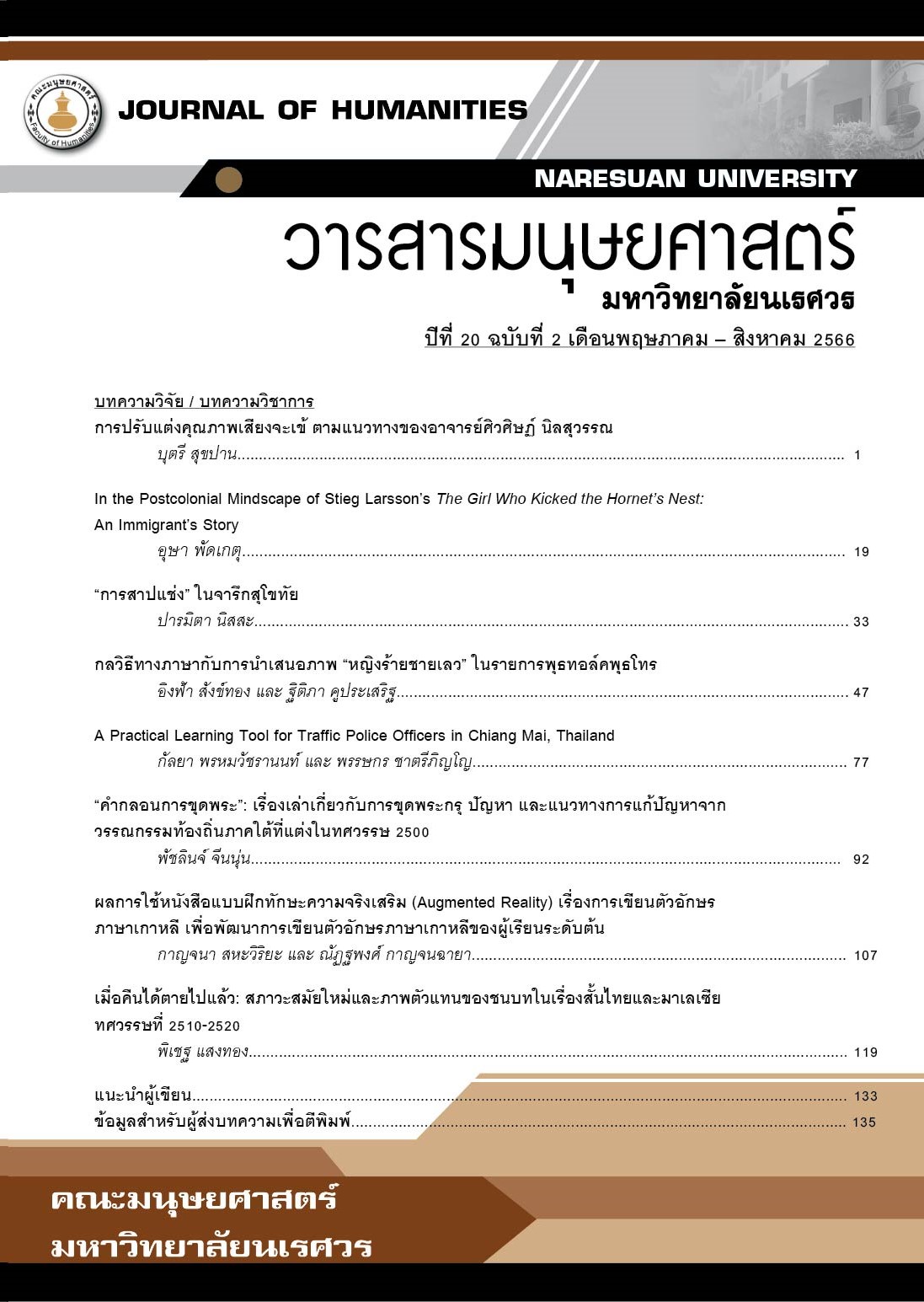
A Practical Learning Tool for Traffic Police Officers in Chiang Mai, Thailand
Article Sidebar
Main Article Content
Abstract
This article is a part of the research titled “Development of a Self-Access Learning Package to Enhance Communicative English Listening and Speaking Skills of Traffic Police Officers in Upper Northern Thailand”. The objective of this article is to illustrate the necessity and functionality of such a learning tool to improve the English communicative skills, which can be used by traffic police officers (TPOs) in order to fulfill their job requirements. Furthermore, the article discusses Phase I of the project, which entails information regarding ways to create a learning tool by integrating the results of the research. This study employed a survey design to administer observations, interviews, and questionnaires in order to investigate the challenges and needs of English communication among 100 TPOs in 8 provinces of the upper northern Thailand. Moreover, the article focuses on Phase II of this project, which contains information regarding the use and the application of this learning tool. The application of this tool was determined by assessing the impact on 60 TPOs in Chiang Mai, Thailand in a 1-day workshop with the goal to improve their shortcoming in specific vocabulary while on duty, to enhance their knowledge of English when attempting to understand various accents of native English speakers, and finally to develop the speed of speaking which affects their ability to listen and to speak while communicating with foreigners. This article also reveals Phase III of using this learning tool in order to narrow down the challenges of 51 TPOs from Chiang Mai Traffic Police Station during a 2-day workshop in an English communicative training course to improve the lack of vocabulary and the specific terms, difficulties in English pronunciation and their mispronunciation, as well as their shortcoming in English grammar.
Article Details

This work is licensed under a Creative Commons Attribution-NonCommercial-NoDerivatives 4.0 International License.
ข้อความรู้ใดๆ ตลอดจนข้อคิดเห็นใดๆ เป็นของผู้เขียนแต่ละท่านโดยเฉพาะ คณะมนุษยศาสตร์ มหาวิทยาลัยนเรศวร และกองบรรณาธิการวารสารมนุษยศาสตร์ฯ ไม่จำเป็นต้องเห็นพ้องด้วย
References
Akinade, E. A., & Owolabi, T. (2009). Research methods: A pragmatic approach for social sciences, behavioural sciences and education. Lagos: Connel Publications.
Albakrawi, H. T. M. (2013). Needs analysis of the English language secondary hotel students in Jordan. International Journal of English Language Teaching, 1(1), 13-23.
Broadbent, D. (1958). Perception and communication. London, UK: Pergamon.
Crystal, D. (2003). The Cambridge encyclopedia of the English language (2nd ed.). Cambridge: Cambridge University Press.
Dudley-Evans, T. & St. John, M. J. (1998). Development in English for specific purposes: A multidisciplinary approach. Cambridge: Cambridge University Press.
Flick, U. (2002). An introduction to qualitative research (2nd ed.). London: Sage.
Hutchinson, T., & Waters, A. (1987). English for specific purposes: A learning-centered approach. Cambridge: Cambridge University Press.
Jordan, R. R. (1997). English for academic purposes: A guide and resource book for teachers. Cambridge: Cambridge University Press.
Kanchanawasri, S., Pitayanon, T., & Srisukkho, D. (1994). The selective appropriate statistics for measurement. Bangkok: Chulalongkorn University Publishing.
Knowles, M. S. (1980). The modern practice of adult education: From pedagogy to andragogy (revised and updated edition). Chicago: Follett Publishing.
Meichenbaum, D. (1997). Cognitive behavioral modification: An integrative approach. New York: Plenum.
Promwatcharanon, K., & Chatreepinyo, P. (2018). An analysis of challenges and requirements of using communicative English for developing a self-access learning package for traffic police officers in upper northern Thailand. Humanities & Social Sciences, 35(1), 163-195.
Richards, J. C., & Rodgers, T. S. (2001). Approaches and methods in language teaching (2nd ed.). Cambridge: Cambridge University Press.
Richards, J. C., & Schmidt, R. W. (2010). Longman dictionary of language teaching & applied linguistics (4th ed.). London: Routledge
Song, L., & Hill, J. R. (2007). A conceptual model for understanding self-directed learning in online environments. Journal of Interactive Online Learning, 6(1), 27-42
Tomlinson, B. (1998). Materials development in language teaching. Cambridge: Cambridge University Press.
