
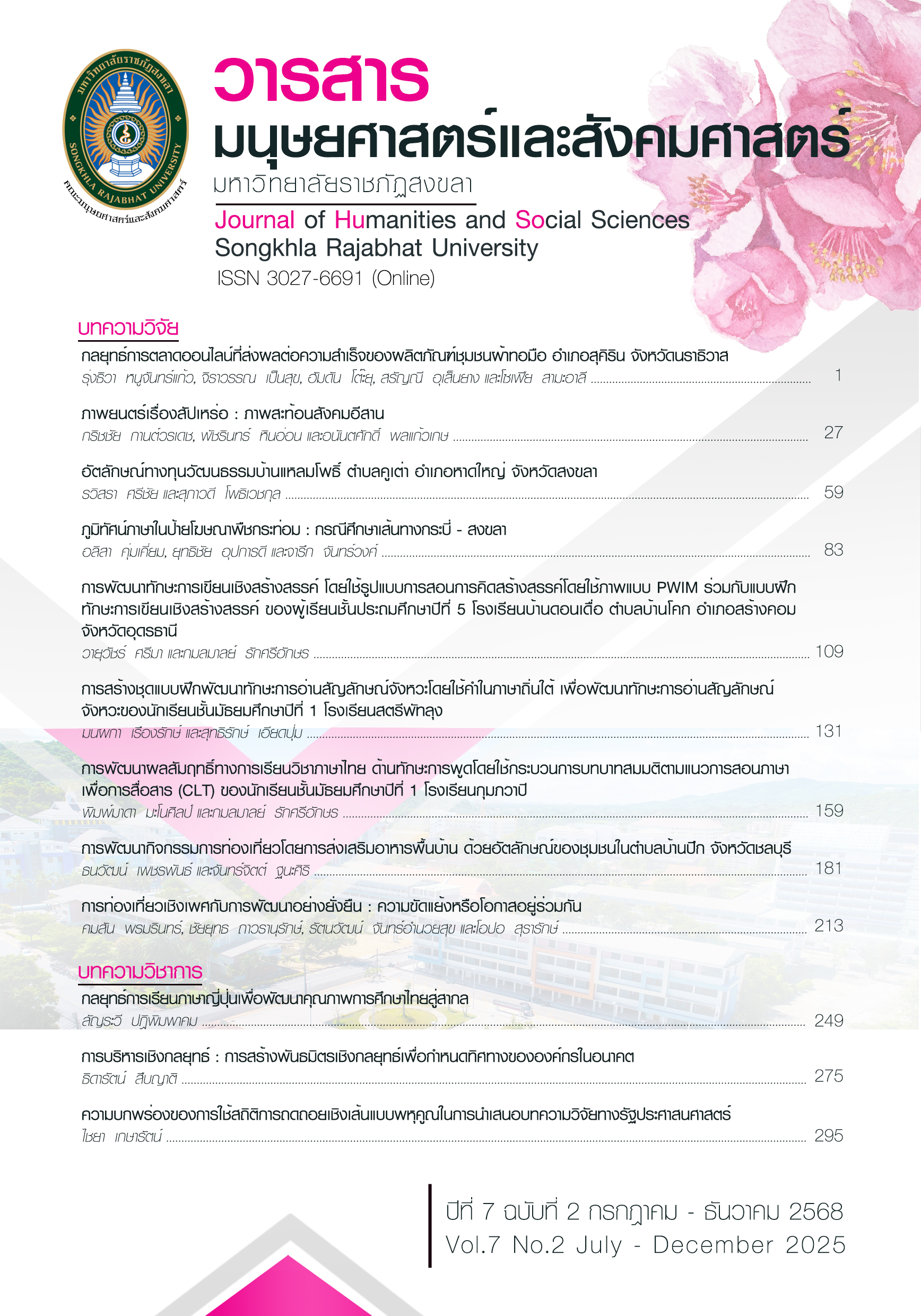
SEX TOURISM AND SUSTAINABLE DEVELOPMENT: CONFLICT OR COEXISTENCE
Article Sidebar
Main Article Content
Abstract
This research aims to 1. examine and discuss the conflicting challenges and potential for coexistence between sex tourism phenomena and sustainable development principles, and 2. provide policy solutions for transforming sex tourism into sustainable tourism. The research method employed a synthesis of document analysis and focus group discussions with 15 specialists in tourism, social welfare, and sexual health. The data was examined and integrated within the context of sustainable development in tourism. The research findings reveal that sex tourism conflicts with the concepts of sustainable development regarding ethics and its adverse effects on society. whereas there exists a shared aspect within the economic component that produces revenue at both national and local levels. To effectively integrate sex tourism with sustainable development, it is essential to implement policies that correspond with sustainability principles. This includes legalizing service trade, establishing governance structures, ensuring the rights of sex workers, preventing human rights abuses, fostering community engagement, and diversifying tourism models. Moreover, efficient communication is necessary to encourage understanding, alongside the establishment of a system of indicators for the ongoing evaluation of policy implementation. Additionally, further extensive and continual research is required to enhance sustainable and holistic development strategies.
Downloads
Article Details

This work is licensed under a Creative Commons Attribution-NonCommercial-NoDerivatives 4.0 International License.
ลิขสิทธิ
References
เดชวิทย์ นิลวรรณ, บังอร ฉัตรรุ่งเรือง, อาชวิน ใจแก้ว, ศุภชัย มุกดาสนิท. (2567). ความสัมพันธ์เชิงสาเหตุของการให้คุณค่าในการท่องเที่ยวโดยชุมชนที่มีอิทธิพลต่อความยั่งยืนในการท่องเที่ยวโดยชุมชนในจังหวัดเชียงใหม่. วารสารบริหารศาสตร์ มหาวิทยาลัยอุบลราชธานี. 13(2), 1-20. สืบค้นเมื่อ 9 ธันวาคม 2567, จาก https://so03.tci-thaijo.org/index.php/jms_ubu/article/view/271979
คมสิทธิ์ เกียนวัฒนา, เสาวนีย์ รัตนาภิบาล, Hannah Elliott และ พุทธิดา พันธ์ครุฑ. (2567). การยอมรับการท่องเที่ยวทางเพศในประเทศไทย. วารสารวิทยาการจัดการมหาวิทยาลัยราชภัฏพิบูลสงคราม. 6(2), 18-31. สืบค้นเมื่อ 10 มกราคม 2568, จาก https://so03.tci thaijo.org/index.php/jmspsru/article/view/268028
ปวีณา ขำพัด และพยอม ธรรมบุตร. (2564). แนวทางเพื่อพัฒนาการท่องเที่ยวแบบบูรณาการอย่างยั่งยืนของจังหวัดพิษณุโลก ประเทศไทย. วารสารการวิจัยการบริหารการพัฒนา. 11(1), 187-199. สืบค้นเมื่อ 17 ธันวาคม 2567, จาก https://so01.tci-thaijo.org/index.php/JDAR/article/view/246030
อัฏฐพล โพธิพิพิธ, คณิต เขียววิชัย และวรรณวีร์ บุญคุ้ม. (2567). การพัฒนากลยุทธ์การท่องเที่ยวเชิงวัฒนธรรมอย่างยั่งยืนของจังหวัดกาญจนบุรี. วารสารสังคมศาสตร์บูรณาการ มหาวิทยาลัยมหิดล. 11(1), 250-274. สืบค้นเมื่อ 22 ธันวาคม 2567, จาก https://so02.tci-thaijo.org/index.php/isshmu/article/view/270845
Bah, Y. M. and Saptandari E. P. P. (2020). Impacts of Child Sex Tourism Systematic Literature Review Impacts of Child Sex Tourism Systematic Literature Review. Global Journal of Human-Social Science: H Interdisciplinary. 20(1), 4-14.
Bianchi, R. V. (2009). The ‘Critical Turn’ in Tourism Studies: A Radical Critique. Tourism Geographies. 11(4), 484-504.
Brennan, D. (2004). Women work, men sponge, and everyone gossips: Macho men and stigmatized/ing women in a sex tourist town. Anthropological Quarterly. 77(4), 705-733. https://dx.doi.org/10.1353/anq.2004.0050
Butler, J. (1990). Gender trouble: Feminism and the subversion of identity. New York: Routledge.
Butler, R. W. (1999). Sustainable tourism: A state of the art review. Tourism Geographies. 1(1), 7-25. https://doi.org/10.1080/14616689908721291
Cabezas, A. L. (2009). Economies of Desire: Sex and Tourism in Cuba and the Dominican Republic. Pennsylvania: Temple University Press.
Cholsaktrakul, P. (2024). Legalization of prostitution for Thailand. Romphruek Journal of the Humanities and Social Sciences. 42(3), 231-252. Retrieved November 15, 2024, from https://so05.tcithaijo.org/index.php/romphruekj/article/view/270557
Clift, S. and Carter, S. (2000). Tourism and Sex: Culture, Commerce and Coercion. New York: Pinter.
Eser, A. (2025). Thailand Sex Tourism Statistics. Retrieved May 31, 2025 from https://zipdo.co/thailand-sex-tourism-statistics/
Hall, C. M. and Lew, A. A. (2009). Understanding and managing tourism impacts: An integrated approach. London: Routledge.
Harris, R., Williams, P. and Griffin, T. (Eds.). (2016). Sustainable Tourism: A Global Perspective. (2nd ed.). New York: Routledge.
Harvey, D. (2005). A Brief History of Neoliberalism. New York: Oxford University Press.
Higgins-Desbiolles, F. (2006). More than an “industry”: The forgotten power of tourism as a social force. Tourism Management. 27(6), 1192-1208.
Hillis, A., Leavey, C., Kewley, S., Church, S. and Hout, M. C. V. (2020). Sex tourism, disease migration and COVID-19: Lessons learnt and best practices moving forward. Journal of Travel Medicine. 27(7), 1-2. from https://doi.org/10.1093/jtm/taaa144
Jeffreys, S. (2009). The Industrial Vagina: The Political Economy of the Global Sex Trade. London: Routledge.
Juimanee, K., Suttibodee, S., Arunthari, S. and Arthivech, U. (2022). Legal measures to solve the problem of voluntary prostitution in the Kingdom of Thailand. Ph.D. in Social Sciences Journal. 12(1), 87-99. Retrieved October 21, 2024, from https://so05.tci-thaijo.org/index.php/phdssj/article/view/220245
Lindner, J. (2024). Prostitution Money Statistics. Retrieved March 10, 2025, from https://gitnux.org/prostitution-money-statistics/
McKenzie, J., Reyes, J. J., Xiong, K. C., Corona, A. and Armsworthy, C. (2021). Virtue, shame, and choice: Perspectives of sex work among adolescents in variously globalized Thai communities. Journal of Cross-Cultural Psychology. 52(6), 533-552. https://doi.org/10.1177/002202212110323
Monterrubio, J. C., and Bello, A. (2011). Local community attitudes towards the impact of tourism on prostitution. Journal of tourism - studies and research in tourism. 12(12), 13-20.
Mowforth, M. and Munt, I. (2016). Tourism and sustainability: Development, globalization and new tourism in the Third World. (4th ed.). New York: Routledge.
Nussbaum, M. C. (1999). Sex and social justice. New York: Oxford University Press.
Ocha, W. and Earth, B. (2013). Identity diversification among transgender sex workers in Thailand’s sex tourism industry. Sexualities. 16(1-2), 195-216. https://doi.org/10.1177/1363460712471117
Oppermann, M. (1999). Sex tourism. Annals of Tourism Research. 26(2), 251-266.
Parreñas, R. S. (2011). Illicit flirtations: Labor, migration, and sex trafficking in Tokyo. Stanford: Stanford University Press.
Saarinen, J. (2006). Traditions of sustainability in tourism studies. Annals of Tourism Research. 33(4), 1121-1140. https://doi.org/10.1016/j.annals.2006.06.007
Scheyvens, R. (2000). Promoting Women’s Empowerment Through Involvement in Ecotourism: Experiences from the Third World.
Journal of Sustainable Tourism. 8(3), 232-249. https://doi.org/10.1080/09669580008667360
Scheyvens, R. (2002). Tourism for development: Empowering communities. London: Prentice Hall.
Sharpley, R. (2009). Tourism development and the environment: Beyond sustainability. London: Earthscan.
Silrak, Y. (2014). Reforming prostitution law in Thailand. [Doctoral dissertation]. School of Law, Faculty of Business, Economics and LawLa Trobe University Research Repository. Retrieved October 12, 2024 from https://opal.latrobe.edu.au/articles/thesis/Reforming_prostitution_law_in_Thailand/21845673
Somswasdi, V. (2004). Legalization of prostitution in Thailand: A challenge to feminism and societal conscience. In Pajerek, J. (Ed.). Cornell Law School Berger International Speaker Papers. Paper 2. Cornell Law School. Retrieved November 24, 2024, from https://scholarship.law.cornell.edu/biss_papers/2
Statham, P. and Scuzzarello, S. (2023). Transgender kathoey and gay men using tourist-zone scenes as ‘social opportunities’ for nonheteronormative living in Thailand. Gender, Place and Culture. 30(2), 183–210. https://doi.org/10.1080/0966369X.2021.1997937
Thailand Development Research Institute. (2022). Thailand should legalise prostitution. Retrieved October 5, 2024, from https://tdri.or.th/en/2022/07/thailand-should-legalise-prostitution/
Truong, T. D. (1990). Sex, Money and Morality: Prostitution and Tourism in Southeast Asia. New Jersey: Zed Books.
United Nations Office on Drugs and Crime. (2020). Global Report on Trafficking in Persons 2020. Retrieved November 18, 2024, from https://www.unodc.org/unodc/en/data-and-analysis/glotip-2020.html
Waller, R. (2020). Decriminalizing Sex Work in Thailand. Retrieved November 27, 2024, from https://seasia.yale.edu/news/decriminalizing-sex-work-thailand
Weitzer, R. (2024). Rethinking Sex Tourism: Thailand as a Case Study by Ronald Weitzer. Retrieved November 22, 2024, from https://nyupress.org/blog/2024/08/05/rethinking-sex-tourism-thailand-as-a-case-study-by-ronald-weitzer/
World Tourism Organization. (2004). Indicators of sustainable development for tourism destinations: A guidebook. Madrid: World Tourism Organization.
World Tourism Organization. (2013). Sustainable Tourism for Development Guidebook - Enhancing capacities for Sustainable Tourism for development in developing countries. https://doi.org/10.18111/9789284415496
