
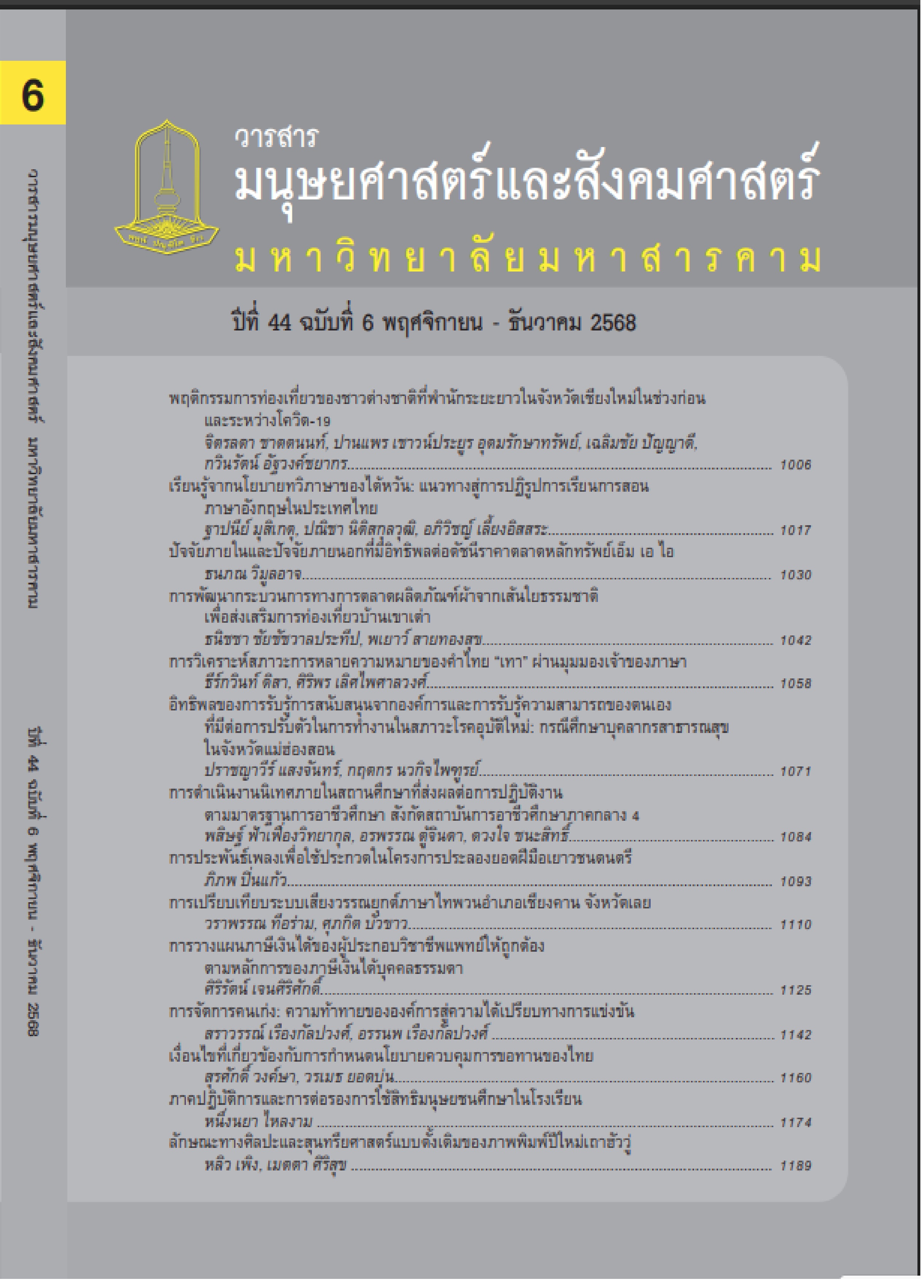
การวิเคราะห์สภาวะการหลายความหมายของคำไทย “เทา” ผ่านมุมมองเจ้าของภาษา
Article Sidebar
Main Article Content
บทคัดย่อ
คลังคำศัพท์ของคนไทยมีอัตราเพิ่มขึ้นและกระจายตัวไปในทุกแวดวง ผ่านกระบวนการต่าง ๆ อาทิ กระบวนการทางวิทยาหน่วยคำและกระบวนการขยายโครงข่ายความหมาย ในด้านอรรถศาสตร์นั้น สภาวะการหลายความหมายคือสภาวะที่คำ ๆ หนึ่งได้รับแนวคิดหรือนิยามใหม่เพิ่มขึ้นโดยยังคงไว้ทั้งรูปแบบและความหมายดั้งเดิม สภาวะการเช่นนี้ปรากฎได้ในนานาภาษา รวมถึงภาษาไทย หนึ่งในคำไทยที่พบสภาวะการหลายความหมายคือ “เทา” ซึ่งแสดงถึงลักษณะสีที่คล้ายกับขี้เถ้า ผู้วิจัยเล็งจึงทำการศึกษาสภาวะการหลายความหมายโดยวิเคราะห์ข้อมูลจากเฟซบุ๊ก อินสตาแกรม และเอ็กซ์ ผ่านการอธิบายด้วยกระบวนการสภาวะการหลายความหมายแบบมีหลักการ นอกจากนั้นผู้วิจัยได้สร้างแบบสำรวจความรับรู้ต่อสภาวะการหลายความหมายของคำว่า “เทา” มีผู้ร่วมตอบแบบสำรวจคือชาวไทยซึ่งเป็นเจ้าของภาษา จำนวน 53 คน ผลการศึกษาในขั้นแรกพบว่า “เทา” มีความหมายนอกจากความหมายต้นแบบอีก 2 ความหมาย ได้แก่ สภาวะความรู้สึกเชิงลบและสภาวะความไม่แน่นอนหรือความไม่สมบูรณ์แบบ ทั้งสองความหมายนี้แสดงให้เห็นว่า “เทา” ไม่เพียงแต่สื่อถึงสภาวะกึ่งกลางระหว่างสีเท่านั้น แต่ยังสะท้อนถึงภาวะเชิงลบต่าง ๆ อีกด้วย สำหรับผลการสำรวจความรับรู้ต่อสภาวะการหลายความหมาย พบว่ากลุ่มตัวอย่างเห็นพ้องกันว่าความหมายต้นแบบของคำว่า “เทา” ในการใช้ภาษาไทยแบบร่วมสมัยคือลักษณะสีที่คล้ายกับขี้เถ้า
Article Details
เอกสารอ้างอิง
Akut, K. B. (2020). Morphological analysis of the neologisms during the COVID-19 pandemic. International Journal of English Language Studies, 2(3), 1-7.
Beretta, A., Fiorentino, R., & Poeppel, D. (2005). The effects of homonymy and polysemy on lexical access: A MEG study. Cognitive Brain Research, 24(1), 57-65.
Evans, V. (2004). The structure of time: Language, meaning and temporal cognition. John Benjamins Publishing Company.
Fauconnier, G., & Turner, M. (2003). Polysemy and conceptual blending. In B. Nerlich, Z. Todd, V. Herman, & D. D. Clarke (Eds.), Polysemy: Flexible patterns of meaning in mind and language (pp. 79-94). De Gruyter Mouton.
Hiranras, J. (2007). A semantic study of /ʔaw/ ‘take’ in Thai [Master’s thesis, Chulalongkorn University]. Chulalongkorn University Intellectual Repository. http://cuir.car.chula.ac.th/handle/123456789/52483/
Huang, G., Zhou, Z., & Liu, J. (2022). A study on polysemy from the cognitive perspective: A case study of “spring”. International Journal of Languages, Literature and Linguistics, 8(1), 208-212.
Iamsa-ard, B. (2024). /sòt/: A polysemy in contemporary Thai. Parichart Journal, 37(2), 343-360.
Iwasaki, S., & Ingkaphirom, P. (2005). A reference grammar of Thai. Cambridge University Press.
Lakoff, G., & Johnson, M. (1980). Metaphors we live by. University of Chicago Press.
Lengwiriyakul, K. (2023). Senses of the word /tɛ̀ː/ in Old Thai (13th-mid 15th century CE). Journal of Letters, 53(1), 144-181.
Lueangrungudom, N. (2023). Semantic extension of the words “nàk” and “baw” in Thai. Thai Language and Literature, 41(1), 27-62.
O’Grady, W. (2001). The syntax files. University of Hawaii.
Rattanapanusorn, R., Paisarnsupnimit, P., & Nasanee, K. (2016). The polysemy of a Thai visual perception verb [hen]. Journal of Humanities and Social Sciences, 4(1), 136-158.
Saejia, W. (2020). ด่าศาสตร์ 101: หรือการด่าด้วยคำหยาบคาย ไม่ได้ทำให้ใครบางคนเจ็บปวดอีกต่อไป [Swear words 101: Or swearing with vulgar words doesn't hurt anyone anymore]. The Matter. https://thematter.co/social/how-people-swear-each-other-nowadays/108317
Treepraken, T. (2021). “Narók” and “Hell”: The study in cognitive linguistics [Master’s thesis, Kasetsart University].
Tyler, A., & Evans, V. (2003). The semantics of English prepositions: Spatial scenes, embedded meaning and cognition. Cambridge University Press.
Wongthai, N. (2018). Language and meaning. K.C. Interpress.
