
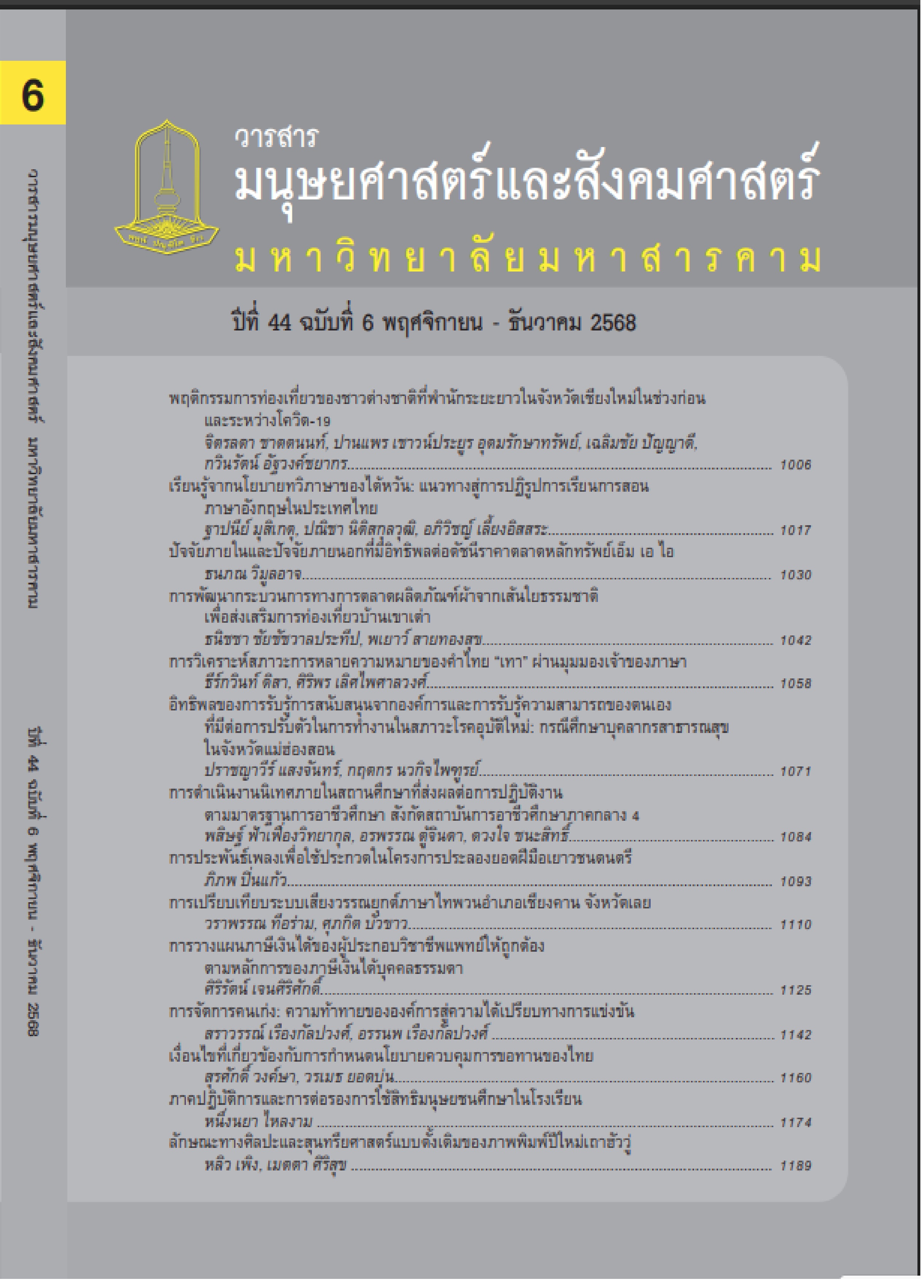
อิทธิพลของการรับรู้การสนับสนุนจากองค์การและการรับรู้ความสามารถของตนเองที่มีต่อการปรับตัวในการทำงานในสภาวะโรคอุบัติใหม่: กรณีศึกษาบุคลากรสาธารณสุขในจังหวัดแม่ฮ่องสอน
Article Sidebar
Main Article Content
บทคัดย่อ
การวิจัยนี้มีวัตถุประสงค์เพื่อศึกษา 1) ระดับการรับรู้การสนับสนุนจากองค์การ การรับรู้ความสามารถของตนเอง และการปรับตัวในการทำงานของบุคลากร 2) อิทธิพลของการรับรู้การสนับสนุนจากองค์การที่มีต่อการปรับตัวในการทำงานของบุคลากร และ 3) อิทธิพลของการรับรู้ความสามารถของตนเองที่มีต่อการปรับตัวในการทำงานของบุคลากร งานวิจัยนี้เป็นงานวิจัยเชิงปริมาณโดยใช้แบบสอบถามเป็นเครื่องมือในการเก็บรวบรวมข้อมูลจากกลุ่มตัวอย่าง คือ บุคลากรสาธารณสุขจังหวัดแม่ฮ่องสอน จำนวน 310 คน ซึ่งได้มาโดยการสุ่มตามความสะดวก สถิติที่ใช้ในการวิเคราะห์ข้อมูลได้แก่ ค่าเฉลี่ย ส่วนเบี่ยงเบนมาตรฐาน การวิเคราะห์สหสัมพันธ์ และการวิเคราะห์การถดถอยเชิงพหุคูณ ผลการศึกษาพบว่า 1) การรับรู้การสนับสนุนจากองค์การของบุคลากรโดยรวมอยู่ในระดับปานกลาง (x̅ = 3.40, SD = 0.77) ในขณะที่การรับรู้ความสามารถของตนเองของบุคลากรและการปรับตัวในการทำงานของบุคลากรโดยรวมอยู่ในระดับมาก (x̅ = 3.99, SD = 0.67; x̅ = 3.56, SD = 0.59) 2) การรับรู้การสนับสนุนจากองค์การส่งผลเชิงบวกต่อการปรับตัวในการทำงานของบุคลากร (B = 0.40, p < 0.01) และ 3) การรับรู้ความสามารถของตนเองส่งผลเชิงบวกต่อการปรับตัวในการทำงานของบุคลากร (B = 0.33, p < 0.01) ผลการศึกษานี้แสดงให้เห็นว่าองค์การควรให้การสนับสนุนบุคลากร โดยเฉพาะด้านผลตอบแทนและสวัสดิการ และการให้รางวัลและเงื่อนไขในการทำงาน รวมถึงการยกระดับการรับรู้ความสามารถของตนเองให้กับบุคลากรเพื่อช่วยให้บุคลากรสามารถปรับตัวในการทำงานในสภาวะโรคอุบัติใหม่ได้
Article Details
เอกสารอ้างอิง
กรรณิการ์ สุขเกษม และสุชาติ ประสิทธิ์รัฐสินธุ์. (2544). นานานวัตกรรมวิธีวิทยาการวิจัย. เฟื่องฟ้า.
คมกริช นันทะโรจพงศ์ และวิโรจน์ เจษฎาลักษณ์. (2561). อิทธิพลของบรรยากาศองค์การและการรับรู้การสนับสนุนจากองค์การที่ส่งผลต่อผลการปฏิบัติงานผ่านความสุขในการทํางานของบุคลากรในอุตสาหกรรมการผลิต. วารสารการจัดการ มหาวิทยาลัยวลัยลักษณ์, 7(1), 21-38.
ปาริชาติ เยพิทักษ์ และธีระวัฒน์ จันทึก. (2559). การรับรู้การสนับสนุนขององค์การและความพอใจในงานที่มีผลต่อความผาสุกขององค์การ. Veridian E-Journal, 9(1), 643-654.
อภิชาญา แท่งทองคำ และพวงเพชร์ วัชรอยู่. (2560). อิทธิพลระหว่างการรับรู้ความสามารถในตนเองและการรับรู้การสนับสนุนจากองค์การที่มีต่อการปรับตัวในการทำงานของเจ้าหน้าที่บริการลูกค้า บริษัท 1577 โฮมชอปปิ้ง จำกัด. วารสารมหาวิทยาลัยอีสเทิร์นเอเชีย ฉบับสังคมศาสตร์และมนุษยศาสตร์, 7(3), 289-300.
Arshadi, N. (2011). The relationships of perceived organizational support (POS) with organizational commitment, in-role performance, and turnover intention: Mediating role of felt obligation. Procedia-Social and Behavioral Sciences, 30, 1103-1108.
Bandura, A. (1977). Self-efficacy: Toward a unifying theory of behavioral change. Psychological Review, 84(2), 191-215.
Bhargava, S., & Pradhan, H. (2018). Moderating effect of situational factors on core self-evaluation and performance relationship. Global Business Review, 20(1), 238-252.
Caesens, G., Stinglhamber, F., Demoulin, S., De Wilde, M., & Mierop, A. (2019). Perceived organizational support and workplace conflict: The mediating role of failure-related trust. Frontiers in Psychology, 9, 2704.
Ciotti, M., Ciccozzi, M., Terrinoni, A., Jiang, W. C., Wang, C., & Bernardini, S. (2020). The COVID-19 pandemic. Critical Reviews in Clinical Laboratory Sciences, 57(6), 365-388.
Davies, S. E., Stoermer, S., & Froese, F. J. (2019). When the going gets tough: The influence of expatriate resilience and perceived organizational inclusion climate on work adjustment and turnover intentions. The International Journal of Human Resource Management, 30(8), 1393-1417.
Eisenberger, R., Huntington, R., Hutchison, S., & Sowa, D. (1986). Perceived organizational support. Journal of Applied Psychology, 71(3), 500–507.
Emrah, K. (2020). Relationships among self-efficacy, job resourcefulness and job performance of hotel cooks in Cappadocia. Journal of Multidisciplinary Academic Tourism, 5(1), 17-27.
Gates, L. B. (1993). The role of the supervisor in successful adjustment to work with a disabling condition: Issues for disability policy and practice. Journal of Occupational Rehabilitation, 3, 179–190.
Gosselin, J. T., & Maddux, J. E. (2003). Self-efficacy. In M. R. Leary & J. P. Tangney (Eds.), Handbook of self and identity (pp. 217-238). Guilford Press.
Hair, J., Black, W. C., Babin, B. J., & Anderson, R. E. (2010). Multivariate data analysis: A global perspective (7th ed.). Pearson.
Krejcie, R. V., & Morgan, D. W. (1970). Determining sample sizes for research activities. Educational and Psychological Measurement, 30(3), 607–610.
Lachman, M. E., Neupert, S. D., & Agrigoroaei, S. (2011). The relevance of control beliefs for health and aging. In K. W. Schaie & S. L. Willis (Eds.), Handbook of the psychology of aging (7th ed., pp. 175-190). Academic Press.
Liu, Y., & Aungsuroch, Y. (2019). Work stress, perceived social support, self-efficacy and burnout among Chinese registered nurses. Journal of Nursing Management, 27(7), 1445-1453.
Mao, J., Chiu, C., Owens, B. P., Brown, J. A., & Liao, J. (2018). Growing followers: Exploring the effects of leader humility on follower self-expansion, self-efficacy, and performance. Journal of Management Studies, 56(2), 343-371.
Mukherjee, S. (2017). Emerging infectious diseases: Epidemiological perspective. Indian Journal of Dermatology, 62(5), 459–467.
Na-Nan, K., Joungtrakul, J., & Dhienhirun, A. (2018). The influence of perceived organizational support and work adjustment on the employee performance of expatriate teachers in Thailand. Modern Applied Science, 12(3), 105-116.
Na-Nan, K., Saribut, S., & Ekkasit, S. (2019). Mediating effects of perceived environment support and knowledge sharing between self-efficacy and job performance of SME employees. Industrial and Commercial Training, 51(6), 342-359.
Nowrouzi-Kia, B., Sithamparanathan, G., Nadesar, N., Gohar, B., & Ott, M. (2022). Factors associated with work performance and mental health of healthcare workers during pandemics: A systematic review and meta-analysis. Journal of Public Health, 44(4), 731–739.
Pappa, S., Ntella, V., Giannakas, T., Giannakoulis, V. G., Papoutsi, E., & Katsaounou, P. (2020). Prevalence of depression, anxiety, and insomnia among healthcare workers during the COVID-19 pandemic: A systematic review and meta-analysis. Brain, Behavior, and Immunity, 88, 901–907. https://doi.org/10.1016/j.bbi.2020.05.026
Rhoades, L., & Eisenberger, R. (2002). Perceived organizational support: A review of the literature. Journal of Applied Psychology, 87(4), 698–714.
Rhoades, L., Eisenberger, R., & Armeli, S. (2001). Affective commitment to the organization: The contribution of perceived organizational support. Journal of Applied Psychology, 86(5), 825–836. https://doi.org/10.1037/0021-9010.86.5.825
Savickas, M. L., & Porfeli, E. J. (2012). Career Adapt-Abilities Scale: Construction, reliability, and measurement equivalence across 13 countries. Journal of Vocational Behavior, 80(3), 661-673.
Senen, M. (2018). The influence of self-efficacy on satisfaction and work-related performance. International Journal of Management Science and Business Administration, 4(4), 43-47.
Takeuchi, R., Wang, M., Marinova, S. V., & Yao, X. (2009). Role of domainspecific facets of perceived organizational support during expatriation and implications for performance. Organization Science, 20(3), 621–634.
Wongsuwan, N., & Na-Nan, K. (2022). Mediating effects of self-efficacy, resilience and job satisfaction on the relationship between person–organisation fit and employee work adjustment. Sustainability, 14(18), 11787.
World Health Organization. (2021). สิทธิ หน้าที่ และความรับผิดชอบของบุคลากรทางการแพทย์และสาธารณสุข และสิ่งสำคัญที่ควรพิจารณาด้านอาชีวอนามัยและความปลอดภัยในการทำงาน ในช่วงที่มีการระบาดของโรคติดเชื้อไวรัสโคโรนา 2019 (COVID-19).
World Health Organization. (2022). Situation by region, country, territory & area. https://covid19.who.int
Wu, P. E., Styra, S., & Gold, L. W. (2020). Mitigating the psychological effects of COVID-19 on health care workers. Canadian Medical Association Journal, 192(17), E459-E460.
