
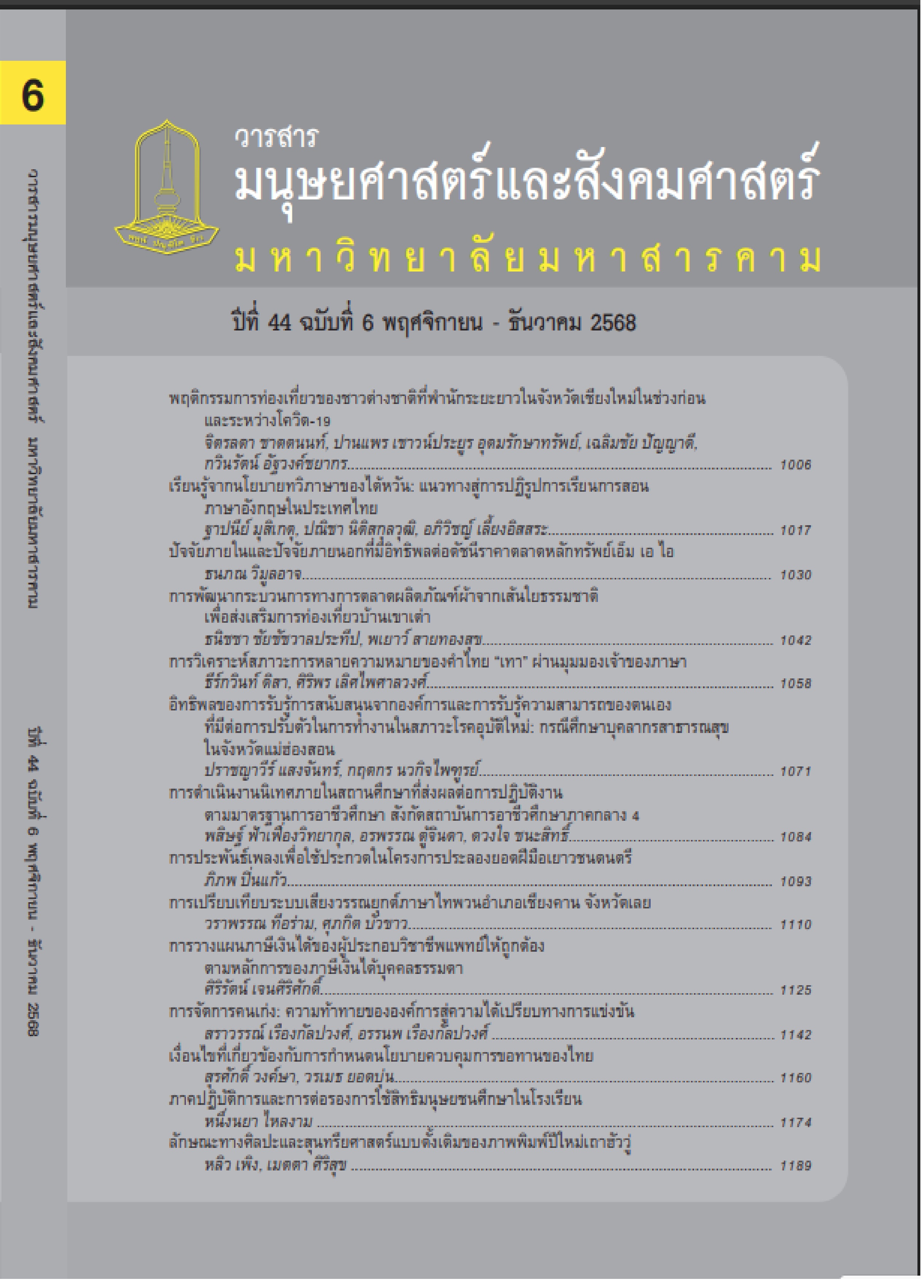
อิทธิพลของการรับรู้การสนับสนุนจากองค์การและการรับรู้ความสามารถของตนเองที่มีต่อการปรับตัวในการทำงานในสภาวะโรคอุบัติใหม่: กรณีศึกษาบุคลากรสาธารณสุขในจังหวัดแม่ฮ่องสอน
Article Sidebar
Main Article Content
Abstract
The objectives of this research are: 1) to study the levels of perceived organizational support, self-efficacy, and work adjustment among public health employees; 2) to examine the influence of perceived organizational support on work adjustment; and 3) to examine the influence of self-efficacy on work adjustment. This quantitative research used a questionnaire as a data collection tool with a sample of 310 public health employees in Mae Hong Son Province. The statistics used for data analysis included mean, standard deviation, correlation analysis, and multiple regression analysis. The results showed that 1) perceived organizational support was at a moderate level, while self-efficacy and work adjustment were at high levels; 2) perceived organizational support had a positive effect on work adjustment; and 3) self-efficacy had a positive effect on work adjustment. The practical implication of this study is that organizations should support their employees, particularly in terms of compensation and benefits, and rewards and working conditions, as well as improving employee self-efficacy to enhance work adjustment.
Article Details
References
กรรณิการ์ สุขเกษม และสุชาติ ประสิทธิ์รัฐสินธุ์. (2544). นานานวัตกรรมวิธีวิทยาการวิจัย. เฟื่องฟ้า.
คมกริช นันทะโรจพงศ์ และวิโรจน์ เจษฎาลักษณ์. (2561). อิทธิพลของบรรยากาศองค์การและการรับรู้การสนับสนุนจากองค์การที่ส่งผลต่อผลการปฏิบัติงานผ่านความสุขในการทํางานของบุคลากรในอุตสาหกรรมการผลิต. วารสารการจัดการ มหาวิทยาลัยวลัยลักษณ์, 7(1), 21-38.
ปาริชาติ เยพิทักษ์ และธีระวัฒน์ จันทึก. (2559). การรับรู้การสนับสนุนขององค์การและความพอใจในงานที่มีผลต่อความผาสุกขององค์การ. Veridian E-Journal, 9(1), 643-654.
อภิชาญา แท่งทองคำ และพวงเพชร์ วัชรอยู่. (2560). อิทธิพลระหว่างการรับรู้ความสามารถในตนเองและการรับรู้การสนับสนุนจากองค์การที่มีต่อการปรับตัวในการทำงานของเจ้าหน้าที่บริการลูกค้า บริษัท 1577 โฮมชอปปิ้ง จำกัด. วารสารมหาวิทยาลัยอีสเทิร์นเอเชีย ฉบับสังคมศาสตร์และมนุษยศาสตร์, 7(3), 289-300.
Arshadi, N. (2011). The relationships of perceived organizational support (POS) with organizational commitment, in-role performance, and turnover intention: Mediating role of felt obligation. Procedia-Social and Behavioral Sciences, 30, 1103-1108.
Bandura, A. (1977). Self-efficacy: Toward a unifying theory of behavioral change. Psychological Review, 84(2), 191-215.
Bhargava, S., & Pradhan, H. (2018). Moderating effect of situational factors on core self-evaluation and performance relationship. Global Business Review, 20(1), 238-252.
Caesens, G., Stinglhamber, F., Demoulin, S., De Wilde, M., & Mierop, A. (2019). Perceived organizational support and workplace conflict: The mediating role of failure-related trust. Frontiers in Psychology, 9, 2704.
Ciotti, M., Ciccozzi, M., Terrinoni, A., Jiang, W. C., Wang, C., & Bernardini, S. (2020). The COVID-19 pandemic. Critical Reviews in Clinical Laboratory Sciences, 57(6), 365-388.
Davies, S. E., Stoermer, S., & Froese, F. J. (2019). When the going gets tough: The influence of expatriate resilience and perceived organizational inclusion climate on work adjustment and turnover intentions. The International Journal of Human Resource Management, 30(8), 1393-1417.
Eisenberger, R., Huntington, R., Hutchison, S., & Sowa, D. (1986). Perceived organizational support. Journal of Applied Psychology, 71(3), 500–507.
Emrah, K. (2020). Relationships among self-efficacy, job resourcefulness and job performance of hotel cooks in Cappadocia. Journal of Multidisciplinary Academic Tourism, 5(1), 17-27.
Gates, L. B. (1993). The role of the supervisor in successful adjustment to work with a disabling condition: Issues for disability policy and practice. Journal of Occupational Rehabilitation, 3, 179–190.
Gosselin, J. T., & Maddux, J. E. (2003). Self-efficacy. In M. R. Leary & J. P. Tangney (Eds.), Handbook of self and identity (pp. 217-238). Guilford Press.
Hair, J., Black, W. C., Babin, B. J., & Anderson, R. E. (2010). Multivariate data analysis: A global perspective (7th ed.). Pearson.
Krejcie, R. V., & Morgan, D. W. (1970). Determining sample sizes for research activities. Educational and Psychological Measurement, 30(3), 607–610.
Lachman, M. E., Neupert, S. D., & Agrigoroaei, S. (2011). The relevance of control beliefs for health and aging. In K. W. Schaie & S. L. Willis (Eds.), Handbook of the psychology of aging (7th ed., pp. 175-190). Academic Press.
Liu, Y., & Aungsuroch, Y. (2019). Work stress, perceived social support, self-efficacy and burnout among Chinese registered nurses. Journal of Nursing Management, 27(7), 1445-1453.
Mao, J., Chiu, C., Owens, B. P., Brown, J. A., & Liao, J. (2018). Growing followers: Exploring the effects of leader humility on follower self-expansion, self-efficacy, and performance. Journal of Management Studies, 56(2), 343-371.
Mukherjee, S. (2017). Emerging infectious diseases: Epidemiological perspective. Indian Journal of Dermatology, 62(5), 459–467.
Na-Nan, K., Joungtrakul, J., & Dhienhirun, A. (2018). The influence of perceived organizational support and work adjustment on the employee performance of expatriate teachers in Thailand. Modern Applied Science, 12(3), 105-116.
Na-Nan, K., Saribut, S., & Ekkasit, S. (2019). Mediating effects of perceived environment support and knowledge sharing between self-efficacy and job performance of SME employees. Industrial and Commercial Training, 51(6), 342-359.
Nowrouzi-Kia, B., Sithamparanathan, G., Nadesar, N., Gohar, B., & Ott, M. (2022). Factors associated with work performance and mental health of healthcare workers during pandemics: A systematic review and meta-analysis. Journal of Public Health, 44(4), 731–739.
Pappa, S., Ntella, V., Giannakas, T., Giannakoulis, V. G., Papoutsi, E., & Katsaounou, P. (2020). Prevalence of depression, anxiety, and insomnia among healthcare workers during the COVID-19 pandemic: A systematic review and meta-analysis. Brain, Behavior, and Immunity, 88, 901–907. https://doi.org/10.1016/j.bbi.2020.05.026
Rhoades, L., & Eisenberger, R. (2002). Perceived organizational support: A review of the literature. Journal of Applied Psychology, 87(4), 698–714.
Rhoades, L., Eisenberger, R., & Armeli, S. (2001). Affective commitment to the organization: The contribution of perceived organizational support. Journal of Applied Psychology, 86(5), 825–836. https://doi.org/10.1037/0021-9010.86.5.825
Savickas, M. L., & Porfeli, E. J. (2012). Career Adapt-Abilities Scale: Construction, reliability, and measurement equivalence across 13 countries. Journal of Vocational Behavior, 80(3), 661-673.
Senen, M. (2018). The influence of self-efficacy on satisfaction and work-related performance. International Journal of Management Science and Business Administration, 4(4), 43-47.
Takeuchi, R., Wang, M., Marinova, S. V., & Yao, X. (2009). Role of domainspecific facets of perceived organizational support during expatriation and implications for performance. Organization Science, 20(3), 621–634.
Wongsuwan, N., & Na-Nan, K. (2022). Mediating effects of self-efficacy, resilience and job satisfaction on the relationship between person–organisation fit and employee work adjustment. Sustainability, 14(18), 11787.
World Health Organization. (2021). สิทธิ หน้าที่ และความรับผิดชอบของบุคลากรทางการแพทย์และสาธารณสุข และสิ่งสำคัญที่ควรพิจารณาด้านอาชีวอนามัยและความปลอดภัยในการทำงาน ในช่วงที่มีการระบาดของโรคติดเชื้อไวรัสโคโรนา 2019 (COVID-19).
World Health Organization. (2022). Situation by region, country, territory & area. https://covid19.who.int
Wu, P. E., Styra, S., & Gold, L. W. (2020). Mitigating the psychological effects of COVID-19 on health care workers. Canadian Medical Association Journal, 192(17), E459-E460.
