
Development of Learning Innovation Thinking book by Using Design Thinking Process to Enhance Critical Thinking and Constructive Communication of Elementary School Student in Chiangmai Education Sandbox
Article Sidebar
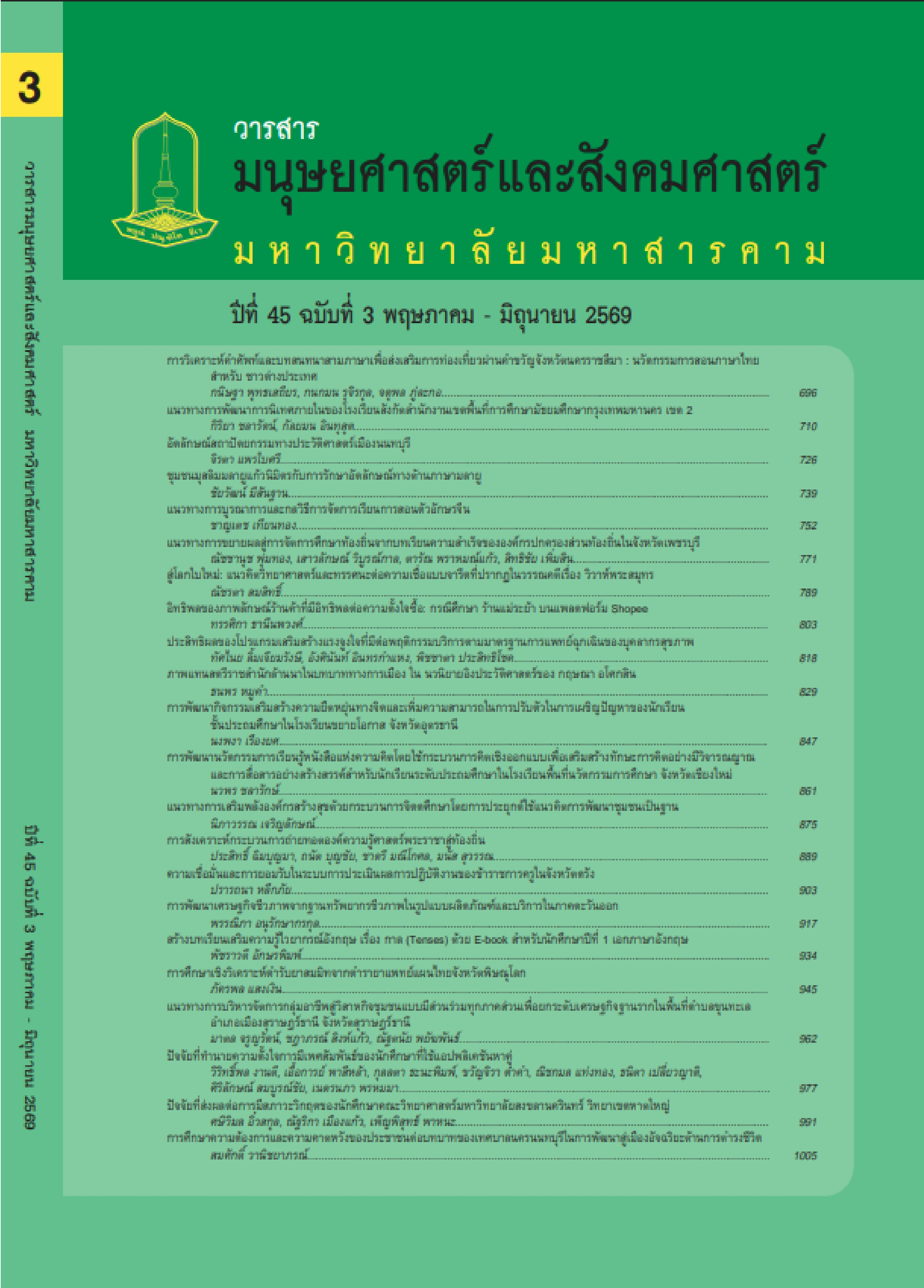
Main Article Content
Abstract
<ABSTRACT
This research aims to develop and examine the effects of Learning Innovation Thinking book by Using Design Thinking Process to Enhance Critical Thinking and Constructive Communication of Elementary School Student in Chiangmai Education Sandbox. The research was conducted in four phases: (1) studying and analyzing key information, (2) designing the "Thinking Book" learning innovation, with a target group of seven experts selected through purposive sampling. The research instrument used was a quality assessment form, and data were analyzed using mean and standard deviation. (3) Implementing the "Thinking Book" learning innovation with a sample of 40 sixth-grade students in the 2024 academic year from the school of Chiangmai Education Sandbox in Fang District, Chiang Mai, selected through cluster sampling. Data were collected both before and after the implementation using critical thinking and creative communication assessment tools. Data analysis involved calculating the mean, standard deviation, and t-test statistics. (4) Evaluating the effectiveness of the innovation by comparing students' critical thinking and creative communication scores before and after the intervention at a significance level of .05.
Research Findings
- The developed "Thinking Book" learning innovation consists of seven key components: (1) principles of the innovation, (2) purpose of the innovation, (3) 8 learning units, including "Welcome to Chiang Mai," "Chiang Mai Story," "Paradise of Chiang Mai," "Chiang Mai Cuisine," "Garment of Chiang Mai," "Unseen Heritage," "Memories of Chiang Mai," and "Modern Chiang Mai," (4) a six-step learning activities comprising analyze the story, interpret the question, Brainstorm, discuss in small groups, find conclusion & make decision, and present to a large-group, (5) learning materials, (6) roles of learners and instructors, and (7) assessment and evaluation. Overall, the accuracy and appropriateness are at the highest level with average scores of 4.52 and 4.62, respectively.
- The implementation results indicated that students demonstrated significantly higher levels of critical thinking and creative communication skills after participating in the learning activities, with statistical significance at the .05 level.
Article Details
References
จักรพงศ์ กันกล่ำ และ จักรพงษ์ แพทย์หลักฟ้า. (2566). การพัฒนารูปแบบการจัดการเรียนการสอนตามแนวการสอนแบบ
โครงงานและกระบวนการคิดเชิงออกแบบเพื่อส่งเสริมความคิดสร้างสรรค์. วารสารวิชาการศึกษาศาสตร์
ศรีนครินทรวิโรฒ. 24(2) : 84-98.
จารุภา นวลเพ็ง และ สิรินภา กิจเกื้อกูล. (2566). การจัดการเรียนรู้โดยใช้สถานการณ์เป็นฐานที่ส่งเสริมการคิดเชิงระบบ
เรื่องระบบนิเวศของนักเรียนชั้นมัธยมศึกษาปีที่ 3. วารสารวมนุษยศาสตร์และสังคมศาสตร์ มหาวิทยาลัยมหาสารคาม. 43(3) : 367-398.
เชษฐชาตรี นวลขำ และ ยศวีร์ สายฟ้า. (2563). ผลการใช้ชุดกิจกรรมการใช้สื่อสังคมออนไลน์ตามแนวคิดปรากฏการณ์เป็นฐาน ร่วมกับการสะท้อนคิดที่มีต่อพฤติกรรมการรู้ดิจิทัลของนักเรียนระดับประถมศึกษา. วารสารศิลปากรศึกษาศาสตร์วิจัย มหาวิทยาลัยศิลปากร. 12(2) : 71-89.
ณัฐภัทร แสงมาลา, ธเนศ เจริญทรัพย์, สุวิทย์ เอื้อศักดิ์ชัย และ วิภารัตน์ มูสิกะเจริญ. (2567). กระแสของการคิด
อย่างมีวิจารณญาณ. Journal of Roi Kaensarn Academi. 9(4) : 838-853.
ณัฐธยาน์ แวงอุบล. (2566). การคิดโดยใช้วิจารณญาณ: ทักษะจำเป็นศตวรรษที่ 21. Journal of Applied Education, 2023. 1(2) : 53-66.
ทรัพสิริ เสนีย์วงศ์ ณ อยุธยา และคณะ. (2564). การจัดการเรียนการสอนจากประสบการณ์ตามสภาพจริงตามรูปแบบกิจกรรมประสบการณ์. วารสารธรรมศาสตร์. 40(2) : 116-129.
ทักษยา วัชรสารทรัพย์. (2566). สื่อและการสูญเสียความหมายของความจริงในยุคหลังความจริง: รายการเล่าข่าวในสื่อโทรทัศน์. วารสารมหาจุฬานาครทรรศน์. 10(2) : 313-325.
ทิศนา แขมมณี. (2561). ศาสตร์การสอน: องค์ความรู้เพื่อการจัดกระบวนการเรียนรู้ที่มีประสิทธิภาพ. (พิมพ์ครั้งที่ 22). กรุงเทพฯ : สำนักพิมพ์แห่งจุฬาลงกรณ์มหาวิทยาลัย.
ปัญจรัศม์ ศุภรานนท์. (2566). อนาคตภาพการจัดการศึกษาโรงเรียนประถมศึกษาขนาดเล็กในทศวรรษหน้า
(พ.ศ.2566 - 2575) วารสารวิชาการศึกษาศาสตร์ ศรีนครินทรวิโรฒ. 24(2) : 115-130.
ผ่องนภา พรหมเกษ. (2566). ปัจจัยที่ส่งผลต่อการคิดอย่างมีวิจารณญาณของอาจารย์ที่มีต่อนักศึกษา.
วารสารมหาจุฬานาครทรรศน์. 10(4) : 409-425.
มานิตย์ อาษานอก. (2561). การพัฒนาและหาประสิทธิภาพ ประสิทธิผลนวัตกรรม สำหรับการเรียนรู้ด้วยตนเอง.
วารสารเทคโนโลยีและสื่อสารการศึกษา คณะศึกษาศาสตร์ มหาวิทยาลัยมหาสารคาม. 1(2) : 9-18
รวิพรรณ จารุทวี. (2563). ปัจจัยที่เกี่ยวข้องกับการสื่อสารอย่างสร้างสรรค์ในสื่อสังคมออนไลน์ของนักศึกษาระดับอุดมศึกษาในเขตกรุงเทพมหานคร. ปริญญานิพนธ์ศิลปศาสตรมหาบัณฑิต สาขาวิชาจิตวิทยาพัฒนาการ คณะมนุษยศาสตร์. บัณฑิตวิทยาลัย มหาวิทยาลัยศรีนครินทรวิโรฒ.
วันชัย น้อยวงค์. (2565). การจัดการเรียนรู้เพื่อส่งเสริมทักษะการคิดอย่างมีวิจารณญาณและการแก้ปัญหา
ของผู้เรียนในศตวรรษที่ 21. วารสารวิจัยเพื่อการปฏิรูปการเรียนรู้. สถาบันวิจัย พัฒนา และสาธิตการศึกษา มหาวิทยาลัยศรีนครินทรวิโรฒ. 5(2) : 54-69.
สกุลการ สังข์ทอง. (2562). การพัฒนารูปแบบการจัดการเรียนรู้แบบ MECCA เพื่อเสริมสร้างความสามารถในการอ่านอย่างมีวิจารณญาณ สำหรับนักเรียนชั้นมัธยมศึกษาตอนปลาย. (ปรัชญาดุษฎีบัณฑิต, ภาควิชาหลักสูตรและวิธีสอน มหาวิทยาลัยศิลปากร).
สมเกียรติ อินทสิงห์. (2562). การพัฒนารูปแบบการจัดการเรียนรู้โดยบูรณาการแนวคิดการเรียนรู้โดยปรากฏการณ์เป็น
ฐานและกระบวนการคิดเชิงออกแบบเพื่อส่งเสริมความรู้เรื่องหลักสูตร ความสามารถในการคิดเชิงนวัตกรรม
และแรงจูงใจใฝ่สัมฤทธิ์ สำหรับนักศึกษาวิชาชีพครู. ASEAN Journal of Education. 5(2) : 21-32.
สำนักงานเลขาธิการสภาการศึกษา. (2562). แนวทางการพัฒนาสมรรถนะผู้เรียนระดับการศึกษาขั้นพื้นฐาน. นนทบุรี: 21 เซ็นจูรี่.
สำนักงานเลขาธิการสภาการศึกษา. (2563). การจัดการเรียนรู้ฐานสมรรถนะเชิงรุก. นนทบุรี: 21 เซ็นจูรี่.
อนงค์นาถ ทนันชัย. (2563). การใช้เทคนิคการจัดการเรียนรู้เชิงรุกเพื่อพัฒนาทักษะการนำเสนอของนักศึกษาในรายวิชาการนำเสนอผลงานทางธุรกิจ. วารสารวิชาการ คณะมนุษยศาสตร์และสังคมศาสตร์ มหาวิทยาลัยราชภัฏนครสวรรค์. 7(1) : 48-68.
Joyce, B., Weil, M., & Calhoun, E. (2009). Models of teaching. (8th ed.). New York: Courtesy of Reece Galleries.
