ประสิทธิผลของระบบการแพทย์ทางไกลต่อการควบคุมความดันโลหิต: การศึกษาเปรียบเทียบย้อนหลังในโรงพยาบาลพิมาย
Article Sidebar
Main Article Content
บทคัดย่อ
บทคัดย่อ
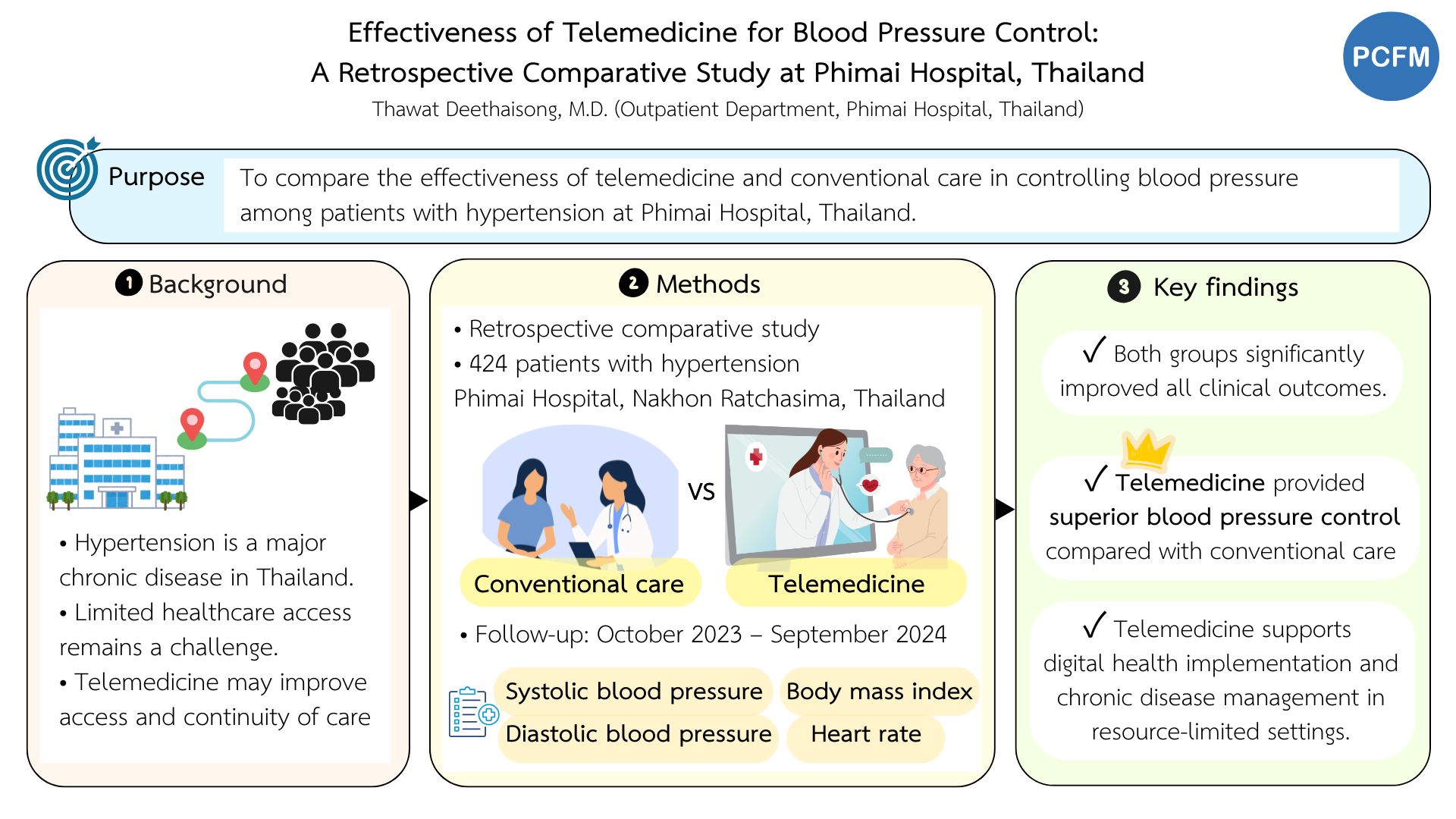
ที่มา: โรคความดันโลหิตสูงเป็นปัญหาสุขภาพเรื้อรังที่สำคัญของประเทศไทย โดยเฉพาะในพื้นที่ที่มีข้อจำกัดในการเข้าถึงบริการทางการแพทย์ การพัฒนาระบบการแพทย์ทางไกลเป็นทางเลือกที่มีความน่าสนใจเนื่องจากช่วยเพิ่มการเข้าถึงบริการและลดภาระของระบบสุขภาพ การศึกษานี้มีวัตถุประสงค์เพื่อเปรียบเทียบประสิทธิผลของระบบการแพทย์ทางไกลกับการดูแลผู้ป่วยตามระบบปกติในการควบคุมโรคความดันโลหิตสูงในโรงพยาบาลพิมาย จังหวัดนครราชสีมา
แบบวิจัย: การศึกแบบวิจัยแบบย้อนหลัง
วัสดุและวิธีการ: วิเคราะห์ข้อมูลเวชระเบียนของผู้ป่วยโรคความดันโลหิตสูง 424 ราย ระหว่างเดือนตุลาคม พ.ศ. 2566 ถึงกันยายน พ.ศ. 2567 เปรียบเทียบผลการตรวจติดตาม ได้แก่ ความดันโลหิต ดัชนีมวลกาย และอัตราการเต้นหัวใจ โดยใช้สถิติ Mann-Whitney U test และ Wilcoxon Signed-Rank Test
ผลการศึกษา: ค่าการตรวจติดตามของทั้งสองกลุ่มลดลงอย่างมีนัยสำคัญทางสถิติ โดยเฉพาะผลการตรวจติดตามครั้งที่สอง ซึ่งสะท้อนประสิทธิผลของการติดตามอย่างสม่ำเสมอ อีกทั้ง การเปรียบเทียบระหว่างกลุ่มพบว่าความดันโลหิตขณะหัวใจบีบและคลายตัวในกลุ่มการแพทย์ทางไกลลดลงมากกว่ากลุ่มตรวจติดตามระบบปกติอย่างมีนัยสำคัญทางสถิติ
สรุป: ผลการตรวจติดตามสะท้อนถึงศักยภาพของการแพทย์ทางไกลในการควบคุมความดันโลหิต และสอดคล้องกับนโยบายระดับประเทศที่มุ่งสนับสนุนการใช้ระบบสุขภาพดิจิทัล ทั้งนี้ ควรพิจารณาปัจจัยด้านสังคม เศรษฐกิจ และพฤติกรรมสุขภาพควบคู่ไปด้วย เพื่อให้การประยุกต์ใช้การแพทย์ทางไกลมีความยั่งยืนและเกิดผลลัพธ์ในระยะยาว
คำสำคัญ: ความดันโลหิตสูง ระบบการแพทย์ทางไกล ประสิทธิผลทางคลินิก
Downloads
Article Details

อนุญาตภายใต้เงื่อนไข Creative Commons Attribution-NonCommercial-NoDerivatives 4.0 International License.
เนื้อหาและข้อมูลในบทความที่ลงตีพิมพ์ในวารสาร PCFM ถือเป็นข้อคิดเห็นและความรับผิดชอบของผู้เขียนบทความโดยตรง ซึ่งกองบรรณาธิการวารสารไม่จำเป็นต้องเห็นด้วยหรือร่วมรับผิดชอบใด ๆ
บทความ ข้อมูล เนื้อหา รูปภาพ ฯลฯ ที่ได้รับการตีพิมพ์ลงในวารสาร PCFM ถือเป็นลิขสิทธิ์ของวารสาร PCFM หากบุคคลหรือหน่วยงานใดต้องการนำทั้งหมดหรือส่วนหนึ่งส่วนใดไปเผยแพร่ต่อหรือเพื่อกระทำการใด ๆ จะต้องได้รับอนุญาตเป็นลายลักษณ์อักษรจากวารสาร PCFM ก่อนเท่านั้น
เอกสารอ้างอิง
World Health Organization. Global report on hypertension: the race against a silent killer. Geneva: World Health Organization; 2023.
Hoffer-Hawlik M, Moran A, Zerihun L, Usseglio J, Cohn J, Gupta R. Telemedicine interventions for hypertension management in low- and middle-income countries: a scoping review. PLoS One. 2021;16(7):e0254222. PubMed PMID: 34242327
Muiruri C, Manavalan P, Jazowski SA, Knettel BA, Vilme H, Zullig LL. Opportunities to leverage telehealth approaches along the hypertension control cascade in sub-Saharan Africa. Curr Hypertens Rep. 2019;21(10):75. PubMed PMID: 31451940
Department of Disease Control. Annual report 2023: Non-communicable diseases division. Bangkok: Aksorn Graphic and Design; 2023.
Drake C, Lewinski AA, Rader A, Schexnayder J, Bosworth HB, Goldstein KM, et al. Addressing hypertension outcomes using telehealth and population health managers: adaptations and implementation considerations. Curr Hypertens Rep. 2022;24:267-84.
Yatabe J, Yatabe MS, Okada R, Ichihara A. Efficacy of telemedicine in hypertension care through home blood pressure monitoring and videoconferencing: randomized controlled trial. JMIR Cardio. 2021;5(2):e27347. PubMed PMID: 34321194
Zhu L, Li D, Jiang XL, Jia Y, Liu Y, Li F, et al. Effects of telemedicine interventions on essential hypertension: a protocol for a systematic review and meta-analysis. BMJ Open. 2022;12(9):e060376. PubMed PMID: 36175096
Pattanathong J. Development of telemedicine service model, Prachuap Khiri Khan Province. J Health Sci Thailand. 2024;33:452-64.
Omboni S. Telemedicine for hypertension management: a paradigm shift from telemonitoring to digital therapeutics. Expert Rev Med Devices. 2023; 20:711-4.
Sudnongbua R. A comparison efficacy of telemedicine platform and Conventional algorithm in patients with diabetes mellitus for control blood sugar in Mahachanachai Hospital Yasotorn Hospital. Acad J Community Public Health. 2024;10:200-10.
Nakhon Ratchasima Provincial Public Health Office. Annual report 2023. Nakhon Ratchasima: Provincial Public Health Office; 2023.
Yamane T. Statistics: an introductory analysis. London: John Weatherhill; 1973.
Chaiyarit K. Effectiveness of telemedicine monitoring on patients with type 2 diabetes during and after the COVID-19 pandemic. Community Health Dev Q Khon Kaen Univ. 2023;11:295-309.
Dermkhuntod N, Kwancharoen R, Chuantantikamol C, Paholpak P, Suraamornkul S. Effects of telehealth monitoring on glycemic control and medication adherence in patients with poorly controlled type 2 diabetes. Vajira Med J. 2021;65(Suppl):S75–90.
Tangwanapri T, Leelaphaibun J. Efficacy of telemedicine on blood pressure control among patients with hypertension during COVID-19 pandemic: a retrospective cohort study. J Prim Care Fam Med. 2023;6:316-27.
Klinphaka P, Prongprasert J, Intharakasem S. “Specialized Internal Medicine Outpatient Clinic” Development of a telemedicine system for hypertensive patients: Outpatient Department of Internal Medicine, Yasothon Hospital. Nurs Health Educ J. 2025; 8:13-24.
Busayarasamee B. Development of care model for diabetes or hypertensive patients in the new era, Ampur Mueang, Nakhon Pathom. Region 4-5 Med J. 2023;42:63-77.
Promrat S, Kapol P, Kapol N. Effects of a program to promote medication adherence using telepharmacy in patients with hypertension. Thai Bull Pharm Sci. 2022;17:31-41.
Strategy and Planning Division (SPD), Ministry of Public Health and the Health Intervention Technology Assessment Program (HITAP). 2023 progress update and 2024 action plan for convergence of digital health platforms and health information systems (HIS) implementation in Thailand (ConvergeDH) under WHO-RTG country cooperation strategy (2022-2026). 2024.
Purisri A. Digital health: the future model of detection and the benefits of behaviour change conversations to improve hypertension via telemedicine. EAU Heritage J Sci Technol. 2023;17:1-18.
Meetham N. Effectiveness of blood pressure control using home sphygmomanometer in patients with hypertension. J Health Sci Thailand. 2018;27:452-9.
