ประสิทธิผลการใช้ระบบติดตามทางไกลในการดูแลผู้ป่วยที่บ้านเพื่อควบคุมระดับน้ำตาลในเลือดของผู้ป่วยโรคเบาหวานชนิดที่ 2 ที่คุมไม่ได้ : การศึกษาแบบ non-randomized historical controlled trial
Article Sidebar
Main Article Content
บทคัดย่อ
บทคัดย่อ
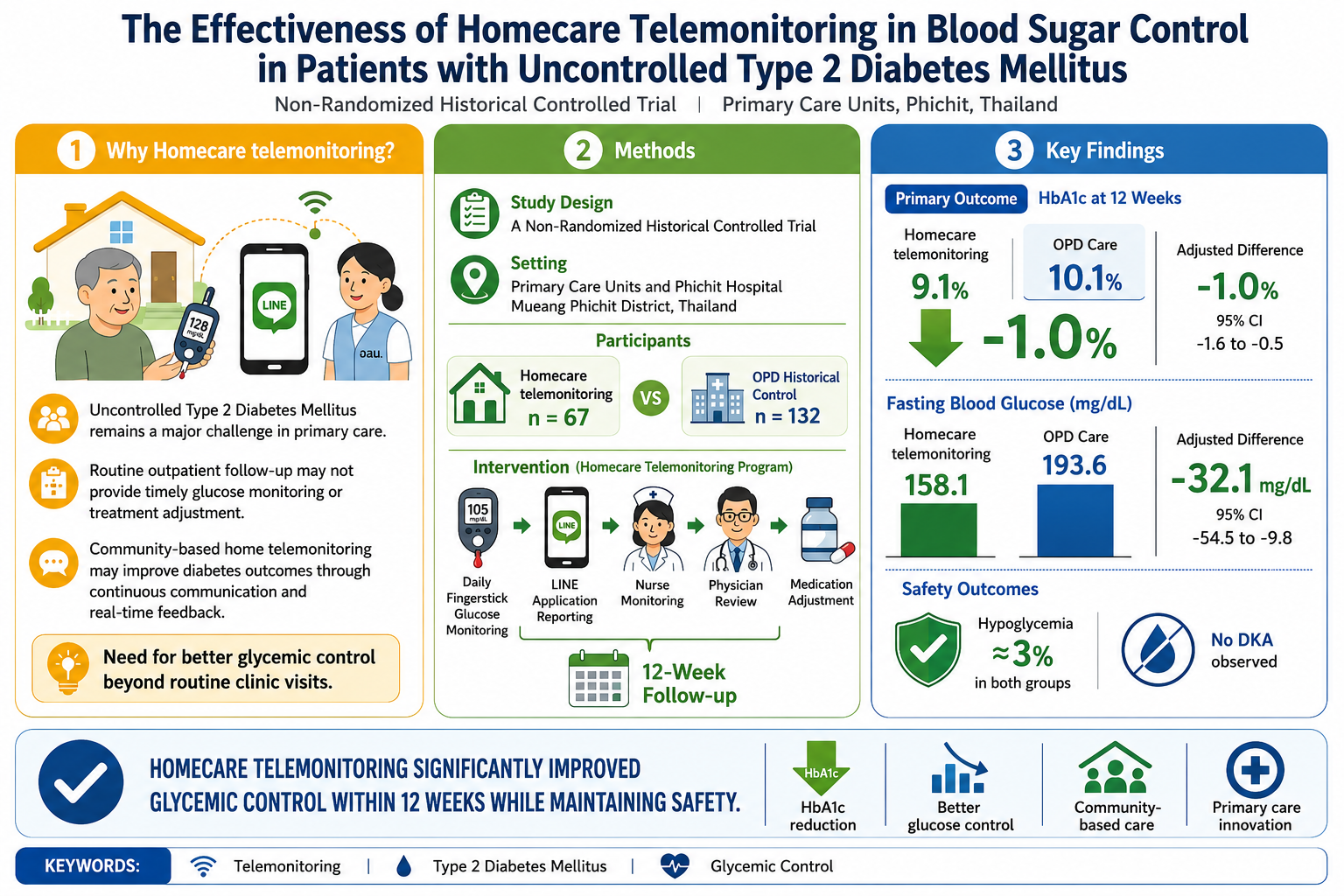
ที่มา: โรคเบาหวานชนิดที่ 2 ที่คุมไม่ได้เป็นปัญหาสำคัญของระบบสาธารณสุข ระบบ homecare telemonitoring เป็นแนวทางการรักษาที่ผสานการมีส่วนร่วมของชุมชน โดยให้อาสาสมัครสาธารณสุขประจำหมู่บ้าน (อสม.) เจาะน้ำตาลปลายนิ้วผู้ป่วยและส่งผลผ่านแอปพลิเคชัน LINE ให้ทีมสหวิชาชีพประเมินและให้คำแนะนำแบบเรียลไทม์ งานวิจัยนี้มีวัตถุประสงค์เพื่อศึกษาประสิทธิผลของ homecare telemonitoring โดยเปรียบเทียบค่าเฉลี่ยระดับน้ำตาลเฉลี่ยสะสมในเลือด (HbA1c) ที่ 12 สัปดาห์ กับการรักษาแบบผู้ป่วยนอก (OPD)
แบบวิจัย: non-randomized historical controlled trial
วัสดุและวิธีการ: ศึกษาในผู้ป่วยเบาหวานชนิดที่ 2 ที่คุมไม่ได้ ณ โรงพยาบาลพิจิตรและหน่วยบริการปฐมภูมิ อำเภอเมืองพิจิตร กลุ่มศึกษาเป็นผู้ป่วยที่รักษาแบบ homecare telemonitoring ระหว่างมกราคม–มิถุนายน พ.ศ. 2568 จำนวน 67 ราย กลุ่มควบคุมเป็นผู้ป่วยที่รักษาแบบผู้ป่วยนอก โดยเก็บข้อมูลย้อนหลังในปี 2566 จำนวน 132 ราย วิเคราะห์ข้อมูลด้วยสถิติ multivariable Gaussian regression โดยปรับปัจจัยกวน ได้แก่ อายุ เพศ ดัชนีมวลกาย ระยะเวลาการเป็นเบาหวาน โรคร่วม วิธีการใช้ยา และระดับน้ำตาลก่อนเริ่มต้น
ผลการศึกษา: กลุ่ม homecare telemonitoring มีค่าเฉลี่ยระดับน้ำตาลเฉลี่ยสะสมในเลือด ที่ 12 สัปดาห์ต่ำกว่ากลุ่มผู้ป่วยนอก อย่างมีนัยสำคัญ (9.1 ± 1.7% เทียบกับ 10.1 ± 2.0%, adjusted mean difference = -1.0%, 95% CI: -1.6 ถึง -0.5) เช่นเดียวกับค่าเฉลี่ยระดับน้ำตาลขณะอดอาหาร (158.1 ± 56.0 มก./ดล. เทียบกับ 193.6 ± 81.0 มก./ดล., adjusted mean difference = -32.1 มก./ดล., 95% CI: -54.5 ถึง -9.8)
สรุป: Homecare telemonitoring มีประสิทธิผลดีกว่าการรักษาแบบผู้ป่วยนอก ในการควบคุมระดับน้ำตาลในผู้ป่วยเบาหวานชนิดที่ 2 ที่คุมไม่ได้ จึงเป็นแนวทางที่ควรพิจารณาใช้ในการดูแลผู้ป่วยในชุมชน
คำสำคัญ: โรคเบาหวานชนิดที่ 2 การควบคุมระดับน้ำตาล ระบบการแพทย์ทางไกล
Downloads
Article Details

อนุญาตภายใต้เงื่อนไข Creative Commons Attribution-NonCommercial-NoDerivatives 4.0 International License.
เนื้อหาและข้อมูลในบทความที่ลงตีพิมพ์ในวารสาร PCFM ถือเป็นข้อคิดเห็นและความรับผิดชอบของผู้เขียนบทความโดยตรง ซึ่งกองบรรณาธิการวารสารไม่จำเป็นต้องเห็นด้วยหรือร่วมรับผิดชอบใด ๆ
บทความ ข้อมูล เนื้อหา รูปภาพ ฯลฯ ที่ได้รับการตีพิมพ์ลงในวารสาร PCFM ถือเป็นลิขสิทธิ์ของวารสาร PCFM หากบุคคลหรือหน่วยงานใดต้องการนำทั้งหมดหรือส่วนหนึ่งส่วนใดไปเผยแพร่ต่อหรือเพื่อกระทำการใด ๆ จะต้องได้รับอนุญาตเป็นลายลักษณ์อักษรจากวารสาร PCFM ก่อนเท่านั้น
เอกสารอ้างอิง
International Diabetes Federation. IDF Diabetes Atlas [Internet]. Brussels: International Diabetes Federation; 2021 [cited 2024 Jan 15]. Available from: https://diabetesatlas.org
กองโรคไม่ติดต่อ กรมควบคุมโรค. สถานการณ์โรคเบาหวานในประเทศไทย [อินเทอร์เน็ต]. นนทบุรี: กรมควบคุมโรค; 2564 [เข้าถึงเมื่อ 15 ธ.ค. 2566]. เข้าถึงได้จาก: https://ddc.moph.go.th/brc/news.php?news = 21692&deptcode = brc
วิชัย เอกพลากร, หทัยชนก พรรคเจริญ, วราภรณ์ เสถียรนพเก้า. การสำรวจสุขภาพประชาชนไทยโดยการตรวจร่างกาย ครั้งที่ 6 พ.ศ. 2562–2563. กรุงเทพฯ: สำนักพิมพ์อักษรกราฟฟิคแอนด์ดีไซน์; 2564.
สมาคมโรคเบาหวานแห่งประเทศไทย ในพระบรมราชูปถัมภ์สมเด็จพระเทพรัตนราชสุดาฯ สยามบรมราชกุมารี. แนวทางเวชปฏิบัติสำหรับโรคเบาหวาน พ.ศ. 2566. กรุงเทพฯ: ศรีเมืองการพิมพ์; 2566.
Jing X, Chen J, Dong Y, Han D, Zhao H, Wang X, et al. Related factors of quality of life of type 2 diabetes patients: a systematic review and meta-analysis. Health Qual Life Outcomes. 2018;16:189. PubMed PMID: 30231882
Phrommintikul A, Dilokthornsakul P, Permsuwan U. Economic burdens for treatment of patients with type 2 diabetes in North Thailand: a hospital-based observational study. Front Endocrinol (Lausanne). 2022;13:824545. PubMed PMID: 35651974
วีระศักดิ์ ศรินนภากรม, เปี่ยมลาภ แสงสายัณห์, มนต์ชัย ศิรบำรุงวงศ์, วิบูลย์ ภัณฑบดีกรณ์, ธัญเดช นิมมานวุฒิพงษ์, วิทูร ชินสว่างวัฒนกุล, และคณะ. แนวทางและมาตรฐานการดูแลผู้ป่วยในที่บ้าน (Home ward) [อินเทอร์เน็ต]. กรุงเทพฯ: กรมการแพทย์ กระทรวงสาธารณสุข; 2565 [เข้าถึงเมื่อ 20 ม.ค. 2566]. เข้าถึงได้จาก: https://www.dms.go.th/backend/Content/Content_File/Publication/Attach/25650805113031AM_homeward.pdf
Ghosh A, Gupta R, Misra A. Telemedicine for diabetes care in India during COVID-19 pandemic and national lockdown period: guidelines for physicians. Diabetes Metab Syndr. 2020;14:273-6.
Health Data Center, Ministry of Public Health. Percentage of diabetes patients with good glycemic control [Internet]. Bangkok: Ministry of Public Health; 2024 [cited 2024 Jan 10]. Available from: https://hdc.moph.go.th/center/public/standard-report-detail/137a726340e4dfde7bbbc5d8aeee3ac3
Saetang T. The efficacy of tele-monitoring and structured feedback loop in people with insulin-treated type 2 diabetes mellitus with suboptimal control [Master’S thesis]. Bangkok: Chulalongkorn University; 2022.
Lee JY, Chan CKY, Chua SS, Ng CJ, Paraidathathu T, Lee KKC, et al. Telemonitoring and team-based management of glycemic control in people with type 2 diabetes: a cluster-randomized controlled trial. J Gen Intern Med. 2020;35:87-94.
Jamsopon K. Effectiveness of the mobile health care service for type 2 diabetes patients during COVID-19 pandemic of primary care cluster in Kang-an community, Prasat District, Surin Province. PCFM. 2020;3:21-34.
Han CY, Zhang J, Ye XM, Lu JP, Jin HY, Xu WW, et al. Telemedicine-assisted structured self-monitoring of blood glucose in management of type 2 diabetes mellitus: results of a randomized clinical trial. BMC Med Inform Decis Mak. 2023;23:182. PubMed PMID: 37710226
National Glycohemoglobin Standardization Program. Factors that interfere with HbA1c test results [Internet]. NGSP; 2023 [cited 2024 Jan 15]. Available from: https://ngsp.org/factors.asp
Cai J, Xu H, Jiang S, Sung J, Sawhney R, Broadley S, et al. Effectiveness of telemonitoring intervention on glycaemic control in patients with type 2 diabetes mellitus: a systematic review and meta-analysis. Diabetes Res Clin Pract. 2023;201:110727. PubMed PMID: 37217016
Wild SH, Hanley J, Lewis SC, McKnight JA, McCloughan LB, Padfield PL, et al. Supported telemonitoring and glycemic control in people with type 2 diabetes: the Telescot Diabetes pragmatic multicenter randomized controlled trial. PLoS Med. 2016;13(7):e1002098. PubMed PMID: 27458809
Han J, Chen S, Wu S, Liu Y, Zhao H, Yuan J. Effectiveness of telehealth services for diabetes management in improving glycemic control and patient self-management: a systematic review and meta-analysis. J Telemed Telecare. 2023;29:135-47.
Lee CS, Tyagi S, Koh EYL, Gong PP, Ang SB, Koh CHG, Tan NC. Health outcomes of telemonitoring of patients with type 2 diabetes mellitus: one-year results from a randomized controlled trial. J Telemed Telecare. 2025;31:1249-59.
Hangaard S, Laursen HVB, Andersen JH, Andersen TO, Nørgaard K, Nielsen JS, et al. The Diabetes TeleMonitoring of patients in insulin therapy (DiaMonT) trial: effect of telemonitoring in patients with type 2 diabetes on insulin therapy. Trials. 2022;23:985. PubMed PMID: 36476605
Sacks DB, Arnold M, Bakris GL, Bruns DE, Horvath AR, Kirkman MS, et al. Guidelines and recommendations for laboratory analysis in the diagnosis and management of diabetes mellitus. Clin Chem. 2011;57:e1-47. PubMed PMID: 21617152
