TG/HDL-C ratio กับความเสี่่ยงสมองตีบในผู้ป่วยความดันสูง
Article Sidebar
Main Article Content
บทคัดย่อ
บทคัดย่อ
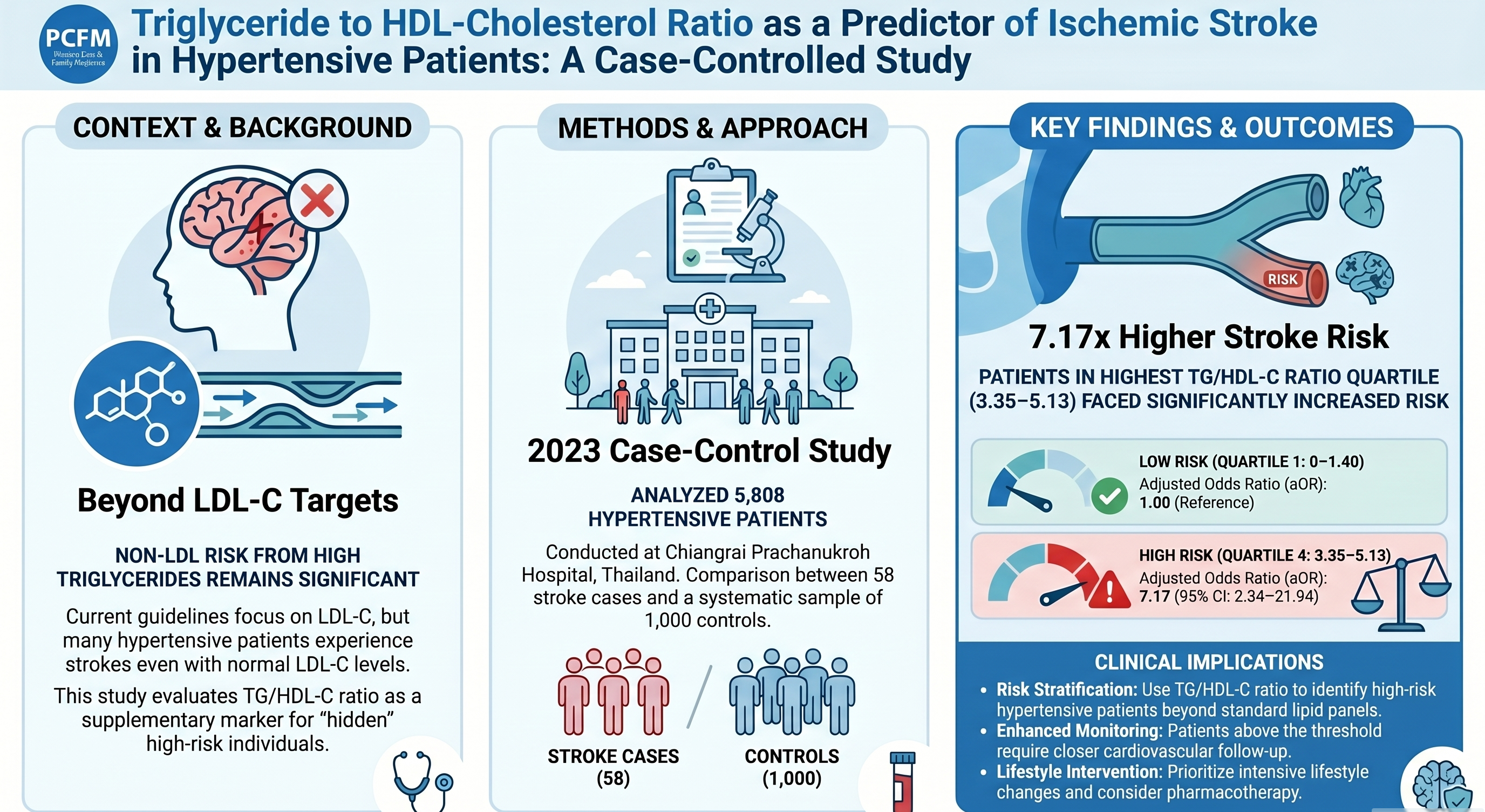
ที่มา: การควบคุมระดับ low-density lipoprotein cholesterol (LDL-C) เป็นเป้าหมายหลักในการลดความเสี่ยงโรคหลอดเลือดสมองตีบในผู้ป่วยความดันโลหิตสูง แต่ในปัจจุบันก็ยังคงพบผู้ป่วยโรคหลอดเลือดสมองตีบจำนวนหนึ่ง ที่มีระดับ LDL-C อยู่ในเกณฑ์ปกติ จึงมีการศึกษาค้นหาปัจจัยเสี่ยงด้านไขมันอื่น ๆ ที่อาจส่งผลต่อการเกิดโรค และพบว่าการศึกษาในปัจจุบันได้มุ่งเน้นไปที่ความสัมพันธ์ระหว่าง triglyceride to high-density lipoprotein cholesterol (HDL-C) ratio กับการเกิดโรคในหลอดเลือด ซึ่งผู้ที่มี triglyceride สูง และ HDL ต่ำ มีความเสี่ยงในการเกิดโรคหัวใจและหลอดเลือดเพิ่มขึ้น การศึกษานี้มีวัตถุประสงค์เพื่อศึกษาความสัมพันธ์ระหว่าง triglyceride to HDL ratio กับการเกิดโรคหลอดเลือดสมองตีบ ในผู้ป่วยความดันโลหิตสูง ที่มารับบริการที่โรงพยาบาลเชียงรายประชานุเคราะห์
วัสดุและวิธีการ: ศึกษาแบบย้อนหลังแบบ case-control study ในผู้ป่วยโรคความดันโลหิตสูง ระหว่างวันที่ 1 มกราคม พ.ศ. 2566 ถึง 31 ธันวาคม พ.ศ. 2566 ที่มารับบริการที่หน่วยบริการปฐมภูมิ โรงพยาบาลเชียงรายประชานุเคราะห์ โดยเกณฑ์คัดเข้า คือ ผู้ป่วยโรคความดันโลหิตสูง และทำการคัดออก ผู้ป่วยที่ประวัติโรคหลอดเลือดหัวใจตีบและโรคหลอดเลือดสมองตีบ ก่อนวันที่ 1 มกราคม พ.ศ. 2566 และได้รับการวินิจฉัยว่าเป็นโรคหลอดเลือดสมองอุดตันจากลิ่มเลือด กลุ่มตัวอย่าง 5,808 คน สุ่มมาเป็นกลุ่มควบคุม control จำนวน 1,000 คน ใช้วิธีการสุ่มอย่างเป็นระบบ และกลุ่ม case จำนวน 58 คน โดยกลุ่ม control ใช้ผลการเจาะเลือดประจำปีย้อนหลัง 3 ปี และสำหรับกลุ่ม case ได้ใช้ผลการตรวจเลือดที่บันทึกไว้ในวันที่มีการวินิจฉัยโรคหลอดเลือดสมองตีบ วิเคราะห์ข้อมูลโดยใช้สถิติ logistic regression เพื่อเปรียบเทียบระหว่างผู้ที่เป็นและไม่เป็นโรคหลอดเลือดสมองตีบ
ผลการศึกษา: มีผู้ป่วยโรคหลอดเลือดสมองตีบ จำนวน 58 คน (ร้อยละ 5.8) เมื่อนำค่า triglyceride-HDL ratio ของกลุ่ม control มาแบ่งเป็น 4 ส่วน พบว่าผู้ที่มี triglyceride-HDL ratio ในกลุ่มสูงสุด คือ quartile 4 (3.35-5.13) มี adjusted odd ratio (OR) = 7.17, 95%CI: 2.34-21.94 (p = 0.001) เมื่อเทียบกับกลุ่มที่มีค่าต่ำสุด คือ quartile 1 (0-1.40)
สรุป: ค่า triglyceride-HDL ratio มากกว่า 3.35 เป็นช่วงที่มีความสัมพันธ์กับโอกาสการเกิดโรคหลอดเลือดสมองตีบอย่างมีนัยสำคัญทางสถิติ อาจเป็นปัจจัยเสริมที่นำมาพิจารณาร่วมกับปัจจัยเสี่ยงอื่น ๆ ในการระบุกลุ่มผู้ป่วยความดันโลหิตสูงที่มีความเสี่ยงสูง และควรได้รับการจัดการปัจจัยเสี่ยงอื่น ๆ อย่างเข้มงวดเป็นพิเศษ เพื่อป้องกันการเกิดโรคหลอดเลือดสมองตีบในอนาคต อย่างไรก็ตามควรมีการศึกษายืนยันเพิ่มเติมในอนาคต เพื่อติดตามกลุ่มที่มี triglyceride-HDL ratio สูงในช่วงข้างต้น ซึ่งจะช่วยยืนยันความเป็นเหตุเป็นผลได้อย่างแท้จริง
คำสำคัญ: อัตราส่วนไตรกลีเซอไรด์ต่อเอชดีแอลคอเลสเตอรอล โรคหลอดเลือดสมองตีบ โรคหัวใจและหลอดเลือด
Downloads
Article Details

อนุญาตภายใต้เงื่อนไข Creative Commons Attribution-NonCommercial-NoDerivatives 4.0 International License.
เนื้อหาและข้อมูลในบทความที่ลงตีพิมพ์ในวารสาร PCFM ถือเป็นข้อคิดเห็นและความรับผิดชอบของผู้เขียนบทความโดยตรง ซึ่งกองบรรณาธิการวารสารไม่จำเป็นต้องเห็นด้วยหรือร่วมรับผิดชอบใด ๆ
บทความ ข้อมูล เนื้อหา รูปภาพ ฯลฯ ที่ได้รับการตีพิมพ์ลงในวารสาร PCFM ถือเป็นลิขสิทธิ์ของวารสาร PCFM หากบุคคลหรือหน่วยงานใดต้องการนำทั้งหมดหรือส่วนหนึ่งส่วนใดไปเผยแพร่ต่อหรือเพื่อกระทำการใด ๆ จะต้องได้รับอนุญาตเป็นลายลักษณ์อักษรจากวารสาร PCFM ก่อนเท่านั้น
เอกสารอ้างอิง
EClinicalMedicine. The rising global burden of stroke [Editorial]. EClinicalMedicine. 2023;59:102028. doi: 10.1016/j.eclinm.2023.102028. PMID: 37256100.
สมศักดิ์ เทียมเก่า. อุบัติการณ์โรคหลอดเลือดสมองประเทศ ไทย. วารสารประสาทวิทยาแห่งประเทศไทย. 2565;39:39-46.
รุ่งโรจน์ กฤตยพงษ์, สุรพันธ์ สิทธิสุข, สุรจิต สุนทรธรรม, วรรณี นิธิยานันท์, วีรพันธุ์ โขวิฑูรกิจ, ประวีณ โล่ห์เลขา, และคณะ. แนวทางเวชปฏิบัติการใช้ยารักษาภาวะไขมันผิดปกติเพื่อป้องกันโรคหัวใจและหลอดเลือด พ.ศ. 2567. กรุงเทพฯ: สำนักพิมพ์กรุงเทพเวชสาร; 2567.
American Heart Association/American College of Cardiology. 2018 Guideline on the Management of Blood Cholesterol. J Am Coll Cardiol. 2019;73:e285-e350.
Mach F, Baigent C, Catapano AL, Koskinas KC, Casula M, Badimon L et al. 2019 ESC/EAS Guidelines for the management of dyslipidaemias. Eur Heart J. 2020;41:111-88.
Ding PF, Zhang HS, Wang J, Gao YY, Mao JN, Hang CH, et al. Insulin resistance in ischemic stroke: Mechanisms and therapeutic approaches. Front Endocrinol (Lausanne). 2022;13:1092431. PubMed PMID: 36589857
Simonson DC. Insulin resistance and diabetes in chronic renal disease. In: Wilcox CS, editor. Textbook of nephro-endocrinology. United States of America: Academic Press; 2009. p. 383-409.
Lee JS, Chang Y, Kim Y, Yun KE, Cho J, Guallar E, et al. Triglyceride and HDL-C dyslipidemia and risks of coronary heart disease and ischemic stroke by glycemic dysregulation status: The Strong Heart Study. Diabetes Care. 2017;40:529-37.
Sullivan KM, Dean A, Soe MM. OpenEpi: Open Source Epidemiologic Statistics for Public Health, Version 3. Sample Size for Match/Unmatched Case-Control Studies [Internet]. 2013 [cited 2024 Aug 2]. Available from: https://www.openepi.com/SampleSize/SSCC.htm
Da Luz PL, Favarato D, Faria-Neto JR Jr, Lemos P, Chagas AC. High ratio of triglycerides to HDL-cholesterol predicts extensive coronary disease. Clinics. 2008;63:427-32.
Salazar MR, Espeche WG, Balbín E, Garcia Aurrecoechea S, Marillet AG, Leiva Sisnieguez CE, et al. Use of the plasma triglyceride/HDL ratio to identify cardiovascular disease in hypertensive subjects. J Am Soc Hypertens. 2014;8:724-31.
Che B, Zhong C, Zhang Y, Zhou X, Wang A, Zhao X, et al. Triglyceride-glucose index and TG/HDL ratio as potential CVD risk factors. Cardiovasc Diabetol. 2023;22:34-40.
World Health Organization. The Asia-Pacific perspective: redefining obesity and its treatment. Sydney: Health Communications Australia; 2000.
International Diabetes Federation. The IDF consensus worldwide definition of the metabolic syndrome [Internet]. 2006 [cited 2024 May 20]. Available from: https://www.idf.org/
Thai Hypertension Society. 2019 Thai Guidelines on the Treatment of Hypertension. Bangkok: Trick Series; 2019.
Thai Medical Services Department. Clinical Practice Guideline for Diabetes 2023. Bangkok: Sri-Muang Printing; 2023.
Thai Atherosclerosis Society. Clinical Practice Guidelines on Pharmacologic Therapy of Dyslipidemia for Cardiovascular Disease Prevention 2016. Bangkok: Thai Atherosclerosis Society; 2016.
Park B, Jung D, Lee HS, Lee YJ. Triglyceride to HDL-cholesterol ratio and the incident risk of ischemic heart disease among Koreans without diabetes: a longitudinal study using national health insurance data. Front Cardiovasc Med. 2021;8:716698. PubMed PMID: 34490378
Sato F, Nakamura Y, Kayaba K, Ishikawa S. TG/HDL-C ratio as a predictor of stroke in the population with healthy BMI. Nutr Metab Cardiovasc Dis 2022;32:1872-9.
Zhang S, Cao C, Han Y, Hu H, Zheng X. A nonlinear relationship between the triglycerides to high-density lipoprotein cholesterol ratio and stroke risk. Diabetol Metab Syndr. 2024;16:96-108.
