
ความชุกและปัจจัยที่สัมพันธ์กับการไม่รายงานปัญหากลั้นปัสสาวะไม่อยู่ ในผู้ป่วยหญิงโรคเบาหวานชนิดที่ 2
Article Sidebar
Main Article Content
บทคัดย่อ
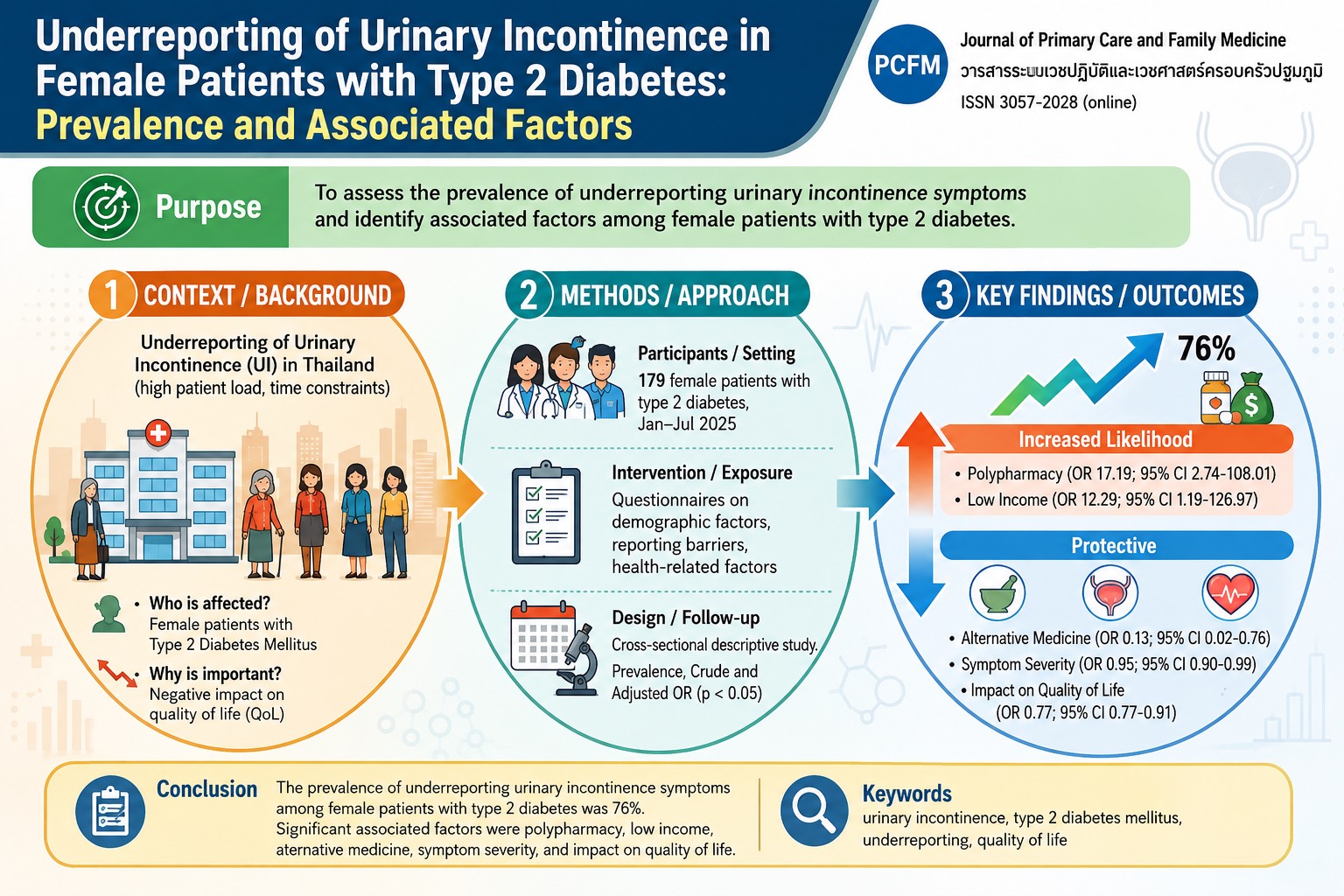
ที่มา: ภาวะกลั้นปัสสาวะไม่อยู่เป็นภาวะแทรกซ้อนที่พบได้บ่อยในผู้ป่วยหญิงโรคเบาหวาน ส่งผลกระทบต่อคุณภาพชีวิต แต่ภาวะดังกล่าวมักไม่ได้รับการรายงาน โดยเฉพาะในบริบทบริการสุขภาพของประเทศไทยที่มีผู้ป่วยโรคไม่ติดต่อเรื้อรังจำนวนมาก และมีข้อจำกัดด้านเวลาในการตรวจรักษา อาจทำให้การรายงานอาการไม่ครอบคลุม การศึกษานี้มีวัตถุประสงค์เพื่อประเมินความชุกของการไม่รายงานอาการและปัจจัยที่เกี่ยวข้อง
แบบวิจัย: การวิจัยเชิงพรรณนาแบบภาคตัดขวาง
วัสดุและวิธีการ: ศึกษาในผู้ป่วยหญิงโรคเบาหวานชนิดที่ 2 ที่มีภาวะกลั้นปัสสาวะไม่อยู่ จำนวน 179 ราย ระหว่างเดือนมกราคม -กรกฎาคม พ.ศ. 2568 เก็บข้อมูลโดยแบบสอบถามครอบคลุมปัจจัยเชิงประชากร ปัจจัยอุปสรรคต่อการรายงาน และปัจจัยด้านสุขภาพ ประเมินด้วยแบบสอบถาม UDI-6 และ IIQ-7 ฉบับภาษาไทย รายงานผลเป็น crude OR, adjusted OR กำหนดระดับนัยสำคัญทางสถิติที่ p < 0.05
ผลการศึกษา: ความชุกของการไม่รายงานอาการ เท่ากับร้อยละ 76.0 ปัจจัยเพิ่มโอกาสไม่รายงานอาการ ได้แก่ การใช้ยาหลายชนิด (OR 17.19; 95% CI 2.74-108.01) รายได้ต่ำ (OR 12.29; 95% CI 1.19-126.97) ขณะที่ปัจจัยลดโอกาสการไม่รายงาน ได้แก่ การรักษาโดยแพทย์ทางเลือก (OR 0.13; 95% CI 0.02-0.76) ความรุนแรงของอาการ (OR 0.95; 95% CI 0.90-0.99) ผลกระทบต่อคุณภาพชีวิต (OR 0.77; 95% CI 0.77-0.91)
สรุป: ความชุกของการไม่รายงานอาการกลั้นปัสสาวะไม่อยู่ในผู้ป่วยหญิงโรคเบาหวานชนิดที่ 2 เท่ากับร้อยละ 76 ปัจจัยที่สัมพันธ์ อย่างมีนัยสำคัญ ได้แก่ การใช้ยาหลายชนิด รายได้ต่ำ การรักษาโดยแพทย์ทางเลือก ความรุนแรงและผลกระทบต่อคุณภาพชีวิต
คำสำคัญ: ภาวะกลั้นปัสสาวะไม่อยู่ เบาหวานชนิดที่ 2 การไม่รายงานอาการ คุณภาพชีวิต
Downloads
Article Details

อนุญาตภายใต้เงื่อนไข Creative Commons Attribution-NonCommercial-NoDerivatives 4.0 International License.
เนื้อหาและข้อมูลในบทความที่ลงตีพิมพ์ในวารสาร PCFM ถือเป็นข้อคิดเห็นและความรับผิดชอบของผู้เขียนบทความโดยตรง ซึ่งกองบรรณาธิการวารสารไม่จำเป็นต้องเห็นด้วยหรือร่วมรับผิดชอบใด ๆ
บทความ ข้อมูล เนื้อหา รูปภาพ ฯลฯ ที่ได้รับการตีพิมพ์ลงในวารสาร PCFM ถือเป็นลิขสิทธิ์ของวารสาร PCFM หากบุคคลหรือหน่วยงานใดต้องการนำทั้งหมดหรือส่วนหนึ่งส่วนใดไปเผยแพร่ต่อหรือเพื่อกระทำการใด ๆ จะต้องได้รับอนุญาตเป็นลายลักษณ์อักษรจากวารสาร PCFM ก่อนเท่านั้น
เอกสารอ้างอิง
Haylen BT, de Ridder D, Freeman RM, Swift SE, Berghmans B, Lee J, et al. An International Urogynecological Association (IUGA)/International Continence Society (ICS) joint report on the terminology for female pelvic floor dysfunction. Int Urogynecol J. 2010;21:5-26.
Markland AD, Richter HE, Fwu CW, Eggers P, Kusek JW. Prevalence and trends of urinary incontinence in adults in the United States, 2001 to 2008. J Urol. 2011;186:589-93.
World Health Organization. Evidence profile: urinary incontinence – Integrated care for older people (ICOPE) [Internet]. Geneva: World Health Organization; 2017 [cited 2025 Aug 7]. Available from: https://www.who.int/publications/i/item/WHO-MCA-17.06.08
International Diabetes Federation. IDF Diabetes Atlas -10th edition [Internet]. 2021 [cited 2024 Aug 31]. Available from: www.diabetesatlas.org.
Nathan DM. Long-term complications of diabetes mellitus. N Engl J Med. 1993;328:1676-85.
Phelan S, Kanaya AM, Subak LL, Hogan PE, Espeland MA, Wing RR, et al. Prevalence and risk factors for urinary incontinence in overweight and obese diabetic women: Action for Health in Diabetes (Look AHEAD) study. Diabetes Care. 2009;32:1391-7.
Bani-issa W, Fakhry R, Al Momani F. Urinary incontinence in Emirati women with diabetes mellitus type 2: prevalence, risk factors and impact on life. J Clin Nurs. 2013;22:3084-94.
Danforth KN, Townsend MK, Curhan GC, Resnick NM, Grodstein F. Type 2 diabetes mellitus and risk of stress, urge and mixed urinary incontinence. J Urol. 2009;181:193-7.
Izci Y, Topsever P, Filiz TM, Cinar ND, Uludağ C, Lagro-Janssen T. The association between diabetes mellitus and urinary incontinence in adult women. Int Urogynecol J Pelvic Floor Dysfunct. 2009;20: 947-52.
Jiang C, Xu M, Zhang L, Yang C, Liang C. Quality of life, disease recognition and care-seeking intention in women with urinary incontinence: an observational study in China. Int J Clin Exp Med. 2016;9:4380-7.
Schreiber Pedersen L, Lose G, Høybye MT, Jürgensen M, Waldmann A, Rudnicki M. Predictors and reasons for help-seeking behavior among women with urinary incontinence. Int Urogynecol J. 2018;29:521-30.
Rashidi Fakari F, Hajian S, Darvish S, Alavi Majd H. Predictors of help-seeking behaviors in women with urinary incontinence: based on Iranian women’s lens. PLoS One. 2023;18:e0289785. PubMed PMID: 37540696
Sullivan R, McNicholas T, Claffey P, Kenny RA, Briggs R. Unreported urinary incontinence: population-based prevalence and factors associated with non-reporting of symptoms in community-dwelling people ≥50 years. Eur Geriatr Med. 2021;12:405-12.
Asemota O, Eldemire-Shearer D, Waldron NK, Standard-Goldson A. Prevalence of self-reported urinary incontinence in community-dwelling older adults of Westmoreland, Jamaica. MEDICC Rev. 2016;18:41-7.
Weerasopone S, Santingamkul A. Validation of the Thai version of the Incontinence Impact Questionnaire (IIQ-7) and the Urogenital Distress Inventory (UDI-6). Chulalongkorn Med J. 2023;60:397-39.
World Health O. Age-friendly PHC centres toolkit. Geneva: World Health Organization; 2008.
Skorupska K, Grzybowska ME, Kubik-Komar A, Rechberger T, Miotla P. Identification of the Urogenital Distress Inventory-6 and the Incontinence Impact Questionnaire-7 cutoff scores in urinary incontinent women. Health Qual Life Outcomes. 2021;19:87. PubMed PMID: 33726776
Peduzzi P, Concato J, Kemper E, Holford TR, Feinstein AR. A simulation study of the number of events per variable in logistic regression analysis. J Clin Epidemiol. 1996;49:1373-9.
Jiang C, Xu M, Zhang L, Yang C, Liang C. Quality of life, disease recognition and care-seeking intention in women with urinary incontinence: An observational study in China. Int J Environ Res Public health. 2016;9:4380-7.
Gasquet I, Tcherny-Lessenot S, Gaudebout P, Bosio Le Goux B, Klein P, Haab F. Influence of the severity of stress urinary incontinence on quality of life, health care seeking, and treatment: A national cross-sectional survey. Eur Urol. 2006;50:818-25.
Duralde ER, Walter LC, Van Den Eeden SK, Nakagawa S, Subak LL, Brown JS, et al. Bridging the gap: determinants of undiagnosed or untreated urinary incontinence in women. Am J Obstet Gynecol. 2016;214:266.e1-7.
Rizk DEE, Shaheen H, Thomas L, Dunn E, Hassan MY. The prevalence and determinants of health care-seeking behavior for urinary incontinence in United Arab Emirates women. Int Urogynecol J. 1999;10:160-5.
Li M, Wang H, Ko W-K, Kwong S-K. Factors associated with health-seeking for urinary incontinence in Hong Kong Chinese women: a cross-sectional study. Int Urogynecol J. 2024;35:95-101.
24. Baah-Nyarkoh E, Alhassan Y, Dwomoh AK, Kretchy IA. Medicated-related burden and adherence in patients with co-morbid type 2 diabetes mellitus and hypertension. Heliyon. 2023;9(4):e15448. doi:10.1016/j.heliyon.2023.e15448..
National Statistical Office, Ministry of Digital Economy and Society. Full report: household economic and social survey 2023 [Internet]. Bangkok: NSO; 2023 [cited 2025 Sep 2]. Available from: https://catalog.nso.go.th/
Astin JA. Why patients use alternative medicine: results of a national study. JAMA. 1998;279:1548-53.
Frawley J, Sibbritt D, Steel A, Chang S, Adams J. Complementary and conventional health-care utilization among young Australian women with urinary incontinence. Urology. 2017;99:92-9.
Wallner LP, Porten S, Meenan RT, O’Keefe Rosetti MC, Calhoun EA, Sarma AV, et al. Prevalence and severity of undiagnosed urinary incontinence in women. Am J Med. 2009;122:1037-42.
Rosenstock IM. The health belief model and preventive health behavior. Health Educ Monogr. 1974;2:354-86.
Hägglund D, Walker-Engström ML, Larsson G, Leppert J. Quality of life and seeking help in women with urinary incontinence. Acta Obstet Gynecol Scand. 2001;80:1051-5.
Minassian VA, Yan X, Lichtenfeld MJ, Sun H, Stewart WF. Predictors of care seeking in women with urinary incontinence. Neurourol Urodyn. 2012;31:470-4.
