
การศึกษาย้อนหลังเรื่องประสิทธิผลของการจัดบริการและติดตามผ่านระบบการแพทย์ทางไกลในผู้ป่วยโรคไม่ติดต่อเรื้อรัง ในหน่วยบริการปฐมภูมิ โรงพยาบาลราชบุรี
Article Sidebar
Main Article Content
บทคัดย่อ
บทคัดย่อ
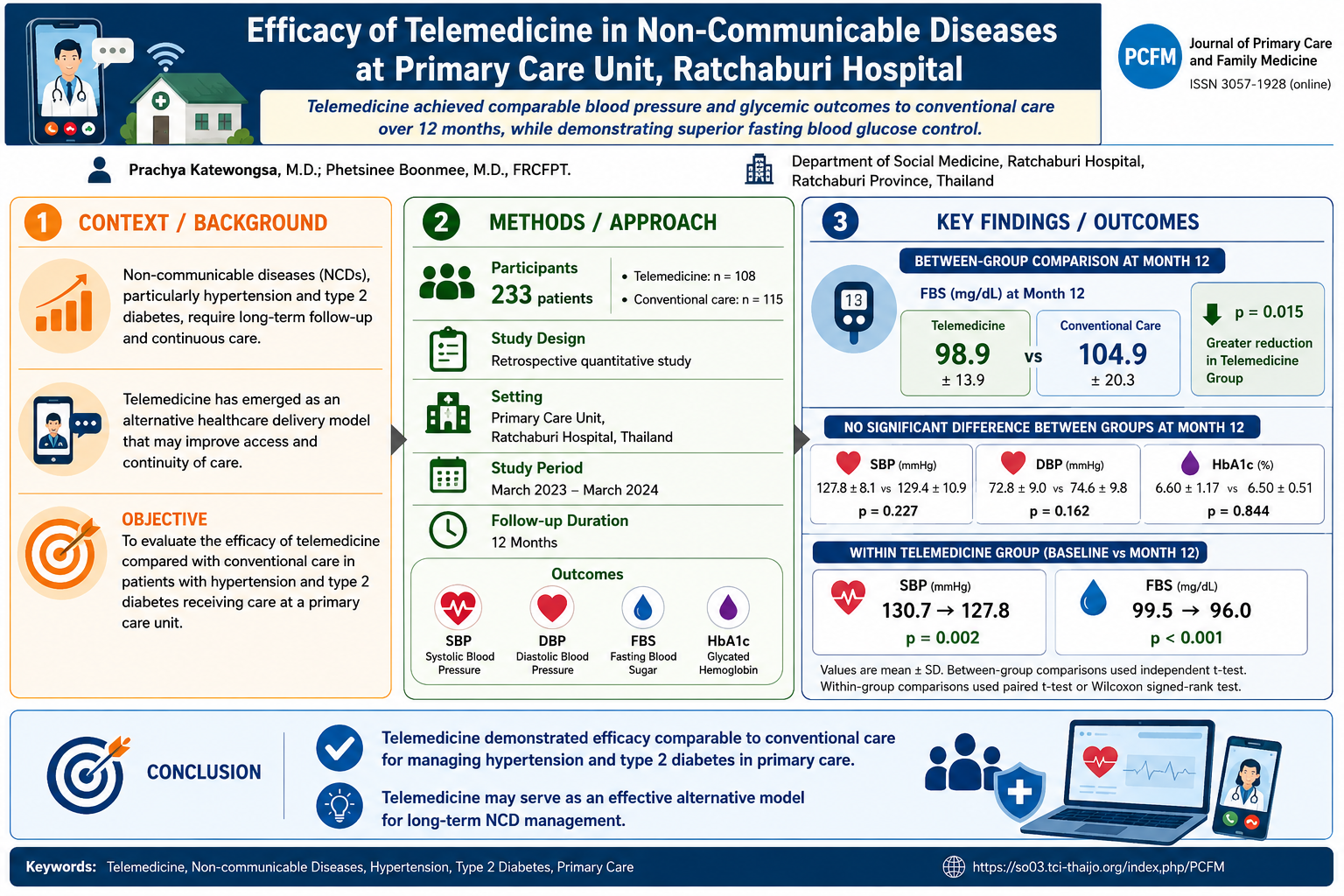
ที่มา: โรคไม่ติดต่อเรื้อรังเป็นโรคที่พบบ่อยและมีแนวโน้มเพิ่มมากขึ้น ระบบการแพทย์ทางไกลช่วยเพิ่มความสะดวกในการรับบริการของผู้ป่วย การศึกษานี้มีวัตถุประสงค์เพื่อประเมินประสิทธิผลของการจัดบริการและติดตามผ่านระบบการแพทย์ทางไกลในผู้ป่วยโรคไม่ติดต่อเรื้อรัง
แบบวิจัย: การวิจัยเชิงปริมาณ (quantitative research) ศึกษาแบบย้อนหลัง (retrospective study)
วัสดุและวิธีการ: ศึกษาเวชระเบียนผู้ป่วยโรคความดันโลหิตสูงและโรคเบาหวานชนิดที่ 2 ที่เข้ารับการรักษาที่ศูนย์สุขภาพชุมชนประชานุเคราะห์ แบ่งเป็นผู้ป่วยรักษาด้วยระบบการแพทย์ทางไกล 108 ราย และวิธีปกติ 115 ราย ตั้งแต่ 1 มีนาคม พ.ศ. 2566 ถึง 31 มีนาคม พ.ศ. 2567
ผลการศึกษา: ผู้ป่วยจำนวนทั้งหมด 233 ราย เมื่อติดตามไป 12 เดือน พบว่าระดับความดันโลหิตขณะบีบตัว (SBP) และค่าระดับความดันโลหิตขณะคลายตัว (DBP) ของ 2 กลุ่มไม่แตกต่างกัน ค่าระดับน้ำตาลในเลือดเมื่ออดอาหาร (FBS) กลุ่มที่รักษาด้วยระบบการแพทย์ทางไกลลดลงมากกว่าวิธีปกติ ส่วนค่าระดับน้ำตาลสะสมที่ 12 เดือน (HbA1C) ไม่แตกต่างกันระหว่าง 2 กลุ่ม เมื่อศึกษากลุ่มที่รักษาด้วยระบบการแพทย์ทางไกลเมื่อสิ้นสุดการศึกษา พบว่า ความดันโลหิต SBP และ FBS ลดลงอย่างมีนัยสำคัญทางสถิติ
สรุป: ประสิทธิผลของระบบการแพทย์ทางไกลไม่แตกต่างกับการให้บริการในวิธีปกติ เป็นทางเลือกหนึ่งในการรักษาผู้ป่วยอย่างมีประสิทธิภาพ
คำสำคัญ: ระบบการแพทย์ทางไกล โรคความดันโลหิตสูง โรคเบาหวาน
Downloads
Article Details

อนุญาตภายใต้เงื่อนไข Creative Commons Attribution-NonCommercial-NoDerivatives 4.0 International License.
เนื้อหาและข้อมูลในบทความที่ลงตีพิมพ์ในวารสาร PCFM ถือเป็นข้อคิดเห็นและความรับผิดชอบของผู้เขียนบทความโดยตรง ซึ่งกองบรรณาธิการวารสารไม่จำเป็นต้องเห็นด้วยหรือร่วมรับผิดชอบใด ๆ
บทความ ข้อมูล เนื้อหา รูปภาพ ฯลฯ ที่ได้รับการตีพิมพ์ลงในวารสาร PCFM ถือเป็นลิขสิทธิ์ของวารสาร PCFM หากบุคคลหรือหน่วยงานใดต้องการนำทั้งหมดหรือส่วนหนึ่งส่วนใดไปเผยแพร่ต่อหรือเพื่อกระทำการใด ๆ จะต้องได้รับอนุญาตเป็นลายลักษณ์อักษรจากวารสาร PCFM ก่อนเท่านั้น
เอกสารอ้างอิง
World Health Organization. Diagnosis and Management of Type 2 Diabetes Geneva. World Health Organization; 2020. [cited 2024 Jan 29], Available from: https://iris.who.int/bitstream/handle/10665/331710/WHO-UCN-NCD-20.1-eng.pdf.
กมลาศ ทองมีสิทธิ์ โยสท์, จิตนภา วาณิชวโรต, กฤษณา ตรียมณีรัตน์. พัฒนารูปแบบการให้บริการวิถีใหม่สำหรับผู้ป่วยโรคไม่ติดต่อเรื้อรัง (เบาหวานและความดันโลหิตสูง) ปี พ.ศ. 2565. สถาบันเวชศาสตร์สมเด็จพระสังฆราชญาณสังวรเพื่อผู้สูงอายุ กรมการแพทย์ กระทรวงสาธารณสุข. นนทบุรี: สินทวีการพิมพ์; 2565.
Lim SS, Vos T, Flaxman AD, Danaei G, Shibuya K, Amann M, et al. A comparative risk assessment of burden of disease and injury attributable to 67 risk factors and risk factor clusters in 21 regions, 1990-2010: a systematic analysis for the Global Burden of Disease Study 2010. Lancet. 2012;380:2224-60.
Rodgers A, Ezzati M, Hoorn SV. Distribution of major health risks: findings from the global burden of disease study. PLoS Med. 2004;1:44-55.
Finley CR, Chan DS, Garrison S, Korownyk C, Kolber MR, Campbell S, et al. What are the most common conditions in primary care? Systematic review. Can Fam Physician. 2018;64:832-40.
Aekplakorn W, Pukcharern H, Satheannoppakao W. Thai National Health Examination Survey, NHES VI. Bangkok: Faculty of medicine Ramathibodi hospital Mahidol University; 2021. 7. United Nations. Asia–Pacific Report on Population Ageing 2022 Trends, policies and good practices regarding older persons and population ageing [internet]. 2022. [cited 2024 Jan 29]. Available from: https://www.unescap.org/sites/default/d8files/event–documents/AP–Ageing– 2022–report.pdf
International Diabetes Federation. Diabetes Atlas 8th edition [Internet]. 2017 [cited 2024 Jan 2]. Available from: https://www.diabetesatlas.org/upload/resources/previous/files/8/IDF_DA_8e– EN–final.pdf 9. กรมควบคุมโรค กระทรวงสาธารณสุข. รายงานสถานการณ์โรค NCDs เบาหวาน ความดันโลหิตสูง และปัจจัยที่เกี่ยวข้อง. กองโรคไม่ติดต่อ. กรุงเทพฯ: โรงพิมพ์อักษรกราฟฟิกแอนด์ดีไซน์; 2563.
กองบริหารสาธารณสุข. การดำเนินการจัดบริการทางการแพทย์วิถีใหม่ (New normal Medical Service). กรุงเทพฯ: บริษัท บอนทูบี พับลิซซิ่ง; 2563.
Department of Medical Service, Mistry of Public Health. Handbook of integrated, people centered health services in new normal diabetic & hypertensive clinic (for healthcare workers). Bangkok. 2020.
Krongbhumin R. Telemedicine on application and the new normal after COVID-19 with communicable theoretical perspective. Phuket Rajabhat University Academic Journal. 2021;17:18-36.
Chantasin W. Self-care of diabetic mellitus in pandemic of COVID-19. Thai Journal of Public Health and Health Education. 2022;2:1-8.
Duan Y, Xie Z, Dong F, Wu Z, Lin Z, Sun N. et al. Effectiveness of home blood pressure telemonitoring: a systematic review and meta-analysis of randomised controlled studies. J Hum Hypertens. 2017;31:427-37.
Margolis KL, Asche SE, Dehmer SP, Bergdall AR, Green BB, Sperl-Hilen JM. et al. Longterm outcomes of the effects of home blood pressure telemonitoring and pharmacist management on blood pressure among adults with uncontrolled hypertension. JAMA. 2018;1:e181617. PubMed PMID: 30646139
Wiriyapong P, Pongsura S, Fuanchan A, Dhippayorn T. The use of telemedicine to support type 2 diabetes care. J Med Health Sci. 2021;28:165-77.
Faul F, Erdfelder E, Lang AG, Buchner A. G* Power 3: A flexible statistical power analysis program for the social, behavioral, and biomedical sciences. Behavior research methods 2007;39:175-91.
Cohen J. Statistical power analysis for the behavioral sciences. Hillsdale, New Jersey: Lawrence Erlbaum Associates; 1988.
Yatabe J, Yatabe MS, Okada R, Ichihara A. Efficacy of telemedicine in hypertension care through home blood pressure monitoring and videoconferencing: randomized controlled trial. JMIR Cardio. 2021;5:e27347. PubMed PMID: 34321194
Tangwanapri T, Sangkaew S, Leelaphaibun J. Efficacy of telemedicine on blood pressure control among patients with hypertensive during COVID-19 pandemic: A retrospective cohort study. Journal of Primary Care and Family Medicine. 2023;6:316-27.
Youkong K, Kitreewutiwong N. Effectiveness of telehealth self-management support program on self management behavior and blood pressure among essential hypertension patients in Sawankhalok District, Sakhothai Province. Nursing Journal of the Ministry of Public Health. 2023;3:25-38.
Bosworth HB, Benjamin J, Olsen MK, Grubber J, Smith V, Pamela W, et al. Home blood pressure management and improved blood pressure control: results from a randomized controlled trial. Arch Intern Med. 2011;171:1173-80.
Wang JG, Li Y, Chia YC, Cheng HM, Minh HV, Siddique S, et al. Telemedicine in the management of hypertension: evolving technological platforms for blood pressure telemonitoring. Journal of Clinical Hypertension (Greenwich, Conn.). 2021;23:435–39.
Gong K, Yan YL, Li Y, Du J, Wang J, Han Y, et al. Mobile health applications for the management of primary hypertension. Medicine (Baltimore). 2020;99(16):e19715. PubMed PMID: 32311957
Hammersley V, Parker R, Paterson M, Hanley J, Pinnock H, Padfield P, et al. Telemonitoring at scale for hypertension in primary care: an implementation study. PLoS Medicine. 2020;17:1-19.
Busayarasamee B. Development of care model for diabetic and hypertensive patients in the new era, Ampur Mueang, Nakhon Pathom. Region 4-5 Medical Journal. 2023;42:63-77.
Dermkhuntod N, Kwancharoen R, Chuantantikamol C, Paholpak P. Effects of telehealth monitoring on glycemic control and medication adherence in patients with poorly controlled type 2 diabetes. Vajira Medical Journal: Journal of Urban Medicine. 2021;65:S75-90.
Trakulboonnate N. The satisfaction of out-patient department service in the Princess Mother Navuti Hosptial. Journal of The Police Nurses. 2017;9:64-74.
Longswasd R. The satisfaction of the out-patients department service of Somdetphraphutalertla Hospital. Hua Hin Sook Jai Klai Kangwon Journal. 2019;4:60-70.
American Diabetes Association. How COVID-19 impacts people with diabetes. [internet]. 2021. [cited 2024 Dec 20]. Available from: https://www.diabetes.org/corona virus-covid-19/how-coronavirus-impacts-people-with-diabetes
Rattanamongkolkul J. Dietz application: telemedicine for diabetes treatment and self-care tracking. Journal of the Thai Informatics Association. 2022;1:46-54.
