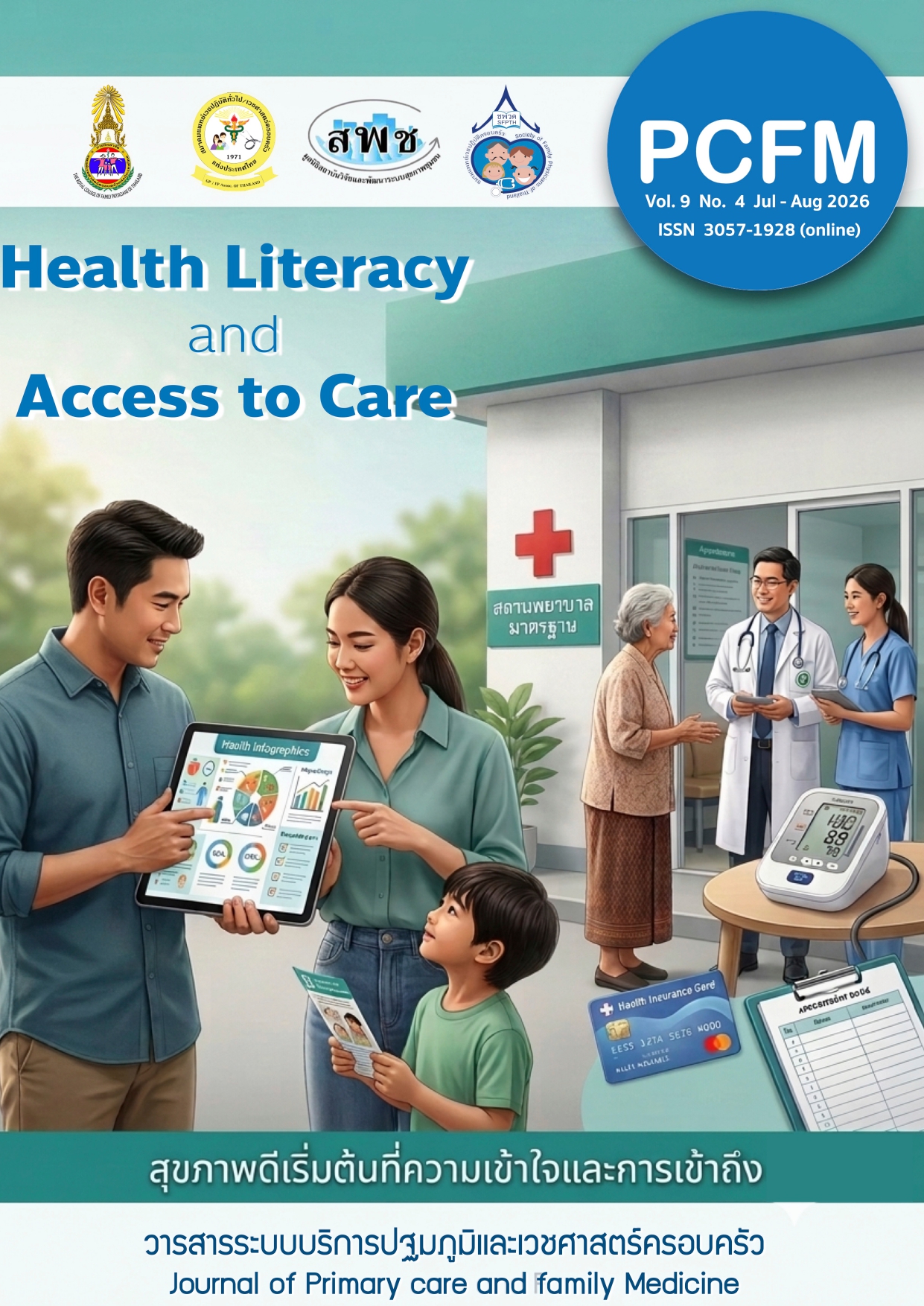
Health Literacy and Access to Quality of Care
Article Sidebar
Main Article Content
Abstract
“…อุตส่าห์หยุดกินยาเบาหวาน ความดันแล้ว แต่ก็ยังเป็นโรคไตอยู่ โชคร้ายจริง”
วาทกรรมสะท้อนความเข้าใจผิดข้างต้นเป็นสิ่งที่บุคลากรทางการแพทย์ได้ยินอยู่เสมอในคลินิกโรคไม่ติดต่อเรื้อรัง (Non-Communicable Diseases: NCDs)
ผู้ป่วยจำนวนมากมีความเชื่อฝังหัวว่า “ยาแผนปัจจุบันคือสารเคมีสะสมที่ทำลายไต” จึงเลือกที่จะหยุดยาหรือลดขนาดยาเอง โดยหารู้ไม่ว่าพยาธิสภาพของระดับน้ำตาลในเลือดและความดันโลหิตสูงที่ควบคุมไม่ได้ต่างหาก คือตัวการหลักที่ทำลายหลอดเลือดฝอยในไตจนนำไปสู่ภาวะไตวายเรื้อรังระยะสุดท้าย (End-Stage Renal Disease: ESRD) 1,2
ปรากฏการณ์นี้ไม่ได้เป็นเพียงความล้มเหลวของการสื่อสาร แต่เป็นภาพสะท้อนชัดเจนของ "ภาวะขาดความรอบรู้ด้านสุขภาพ" (Health illiteracy) ซึ่งเป็นอุปสรรคสำคัญที่บั่นทอนการเข้าถึงคุณภาพการรักษาอย่างแท้จริง
Downloads
Article Details

This work is licensed under a Creative Commons Attribution-NonCommercial-NoDerivatives 4.0 International License.
The content and information in articles published in the PCFM journal are solely the opinions and responsibilities of the authors. The journal's editorial board does not necessarily agree with or share any responsibility for them.
All articles, information, content, images, etc., published in the PCFM journal are the copyright of the PCFM journal. If any individual or organization wishes to reproduce, distribute, or use any part or the entirety of the content, they must obtain written permission from the PCFM journal beforehand.
References
Kidney Disease: Improving Global Outcomes (KDIGO) Diabetes Work Group. KDIGO 2026 Clinical Practice Guideline for Diabetes Management in Chronic Kidney Disease. Kidney Int. 2026.
สมาคมโรคไตแห่งประเทศไทย. คำแนะนำสำหรับการดูแลรักษาโรคไตเรื้อรัง พ.ศ. 2565. กรุงเทพฯ: สมาคมโรคไตแห่งประเทศไทย; 2565.
Nutbeam D. Health literacy as a public health goal: a challenge for contemporary health education and communication strategies into the 21st century. Health Promot Int. 2000;15(3):259-67.
Oguntibeju OO. Health literacy and impact on health outcomes, barriers and gaps: Systematic review. Int J Res Bus Soc Sci. 2026;14(10):552-62.
Schillinger D, Piette J, Grumbach K, Wang F, Wilson C, Daher C, et al. Closing the loop: physician communication with diabetic patients who have low health literacy. Arch Intern Med. 2003;163(1):83-90.
Brach C, Keller D, Hernandez LM, Baur C, Parker R, Dreyer B, et al. Ten attributes of health literate health care organizations. Washington (DC): Institute of Medicine; 2012.
