
A Study of the Effectiveness of a Health Behavior Modification Program for the Prevention of Cervical Cancer among Women at Risk in the Catchment Area of Ban Thiandat Subdistrict Health Promoting Hospital, Ban Mai Subdistrict, Sam Phran District, Nakhon Pathom Province
Article Sidebar
Main Article Content
Abstract
ABSTRACT
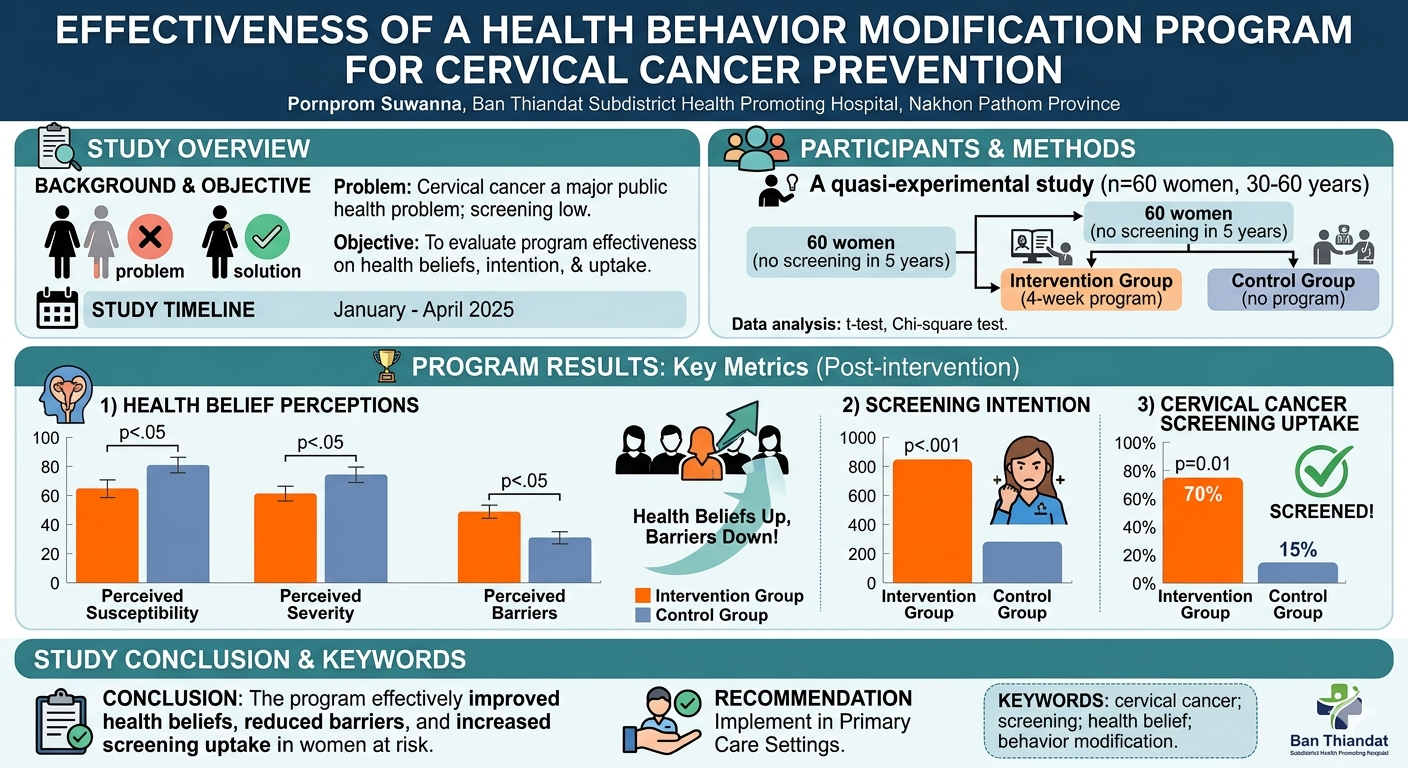
Background: Cervical cancer remains a major public health problem among Thai women, while the uptake of cervical cancer screening remains low. This study aimed to evaluate the effectiveness of a health behavior modification program on health belief perceptions, screening intention, and cervical cancer screening uptake among women at risk.
Methods: A quasi-experimental two-group pretest–posttest design was conducted from January to April 2025 at Ban Thiandat Subdistrict Health Promoting Hospital, Nakhon Pathom Province. Sixty women aged 30–60 years who had not undergone cervical cancer screening within the previous five years were recruited and equally assigned to an intervention group and a control group. The intervention group participated in a four-week health behavior modification program. Data were analyzed using descriptive statistics, Independent t-test, Paired t-test, and Chi-square test.
Results: After the intervention, the experimental group demonstrated a statistically significant improvement in health belief scores. Perceived susceptibility and perceived severity of disease were significantly higher than those of the control group, while perceived barriers to cervical cancer screening were significantly lower (p < 0.05). Furthermore, screening intention was significantly higher than that of the control group (p < 0.001), and the cervical cancer screening uptake rate was significantly higher than that of the control group (p = 0.010).
Conclusions: The health behavior modification program effectively improved health beliefs, reduced perceived barriers, and increased cervical cancer screening uptake among women at risk. Implementation of this program in primary care settings is recommended.
Keywords: cervical cancer, screening, health belief, behavior modification
Downloads
Article Details

This work is licensed under a Creative Commons Attribution-NonCommercial-NoDerivatives 4.0 International License.
The content and information in articles published in the PCFM journal are solely the opinions and responsibilities of the authors. The journal's editorial board does not necessarily agree with or share any responsibility for them.
All articles, information, content, images, etc., published in the PCFM journal are the copyright of the PCFM journal. If any individual or organization wishes to reproduce, distribute, or use any part or the entirety of the content, they must obtain written permission from the PCFM journal beforehand.
References
World Health Organization. Cervical cancer [Internet]. Geneva: World Health Organization; 2023 [cited 2026 Jun 24]. Available from: https://www.who.int/news-room/fact-sheets/detail/cervical-cancer.
International Agency for Research on Cancer. Global Cancer Observatory [Internet]. Lyon (FR): IARC; 2023 [cited 2023 Mar 15]. Available from: https://gco.iarc.fr
World Health Organization. Global strategy to accelerate the elimination of cervical cancer as a public health problem. Geneva: World Health Organization; 2020.
สถาบันมะเร็งแห่งชาติ. มะเร็งในประเทศไทย เล่มที่ 10. กรุงเทพมหานคร: สถาบันมะเร็งแห่งชาติ; 2564.
กระทรวงสาธารณสุข. แนวทางการดำเนินงานตรวจคัดกรองมะเร็งปากมดลูกระดับประเทศ. กรุงเทพมหานคร: กระทรวงสาธารณสุข; 2565.
Bruni L, Albero G, Serrano B, Mena M, Collado JJ, Gómez D, et al. ICO/IARC Information Centre on HPV and Cancer (HPV Information Centre). Human Papillomavirus and Related Diseases in the World. Summary Report. Barcelona: ICO/IARC; 2023
Rosenstock IM. Historical origins of the Health Belief Model. Health Educ Monogr. 1974;2:328-35.
ภูนรินทร์ สีกุด, มะลิวัลย์ บางนิ่มน้อย, ซาลินี มานะยิ่ง. ปัจจัยที่มีความสัมพันธ์กับการมารับบริการตรวจคัดกรองมะเร็งปากมดลูกของสตรีกลุ่มเสี่ยง ตำบลบ้านใหม่ อำเภอเมือง จังหวัดนครราชสีมา. วารสารสาธารณสุขมูลฐาน ภาคตะวันออกเฉียงเหนือ. 2564;36:37-47.
Klein SB. Learning: Principles and Applications. 6th ed. New York: McGraw-Hill; 2012.
Glanz K, Rimer BK, Viswanath K. Health Behavior: Theory, Research, and Practice. 5th ed. San Francisco: Jossey-Bass; 2015.
นิภาพร พอใจ. ประสิทธิผลของโปรแกรมปรับเปลี่ยนพฤติกรรมสุขภาพเพื่อป้องกันโรคมะเร็งปากมดลูกในสตรีกลุ่มเสี่ยง ในเขตสถานีอนามัยตำบลสะเนียน อำเภอเมืองน่าน จังหวัดน่าน [วิทยานิพนธ์ปริญญามหาบัณฑิต]. กรุงเทพมหานคร: มหาวิทยาลัยราชภัฏบ้านสมเด็จเจ้าพระยา; 2552.
Thahirabanuibrahim, Logaraj M. The effect of the health belief model education for cervical cancer prevention, screening promotion among rural women in Chengalpattu district, Tamil Nadu (HBMECC). J Educ Health Promot. 2023;12:166. PubMed PMID: 37404911
เสาวราภรณ์ แฝงสะโด. ผลของโปรแกรมการส่งเสริมความรอบรู้ด้านสุขภาพต่อพฤติกรรมการป้องกันโรคมะเร็งปากมดลูกของสตรีกลุ่มเสี่ยงที่มารับบริการในโรงพยาบาลร้อยเอ็ด. วารสารวิจัยและพัฒนานวัตกรรมทางสุขภาพ. 2567; 5:370-81.
Champion VL, Skinner CS. The health belief model. In: Glanz K, Rimer BK, Viswanath K, editors. Health Behavior and Health Education: Theory, Research, and Practice. 4th ed. San Francisco: Jossey-Bass; 2008. p. 45-65.
Bandura A. Self-efficacy: The exercise of control. New York, NY: W.H. Freeman; 1997.
Jones CL, Jensen JD, Scherr CL, Brown NR, Christy K, Weaver J. The health belief model as an explanatory framework in communication research: Exploring parallel, serial, and moderated mediation. Health Commun. 2015;30:566-76.
