
Association Between Perceived Health Status and Life Satisfaction Among Urban Older Adults with Non-Communicable Diseases: A Cross-Sectional Study
Article Sidebar
Main Article Content
Abstract
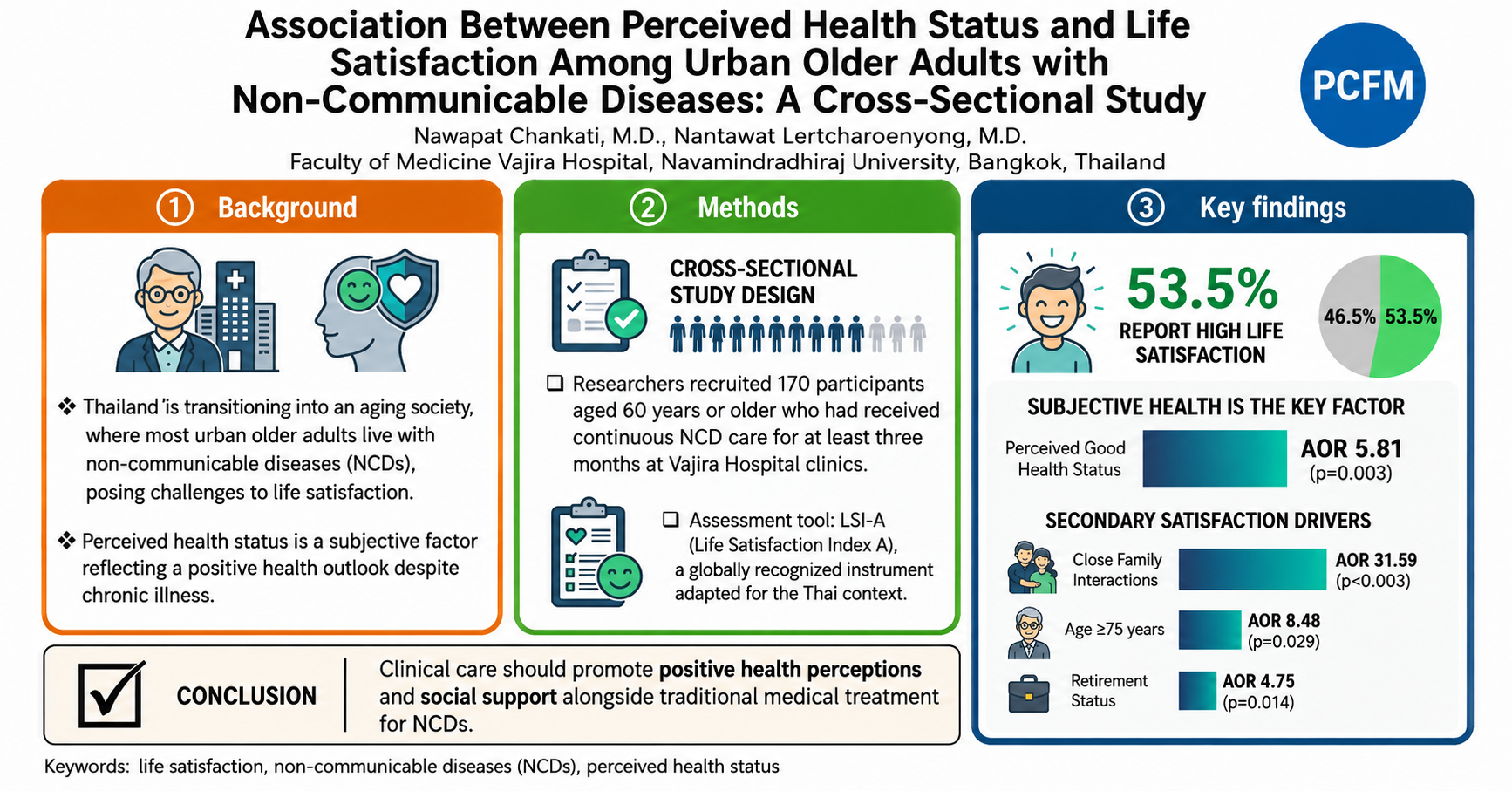
Background: Thailand has become an aging society, with most older adults living with non-communicable diseases in urban areas, which may affect life satisfaction. Perceived health status is a key subjective factor reflecting older adults’ capacity to adapt and live independently. This study examined the association between perceived health status and life satisfaction among urban older adults with non-communicable diseases, as well as related demographic, social, and health factors.
Design: Cross-sectional study
Methods: A total of 170 participants were recruited using convenience sampling from older adults aged 60 years and above with non-communicable diseases who had received continuous care for at least three months at the Family Medicine Clinic and the Urban Primary Care Clinic, Vajira Hospital, and provided informed consent. Data were collected using a demographic questionnaire and the Life Satisfaction Index A (LSI-A) to measure life satisfaction. Factors associated with life satisfaction were analyzed using univariate and multivariate logistic regression models.
Results: Most older adults reported high life satisfaction (53.53%). Perceived good health status was significantly associated with life satisfaction (p < 0.05). Other factors significantly associated with life satisfaction included older age, employment status (particularly retirement), use of healthcare coverage other than the Universal Coverage Scheme, living with relatives or others, and close family interactions.
Conclusions: Perceived health status was the key factor associated with life satisfaction among urban older adults with non-communicable diseases, highlighting the importance of promoting positive health perceptions alongside medical care.
Keywords: life satisfaction, non-communicable diseases, perceived health status
Downloads
Article Details

This work is licensed under a Creative Commons Attribution-NonCommercial-NoDerivatives 4.0 International License.
The content and information in articles published in the PCFM journal are solely the opinions and responsibilities of the authors. The journal's editorial board does not necessarily agree with or share any responsibility for them.
All articles, information, content, images, etc., published in the PCFM journal are the copyright of the PCFM journal. If any individual or organization wishes to reproduce, distribute, or use any part or the entirety of the content, they must obtain written permission from the PCFM journal beforehand.
References
สร้างสรรค์งานออกแบบ (TCDC). Aging Society VS. Aged Society in Global and Thai Context [อินเทอร์เน็ต]. 2558 [สืบค้นเมื่อ 6 พ.ย. 2567]. เข้าถึงได้จาก: https://resource.tcdc.or.th/ebook/AgingSociety_Report_official.pdf
สำนักงานสถิติแห่งชาติ. บทสรุปสำหรับผู้บริหาร การสำรวจประชากรสูงอายุในประเทศไทย พ.ศ. 2567 (อินเทอร์เน็ต). 2567 [สืบค้นเมื่อ 6 พ.ย. 2567]. เข้าถึงได้จาก: https://www.nso.go.th/nsoweb/storage/survey_detail/2024/20241003145311_ศูนย์94190.pdf
Neugarten BL, Havighurst RJ, Tobin SS. The measurement of life satisfaction. J Gerontol. 1961;16:134-43. doi:10.1093/geronj/16.2.134.
Palmore EB, Luikart C. Health and social factors related to life satisfaction. J Health Soc Behav. 1972;13:68-80. doi:10.2307/2136974.
ศรีเรือน แก้วกังวาล. แบบทดสอบ LSIA และ Life Experience Test: การสร้างและวิธีใช้วัดความพอใจในชีวิตและ พฤติกรรมสังคม. ใน: รายงานผลการวิจัยในการประชุมทางวิชาการของมหาวิทยาลัยเกษตรศาสตร์ ครั้งที่ 28; 29-31 มกราคม 2533; กรุงเทพฯ. กรุงเทพฯ: มหาวิทยาลัยเกษตรศาสตร์; 2533. หน้า 861-9.
สุจิตรา นิลเลิศ. ความสัมพันธ์ระหว่างการได้รับการอุปถัมภ์จากบุตรกับคุณภาพชีวิตผู้สูงอายุไทยในชนบท จังหวัดสุพรรณบุรี [วิทยานิพนธ์ปริญญาดุษฎีบัณฑิต]. นครปฐม: มหาวิทยาลัยมหิดล; 2539.
Wu W, Shang Y, Calderón-Larrañaga A, Rizzuto D, Saadeh M, Dove A, et al. Association of life satisfaction with disability-free survival: role of chronic diseases and healthy lifestyle. Age Ageing. 2021;50:1657-65. doi:10.1093/ageing/afab086.
ชัยฤทธิ์ โพธิสุวรรณ, อรุณี บุญอรุฬพิเชฎฐ์. ความพึงพอใจในชีวิตของผู้สูงอายุ: กรณีศึกษาชมรมผู้สูงอายุ ศูนย์บริการสาธารณสุข ภาค 2 กรุงเทพมหานคร. วารสารศึกษาศาสตร์ปริทัศน์. 2542;14:93-114.
Anantanasuwong D, Seenprachawong U. Life satisfaction of the older Thai: findings from the pilot HART. In: Smith JP, Majmundar M, editors. Aging in Asia: findings from new and emerging data initiatives. Washington (DC): National Academies Press; 2012. p. 363-87. doi:10.17226/13361.
Warr P, Butcher V, Robertson I, Callinan M. Older people’s well-being as a function of employment, retirement, environmental characteristics and role preference. Br J Psychol. 2004;95(Pt 3):297-324. doi:10.1348/0007126041528095.
วุฒิเมธา ห้วยทราย, ศรายุทธ ชูสุนา. ปัจจัยทำนายคุณภาพชีวิตของผู้สูงอายุในชมรมผู้สูงอายุตำบลบางนกแขวก อำเภอบางคนที จังหวัดสมุทรสงคราม. วารสารวิชาการสาธารณสุข. 2566;32:165-76.
Tang F, Chen H, Zhang Y, Mui AC. Employment and life satisfaction among middle- and old-aged adults in China. Gerontol Geriatr Med. 2018;4:2333721418778202. PubMed PMID: 30038952
Joowong S, Junsirimongkol B, Khaektao P, Doungyota T, Paomee K. A cross-sectional study of factors associated with life satisfaction in Thai elderly. Eur Psychiatry. 2022;65(Suppl 1):S91-S92. doi:10.1192/j.eurpsy.2022.271.
Kaikeaw S, Punpuing S, Chamchan C, Prasartkul P. Socioeconomic inequalities in health outcomes among Thai older population in the era of Universal Health Coverage: trends and decomposition analysis. Int J Equity Health. 2023;22:144. doi:10.1186/s12939-023-01952-0.
Shin SH, Sok SR. A comparison of the factors influencing life satisfaction between Korean older people living with family and living alone. Int Nurs Rev. 2012;59:252-8. doi:10.1111/j.1466-7657.2011.00946.x.
พัชรี คมจักรพันธุ์, วรรณี จันทร์สว่าง. การศึกษาเปรียบเทียบความพึงพอใจในชีวิตของผู้สูงอายุที่มีรูปแบบการอยู่อาศัยที่แตกต่างกัน. วารสารพฤฒาวิทยาและเวชศาสตร์ผู้สูงอายุ. 2553;11:1-12.
Mpofu E, Zhan RF, Yin C, Brock K. Qualities of Older Adults’ Family and Friendship Relationships and Their Association with Life Satisfaction. Geriatrics. 2024;9:49. doi:10.3390/geriatrics9020049.
อรนุช อุดมสมฤดี. สัมพันธภาพในครอบครัวกับความพึงพอใจในชีวิตของผู้สูงอายุในเขตเทศบาลนครสวรรค์ จังหวัดนครสวรรค์ [สารนิพนธ์มหาบัณฑิต]. กรุงเทพฯ: บัณฑิตวิทยาลัย, มหาวิทยาลัยศรีนครินทรวิโรฒ; 2550.
Chantranapaporn P, Wongkumsin T. Family relationship, life satisfaction and spiritual well-being among the elderly of the senior club at Klong Sam Wa Public Health Center 64. Pacific Rim Int J Nurs Res. 2020;24:234-47. doi:10.55064/prijnr2020.24.2.234.
Pinto JM, Fontaine AMGV, Neri AL. The influence of physical and mental health on life satisfaction is mediated by self-rated health: A study with Brazilian elderly. Arch Gerontol Geriatr. 2016;65:104-10.
อุทัยวรรณ กศานต์สกุล. ปัจจัยที่มีผลต่อความพึงพอใจในชีวิตของผู้สูงอายุ: ศึกษาเฉพาะกรณีข้าราชการบำนาญ กระทรวงมหาดไทย [วิทยานิพนธ์ปริญญามหาบัณฑิต]. กรุงเทพฯ: สถาบันบัณฑิตพัฒนบริหารศาสตร์; 2536.
เรณา พงษ์เรืองพันธุ์, ประสิทธิ์ พงษ์เรืองพันธุ์. ปัจจัยที่มีความสัมพันธ์กับความพึงพอใจในชีวิตของผู้สูงอายุในเขตพัฒนาชายฝั่งทะเลภาคตะวันออก. ชลบุรี: คณะพยาบาลศาสตร์ มหาวิทยาลัยบูรพา; 2542.
Ocampo JM. Self-rated health: Importance of use in elderly adults. Colombia Medica (Cali). 2010; 41:275-89.
Almevall A, Dahlin Almevall A, Öhlin J, Gustafson Y, Zingmark K, Niklasson J, et al. Self-rated health in old age, related factors and survival: A 20-year longitudinal study within the Silver-MONICA cohort. Arch Gerontol Geriatr. 2024;122:105392. PubMed PMID: 38492492
Kang W, Malvaso A. Self-rated health (SRH) partially mediates and associations between personality traits and life satisfaction in older adults. Front Psychol. 2023;14:1189194. PubMed PMID: 37484078
Park S, Kang SW. Factors related to self-rated health among community-dwelling older adults. Healthcare (Basel). 2025;13:314. PubMed PMID: 39942503
สุชาดา สมบูรณ์, ศิริลักษณ์ โสมานุสรณ์, ชมณาด สุ้มเงิน. ปัจจัยที่มีความสัมพันธ์กับการสูงวัยอย่างมีสุขภาวะของผู้สูงอายุ. วารสารเกื้อการุณย์. 2561;25:141-53.
