Prevalence and Risk Factors Associated with Underreported Urinary Incontinence Among Female Patients with Type 2 Diabetes Mellitus
Article Sidebar
Main Article Content
Abstract
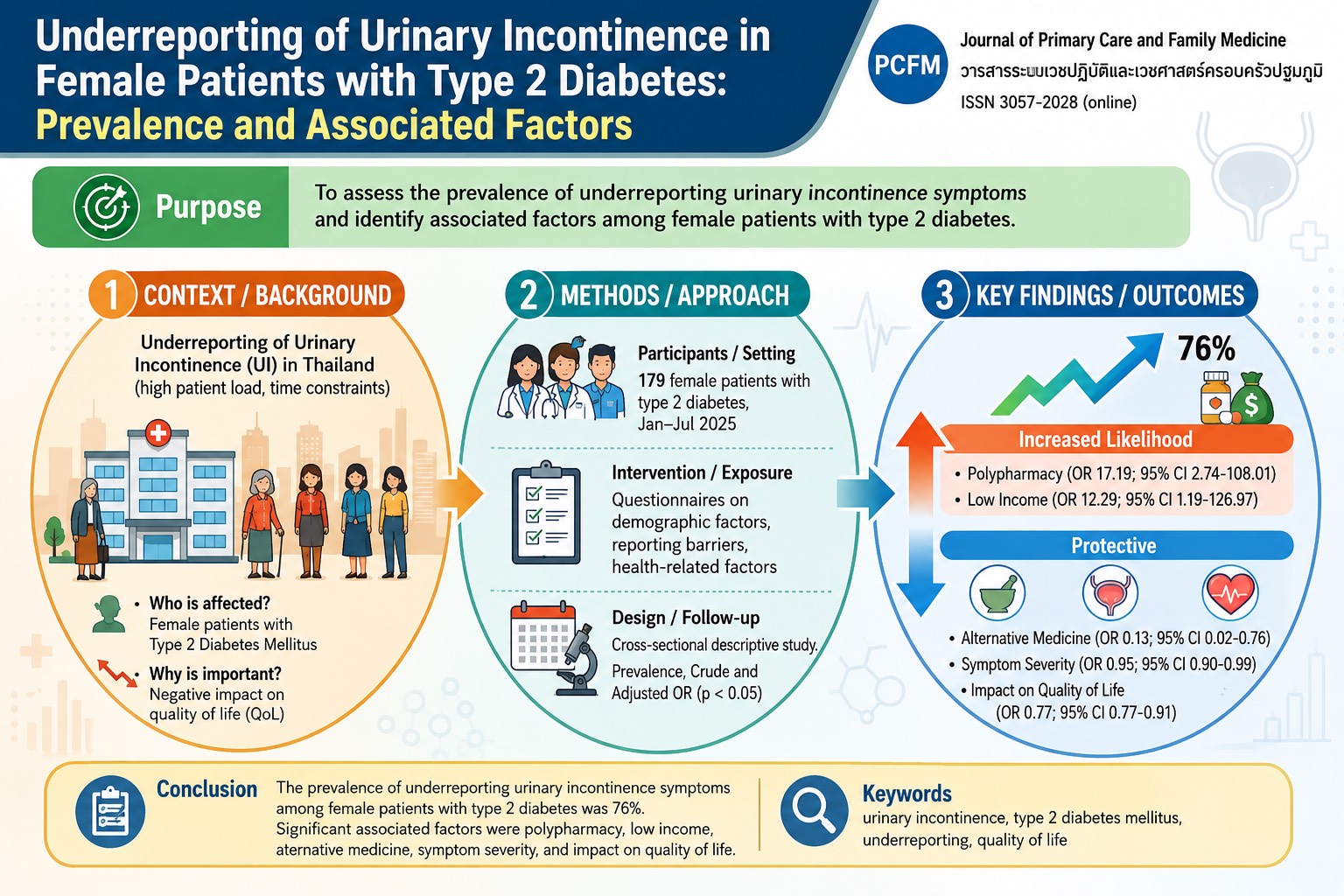
Background: Urinary incontinence is a common complication in female patients with type 2 diabetes, which negatively impacts quality of life. However, this condition is often underreported. Particularly in Thailand’s healthcare, due to the number of non-communicable disease patients and time constraints, symptom reporting may not be comprehensive. This study aimed to assess the prevalence of underreporting symptoms and identify associated factors.
Design: Cross-sectional descriptive study
Methods: The study involved 179 female patients with type 2 diabetes experiencing urinary incontinence between January and July 2025. Data were collected using questionnaires covering demographic factors, barriers to reporting, and health-related factors. Symptom severity and impact were assessed using the Thai versions of the UDI-6 and IIQ-7 questionnaires. Results were reported as Crude OR and Adjusted OR, with statistical significance of p < 0.05.
Results: The prevalence of underreporting symptoms was 76%. Factors that increased the likelihood of not reporting symptoms included polypharmacy (OR 17.19; 95% CI 2.74-108.01) and low income (OR 12.29; 95% CI 1.19-126.97). Protective factors that reduced the likelihood of underreporting symptoms were treatment with alternative medicine (OR 0.13; 95% CI 0.02-0.76), severity of symptoms (OR 0.95; 95% CI 0.90-0.99), and impact on quality of life (OR 0.77; 95% CI 0.77-0.91).
Conclusion: The prevalence of underreporting urinary incontinence symptoms among female patients with type 2 diabetes was 76%. Significant associated factors were polypharmacy, low income, alternative medicine, symptom severity, and impact on quality of life.
Keywords: urinary incontinence, type 2 diabetes mellitus, underreporting, quality of life
Downloads
Article Details

This work is licensed under a Creative Commons Attribution-NonCommercial-NoDerivatives 4.0 International License.
The content and information in articles published in the PCFM journal are solely the opinions and responsibilities of the authors. The journal's editorial board does not necessarily agree with or share any responsibility for them.
All articles, information, content, images, etc., published in the PCFM journal are the copyright of the PCFM journal. If any individual or organization wishes to reproduce, distribute, or use any part or the entirety of the content, they must obtain written permission from the PCFM journal beforehand.
References
Haylen BT, de Ridder D, Freeman RM, Swift SE, Berghmans B, Lee J, et al. An International Urogynecological Association (IUGA)/International Continence Society (ICS) joint report on the terminology for female pelvic floor dysfunction. Int Urogynecol J. 2010;21:5-26.
Markland AD, Richter HE, Fwu CW, Eggers P, Kusek JW. Prevalence and trends of urinary incontinence in adults in the United States, 2001 to 2008. J Urol. 2011;186:589-93.
World Health Organization. Evidence profile: urinary incontinence – Integrated care for older people (ICOPE) [Internet]. Geneva: World Health Organization; 2017 [cited 2025 Aug 7]. Available from: https://www.who.int/publications/i/item/WHO-MCA-17.06.08
International Diabetes Federation. IDF Diabetes Atlas -10th edition [Internet]. 2021 [cited 2024 Aug 31]. Available from: www.diabetesatlas.org.
Nathan DM. Long-term complications of diabetes mellitus. N Engl J Med. 1993;328:1676-85.
Phelan S, Kanaya AM, Subak LL, Hogan PE, Espeland MA, Wing RR, et al. Prevalence and risk factors for urinary incontinence in overweight and obese diabetic women: Action for Health in Diabetes (Look AHEAD) study. Diabetes Care. 2009;32:1391-7.
Bani-issa W, Fakhry R, Al Momani F. Urinary incontinence in Emirati women with diabetes mellitus type 2: prevalence, risk factors and impact on life. J Clin Nurs. 2013;22:3084-94.
Danforth KN, Townsend MK, Curhan GC, Resnick NM, Grodstein F. Type 2 diabetes mellitus and risk of stress, urge and mixed urinary incontinence. J Urol. 2009;181:193-7.
Izci Y, Topsever P, Filiz TM, Cinar ND, Uludağ C, Lagro-Janssen T. The association between diabetes mellitus and urinary incontinence in adult women. Int Urogynecol J Pelvic Floor Dysfunct. 2009;20: 947-52.
Jiang C, Xu M, Zhang L, Yang C, Liang C. Quality of life, disease recognition and care-seeking intention in women with urinary incontinence: an observational study in China. Int J Clin Exp Med. 2016;9:4380-7.
Schreiber Pedersen L, Lose G, Høybye MT, Jürgensen M, Waldmann A, Rudnicki M. Predictors and reasons for help-seeking behavior among women with urinary incontinence. Int Urogynecol J. 2018;29:521-30.
Rashidi Fakari F, Hajian S, Darvish S, Alavi Majd H. Predictors of help-seeking behaviors in women with urinary incontinence: based on Iranian women’s lens. PLoS One. 2023;18:e0289785. PubMed PMID: 37540696
Sullivan R, McNicholas T, Claffey P, Kenny RA, Briggs R. Unreported urinary incontinence: population-based prevalence and factors associated with non-reporting of symptoms in community-dwelling people ≥50 years. Eur Geriatr Med. 2021;12:405-12.
Asemota O, Eldemire-Shearer D, Waldron NK, Standard-Goldson A. Prevalence of self-reported urinary incontinence in community-dwelling older adults of Westmoreland, Jamaica. MEDICC Rev. 2016;18:41-7.
Weerasopone S, Santingamkul A. Validation of the Thai version of the Incontinence Impact Questionnaire (IIQ-7) and the Urogenital Distress Inventory (UDI-6). Chulalongkorn Med J. 2023;60:397-39.
World Health O. Age-friendly PHC centres toolkit. Geneva: World Health Organization; 2008.
Skorupska K, Grzybowska ME, Kubik-Komar A, Rechberger T, Miotla P. Identification of the Urogenital Distress Inventory-6 and the Incontinence Impact Questionnaire-7 cutoff scores in urinary incontinent women. Health Qual Life Outcomes. 2021;19:87. PubMed PMID: 33726776
Peduzzi P, Concato J, Kemper E, Holford TR, Feinstein AR. A simulation study of the number of events per variable in logistic regression analysis. J Clin Epidemiol. 1996;49:1373-9.
Jiang C, Xu M, Zhang L, Yang C, Liang C. Quality of life, disease recognition and care-seeking intention in women with urinary incontinence: An observational study in China. Int J Environ Res Public health. 2016;9:4380-7.
Gasquet I, Tcherny-Lessenot S, Gaudebout P, Bosio Le Goux B, Klein P, Haab F. Influence of the severity of stress urinary incontinence on quality of life, health care seeking, and treatment: A national cross-sectional survey. Eur Urol. 2006;50:818-25.
Duralde ER, Walter LC, Van Den Eeden SK, Nakagawa S, Subak LL, Brown JS, et al. Bridging the gap: determinants of undiagnosed or untreated urinary incontinence in women. Am J Obstet Gynecol. 2016;214:266.e1-7.
Rizk DEE, Shaheen H, Thomas L, Dunn E, Hassan MY. The prevalence and determinants of health care-seeking behavior for urinary incontinence in United Arab Emirates women. Int Urogynecol J. 1999;10:160-5.
Li M, Wang H, Ko W-K, Kwong S-K. Factors associated with health-seeking for urinary incontinence in Hong Kong Chinese women: a cross-sectional study. Int Urogynecol J. 2024;35:95-101.
24. Baah-Nyarkoh E, Alhassan Y, Dwomoh AK, Kretchy IA. Medicated-related burden and adherence in patients with co-morbid type 2 diabetes mellitus and hypertension. Heliyon. 2023;9(4):e15448. doi:10.1016/j.heliyon.2023.e15448..
National Statistical Office, Ministry of Digital Economy and Society. Full report: household economic and social survey 2023 [Internet]. Bangkok: NSO; 2023 [cited 2025 Sep 2]. Available from: https://catalog.nso.go.th/
Astin JA. Why patients use alternative medicine: results of a national study. JAMA. 1998;279:1548-53.
Frawley J, Sibbritt D, Steel A, Chang S, Adams J. Complementary and conventional health-care utilization among young Australian women with urinary incontinence. Urology. 2017;99:92-9.
Wallner LP, Porten S, Meenan RT, O’Keefe Rosetti MC, Calhoun EA, Sarma AV, et al. Prevalence and severity of undiagnosed urinary incontinence in women. Am J Med. 2009;122:1037-42.
Rosenstock IM. The health belief model and preventive health behavior. Health Educ Monogr. 1974;2:354-86.
Hägglund D, Walker-Engström ML, Larsson G, Leppert J. Quality of life and seeking help in women with urinary incontinence. Acta Obstet Gynecol Scand. 2001;80:1051-5.
Minassian VA, Yan X, Lichtenfeld MJ, Sun H, Stewart WF. Predictors of care seeking in women with urinary incontinence. Neurourol Urodyn. 2012;31:470-4.
