
Predictors of Emergency Department Utilization Among Advanced Cancer Patients: Machine Learning Model Development and Internal Validation
Article Sidebar
Main Article Content
Abstract
ABSTRACT
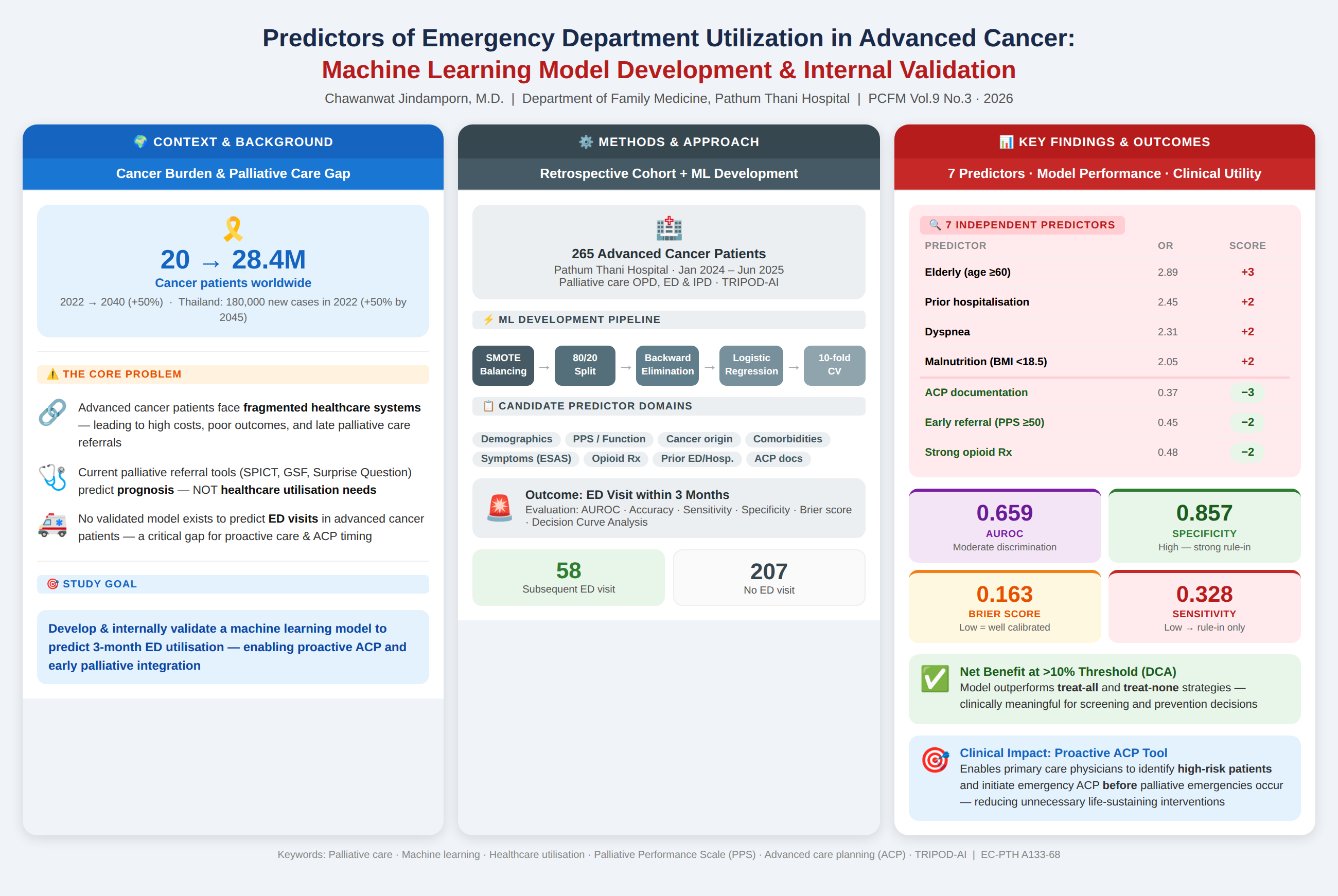
Background: In 2022, nearly 20 million people worldwide were living with cancer, projected to rise to 28.4 million by 2040. Advanced cancer patients experience multidimensional suffering while navigating fragmented healthcare systems, contributing to high costs and poor outcomes. Current palliative care referral tools focus on prognosis rather than predicting healthcare utilization needs. This study developed and internally validated machine learning models to predict subsequent Emergency Department utilization, with the ultimate goal of creating practical clinical tools to support proactive care decisions and early palliative care integration.
Methods: This retrospective cohort study with machine learning model development analyzed electronic medical records of advanced cancer patients referred to palliative care at Pathum Thani Hospital between January 2024 and June 2025. The study employed logistic regression with a machine learning development process to predict emergency care utilization. Performance was evaluated using AUROC, accuracy, calibration metrics, and DCA.
Results: Backward Elimination showed potential predictors for three-month subsequent emergency care utilization, including elderly status, malnutrition, presence of dyspnea, previous three-month hospitalization, functional status (PPS), adequate strong opioid prescribing, and ACP documentation. The internally validated model demonstrated moderate discriminative ability, accuracy, high specificity, and high calibration (low Brier score) with a low potential for overfitting between validation and test sets. Nevertheless, the model had low sensitivity, indicating it is more appropriate for a rule-in than a rule-out approach. The DCA showed net benefit over the treat-all and treat-no strategies at the harm-benefit treatment threshold probability > 10%.
Conclusion: This predictive tool enables proactive interventions, especially for emergency advanced care planning for patients most likely to require emergency services. However, this study requires ongoing development since it is limited to a single site and demonstrates low sensitivity. Further work is needed to establish external validation and assess real-world impact.
Keywords: palliative care, machine learning, healthcare utilization, Palliative Performance Scale, advanced care planning
Downloads
Article Details

This work is licensed under a Creative Commons Attribution-NonCommercial-NoDerivatives 4.0 International License.
The content and information in articles published in the PCFM journal are solely the opinions and responsibilities of the authors. The journal's editorial board does not necessarily agree with or share any responsibility for them.
All articles, information, content, images, etc., published in the PCFM journal are the copyright of the PCFM journal. If any individual or organization wishes to reproduce, distribute, or use any part or the entirety of the content, they must obtain written permission from the PCFM journal beforehand.
References
Bray F, Laversanne M, Sung H, Ferlay J, Siegel RL, Soerjomataram I, et al. Global Cancer Statistics 2022: GLOBOCAN Estimates of Incidence and Mortality Worldwide for 36 Cancers in 185 Countries. CA: A Cancer Journal for Clinicians. 2024;74:229-63.
International Agency for Research on Cancer. 2024. Cancer Tomorrow: Estimated number of new cases from 2022 to 2045, Both sexes, age [0-85+] All cancers. Available from: Available here: https://gco.iarc.fr/tomorrow/en/dataviz/bars?populations=764 [accessed: June 2024].
Potaya S, Thongcharoen V, Raungratanaamporn S, et al. 2024. A Scenario for a Model of Excellence in Comprehensive Cancer Care. Asian Pac J Cancer Prev. 25: 273-79.
Wilson KG, Chochinov HM, McPherson CJ, LeMay K, Allard P, Chary S, et al. Suffering With Advanced Cancer. Journal of Clinical Oncology. 2007;25:1691–7.
Popovic G, Harhara T, Pope A, al-Awamer A, Banerjee S, Bryson J, et al. Patient-Reported Functional Status in Outpatients With Advanced Cancer : Correlation With Physician-Reported Scores and Survival. Journal of Pain and Symptom Management. 2018;55:1500–8.
Dillon EC, Martinez MC, Li M, Mann-Grewal AK, Luft HS, Liang SY, et al. “It is not the fault of the health care team - it is the way the system works”: a mixed-methods quality improvement study of patients with advanced cancer and family members reveals challenges navigating a fragmented healthcare system and the administrative and financial burdens of care. BMC Health Services Research. 2024 Nov 11;24(1).
Zafari A, Mehdizadeh P, Bahadori M, Nooredin Dopeykar, Ehsan Teymourzadeh, Ramin Ravangard. Estimating the Costs of End-of-Life Care in Patients With Advanced Cancer From the Perspective of an Insurance Organization: A Cross-Sectional Study in Iran. Value in Health Regional Issues. 2023;41:7–14.
World Health Organization. Palliative care [Internet]. Geneva: World Health Organization; 2020 [cited 2026 Jun 22]. Available from: https://www.who.int/news-room/fact-sheets/detail/palliative-care
Sanders JJ, Temin S, Ghoshal A, Alesi ER, Zipporah Vunoro Ali, Chauhan C, et al. Palliative Care for Patients With Cancer: ASCO Guideline Update. J Clin Oncol. 2024;42:2336-57.
Wentlandt K, Krzyzanowska MK, Swami N, Rodin GM, Le LW, Zimmermann C. Referral practices of oncologists to specialized palliative care. J Clin Oncol. 2012;30:4380-6. PubMed PMID: 23109708.
Charalambous H, Pallis A, Hasan B, O’Brien M. Attitudes and referral patterns of lung cancer specialists in Europe to Specialized Palliative Care (SPC) and the practice of Early Palliative Care (EPC). BMC Palliative Care. 2014;13:59. PubMed PMID: 25550683
Gonzalez, R., Srinivas, S., Waterman, B.L. et al. Impact of early vs late palliative care referrals on healthcare utilization in patients with pancreatic cancer. J Cancer Res Clin Oncol. 2023;149:14997–15002.
Kriti Dhamija, Awuah KFB, Srinishant Rajarajan, Babu K, Bucchin K, Flanagan A, et al. The impact of early versus late palliative care referral (PCR) on healthcare utilization in pancreatic cancer patients: A single-center retrospective study. J Clin Oncol. 2025;43(16_suppl):12092–2.
Vu E, Steinmann N, Schröder C, Forster RE, Aebersold DM, Steffen Eychmüller, et al. Applications of machine learning in palliative care: a systematic review. Cancers. 2023;15:1596–6.
Dale J, Petrova M, Munday D, Koistinen-Harris J, Lall R, Thomas K. A national facilitation project to improve primary palliative care: impact of the Gold Standards Framework on process and self-ratings of quality. Quality and Safety in Health Care. 2009;18:174–80.
Piers R, De Brauwer I, Baeyens H, Velghe A, Hens L, Deschepper E, et al. Supportive and Palliative Care Indicators Tool prognostic value in older hospitalised patients: a prospective multicentre study. BMJ Supportive Palliat Care. 2021;14(e2):e003042. PubMed PMID: 34059507
Mahura M, Karle B, Sayers L, Dick-Smith F, Elliott R. Use of the supportive and palliative care indicators tool (SPICTTM) for end-of-life discussions: a scoping review. BMC palliat Care. 2024;23(1):119. PubMed PMID: 38750464
Bischoff KE, Patel K, W. John Boscardin, O’Riordan DL, Pantilat SZ, Smith AK. Prognoses associated With Palliative Performance Scale Scores in Modern Palliative Care Practice. JAMA Netw Open. 2024 ;7(7):e2420472. PubMed PMID: 38976269
El Majzoub I, Qdaisat A, Chaftari PS, Yeung SCJ, Sawaya RD, Jizzini M, et al. Association of emergency department admission and early inpatient palliative care consultation with hospital mortality in a comprehensive cancer center. Support Care Cancer. 2019;27:2649–55.
Tao J, Seier K, Marasigan-Stone CB, Simondac JSS, Pascual AV, Kostelecky N, et al. Delirium as a risk factor for mortality in critically Ill patients with cancer. JCO Oncol Pract. 2023;19:e838–47.
Suraarunsumrit P, Nopmaneejumruslers C, Srinonprasert V. Advance care planning (ACP) associated with reduced health care utilization in deceased older patients with advanced stage of chronic diseases. J Med Assoc Thai. 2019;102:801-8.
Malhotra C, Shafiq M, Batcagan-Abueg APM. What is the evidence for efficacy of advance care planning in improving patient outcomes? A systematic review of randomised controlled trials. BMJ Open. 2022;12(7):e060201. doi: 10.1136/bmjopen-2021-060201. PMCID: PMC9301802.
