
Prevalence and Factors Associated with Medication Non-Adherence Among Uncontrolled Type 2 Diabetes Patients: Primary Care Setting
Article Sidebar
Main Article Content
Abstract
ABSTRACT
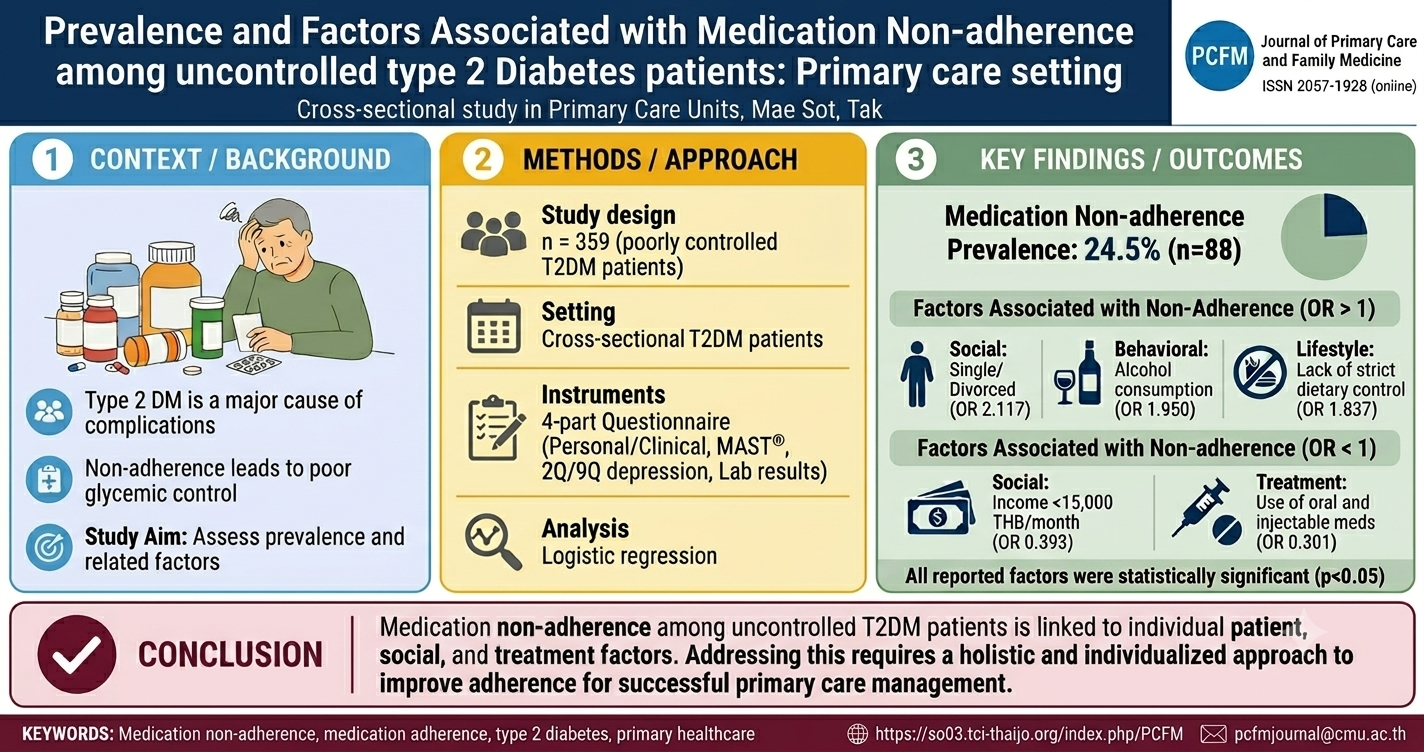
Background: Type 2 diabetes mellitus is a significant cause of severe complications. Non-adherence to medication is a critical factor contributing to poor glycemic control among patients with type 2 diabetes. Investigating medication adherence and its associated factors is essential for improving the quality of diabetes care. This study aimed to assess the prevalence of medication non-adherence and the factors associated with this non-adherence among patients with poorly controlled type 2 diabetes receiving care in primary healthcare settings.
Methods: A cross-sectional study was conducted among patients with poorly controlled type 2 diabetes. Research instruments included a questionnaire divided into four sections: personal and clinical information, the Medication Adherence Scale in Thais (MAST)®, a 2Q and 9Q depression assessment, and a record of the latest laboratory blood test results. Statistical analysis was performed using logistic regression.
Results: A total of 359 participants were included in the study, revealing that 88 individuals (24.5%) exhibited medication non-adherence. Factors associated with non-adherence include being single, divorced, or separated (OR 2.117, 95% CI 1.210-3.703), alcohol consumption (OR 1.950, 95% CI 1.101-3.453), and lack of strict dietary control (OR 1.837, 95% CI 1.019-3.313). household income of less than 15,000 THB/month (OR 0.393, 95% CI 0.208-0.742) and the use of both oral and injectable medications (OR 0.301, 95% CI 0.104-0.869).
Conclusion: Factors associated with medication non-adherence among poorly controlled type 2 diabetes patients receiving care in primary healthcare settings in Mae Sot District, Tak Province, encompass individual patient factors, social factors, and those related to diabetes treatment. Addressing this issue should consider a holistic and individualized approach, integrating various methodologies to enhance medication adherence, which is a crucial component in achieving successful diabetes management in primary care.
Keywords: medication non-adherence, medication adherence, type 2 diabetes, primary healthcare
Downloads
Article Details

This work is licensed under a Creative Commons Attribution-NonCommercial-NoDerivatives 4.0 International License.
The content and information in articles published in the PCFM journal are solely the opinions and responsibilities of the authors. The journal's editorial board does not necessarily agree with or share any responsibility for them.
All articles, information, content, images, etc., published in the PCFM journal are the copyright of the PCFM journal. If any individual or organization wishes to reproduce, distribute, or use any part or the entirety of the content, they must obtain written permission from the PCFM journal beforehand.
References
สมาคมโรคเบาหวานแห่งประเทศไทย. แนวทางเวชปฏิบัติสำหรับโรคเบาหวาน 2566 Clinical Practice Guideline for Diabetes 2023. กรุงเทพมหานคร: ศรีเมืองการพิมพ์, 2566.
Diabetes in the Western Pacific. In IDF Diabetes Atlas scientific committee. IDF Diabetes Atlas. 10th ed. (Internet). 2023. [cited 2023 Oct, 23]. Available from: www.diabetesatlas.org
Sarwar N, Gao P, Kondapally SSR, Gobin R, Kaptoge S, Di Angelantonio E, et al. Diabetes mellitus, fasting blood glucose concentration, and risk of vascular disease: a collaborative meta-analysis of 102 prospective studies. The Lancet. 2010;375(9733):2215-22.
Sanal TS, Nair NS, Adhikari P. Factors associated with poor glycemic control of type 2 diabetes mellitus: a systemic review and meta-analysis. journal of diabetology. [Internet]. 2011;3:n. pag. [cited 2023 Oct, 23]. Available from: https://api.semanticscholar.org/CorpusID:44118180
Hoque M, Somaya B, Hoque M, Hoque ME. Factors influence diabetes mellitus control at a primary health care facility in durban, South Africa. Journal of Diabetes Metabolism and its Complications. 2021;3:1-8.
มนศภรณ์ สมหมาย, ชนัญญา จิระพรกุล, เนาวรัตน์ มณีนิล. ปัจจัยที่มีความสัมพันธ์กับการควบคุมระดับน้ำตาลสะสมไม่ได้ในผู้ป่วยเบาหวาน ชนิดที่ 2 ที่เป็นผู้สูงอายุ จังหวัดยโสธร : การศึกษาแบบจับคู่ย้อนหลัง. วารสารควบคุมโรค. 2021;47:289-99.
เพชรรัตน์ บุนนาค. ปัจจัยด้านจิตสังคมในผู้ป่วยเบาหวานที่ควบคุมระดับนํ้าตาลในเลือดไม่ได้ ที่ศูนย์บริการปฐมภูมิ คณะแพทยศาสตร์ มหาวิทยาลัยธรรมศาสตร์ (คูคต). ธรรมศาสตร์เวชสาร. 2017;17:303-14.
Erkocho MS, Adugna DT, Arficho TT, Azene AG. Poor dietary practice and associated factors among type-2 diabetes mellitus patients on follow up in Nigist Eleni Mohammed Memorial Teaching Hospital, Ethiopia. Pan African Medical Journal. [Internet]. 2022;41:n. pag. [cited 2023 Oct, 23]. Available from: https://doi.org/10.11604/pamj.2022.41.164.28675
Al-Salmi N, Cook P, Dsouza MS. Diet adherence among adults with type 2 diabetes mellitus: a concept analysis. Oman Medical Journal. [Internet]. 2022;37:n. pag. [cited 2023 Oct, 23]. Available from: https://doi.org/10.5001/omj.2021.69
นันทลักษณ์ สถาพรนานนท์. ความไม่ร่วมมือในการใช้ยา. วารสารไทยไภษัชยนิพนธ์ (ฉบับการศึกษาต่อเนื่องทางเภสัช ศาสตร์) มศก. 2012;7:1-17.
ธนกฤต มงคลชัยภักดิ์, สุธาทิพย์ พิชญไพบูลย์, อลิศรา แสงวิรุณ. ปัจจัยที่มีผลต่อความร่วมมือในการใช้ยาของผู้ป่วยเบาหวาน ณ โรงพยาบาลตำรวจ. วารสารเภสัชกรรมไทย. 2558;7:47-59.
ปรเมษฐ์ พรหมพินิจ, วุธิพงศ์ ภักดีกุล, วรินท์มาศ เกษทองมา. ปัจจัยที่มีผลต่อความร่วมมือในการใช้ยาของผู้ป่วยเบาหวานชนิดที่ 2 ณ โรงพยาบาลส่องดาว จังหวัดสกลนคร. วารสารวิจัยและพัฒนาระบบสุขภาพ. 2020;1:538-50.
สุพรรษา อุ่นสะอาด. ปัจจัยที่มีความสัมพันธ์กับความร่วมมือในการใช้ยาของข้าราชการตำรวจเกษียณที่ป่วยด้วยโรคไม่ติดต่อเรื้อรัง ณ คลินิกตรวจโรคเวชศาสตร์ครอบครัว โรงพยาบาลตำรวจ. วารสารระบบบริการปฐมภูมิและเวชศาสตร์-ครอบครัว. 2022;5:173-84.
Wangchuk T, Norbu P, Dorji S, Tashi S, Wangmo D, Wangdi K, Wangay T, et al. Factors affecting the level of medication adherence to anti-diabetic treatment: A multi-center cross-sectional study in Eastern Bhutan. Bhutan Health Journal. 2024;10):14–9.
Sahoo J, Mohanty S, Kundu A, Epari V. Medication adherence among patients of type II diabetes mellitus and its associated risk factors: a cross-sectional study in a tertiary care hospital of eastern India. Cureus. 2022 14(12): e33074. PubMed PMID: 36721541
Thapar R, Holla R, Kumar N, Aithal S, Karkera S, Rao C, et al. Factors influencing adherence to anti-diabetes medications among type 2 diabetes patients attending tertiary care hospitals in Mangaluru. Clinical Epidemiology and Global Health. 2020;8:1089-93.
Mirahmadizadeh A, Khorshidsavar H, Seif M, Sharifi MH. Adherence to medication, diet and physical activity and the associated factors amongst patients with type 2 diabetes. Diabetes Ther. 2020;11:479-94.
Mannan A, Hasan MM, Akter F, Rana MM, Chowdhury NA, Rawal LB, et al. Factors associated with low adherence to medication among patients with type 2 diabetes at different healthcare facilities in southern Bangladesh. Global Health Action. [Internet]. 2021;14:n. pag. [cited 2023 Oct, 23]. Available from: https://doi.org/10.1080/16549716.2021.1872895
Kirkman MS, Rowan-Martin MT, Levin R, Fonseca VA, Schmittdiel JA, Herman WH, et al. Determinants of adherence to diabetes medications: Findings from a large pharmacy claims database. Diabetes Care. 2015;38:604-9.
Alshyarba R, Alrefeidi F, Nazih S, Asiri. N, Habtar F, Alshahrani S. Patient factors associated with diabetes medication adherence at different health literacy levels: a cross-sectional study at a family medicine clinic. International Journal of Medicine in Developing Countries. 2020;5:204-9.
Maung WYM, Tiraphat S, Puckpinyo A. Factors associated with medication adherence among type 2 Diabetes patients in a private clinic in Yangon, Myanmar. Journal of Public Health and Development. 2017;15:1-18.
Huang J, Ding S, Xiong S, Liu Z. Medication adherence and associated factors in patients with type 2 diabetes: a structural equation model. Front Public Health. 2021;9:730845. PubMed PMID: 34805063
รายงานสถิติโรคเบาหวาน HDC 2565. [อินเทอร์เน็ต]. 2566. [เข้าถึงเมื่อ 23 ต.ค. 2566]. เข้าถึงได้จาก: https://hdcservice.moph.go.th/hdc/reports/page_kpi.php?flag_kpi_level =9&flag_kpi_year=2022
โรงพยาบาลแม่สอด อำเภอแม่สอด จังหวัดตาก. รายงานจำนวนผู้ป่วย DM HT ที่รับยา รพ.สต. เขตอำเภอแม่สอดปีงบประมาณ 2566.
Cochran WG. Sampling technique. 2nd ed. John Wiley and Sons, New York. 1963.
อมรพรรณ ศุภจำรูญ, สงวน ลือเกียรติบัณฑิต, วรนุช แสงเจริญ. ความตรงและความเที่ยงของแบบวัดความร่วมมือในการใช้ยาสำหรับชาวไทย: การทดสอบในผู้ป่วยโรคเบาหวาน. วารสารเภสัชกรรมไทย 2561;10:607-19.
กมลชนก จงวิไลเกษม, สงวน ลือเกียรติบัณฑิต. การพัฒนาแบบวัดความร่วมมือในการใช้ยาสำหรับคนไทย. วารสารเภสัชกรรมไทย 2564;13:17-30.
กรมสุขภาพจิต กระทรวงสาธารณสุข. แบบคัดกรองโรคซึมเศร้า 2Q 9Q 8Q. (อินเทอร์เน็ต). 2559. [เข้าถึงเมื่อ 2566 ต.ค. 23]. เข้าถึงได้จาก : https://dmh.go.th/test/download/view.asp?id=22.
Salama HAE.-SA., Shaltoot HM., Abdul-Rahman S. A, El-Hamid DMA. Factors affecting adherence to Medications among type2 diabetic patients attending primary health care center in Cairo. QJM: International Journal of Medicine. [Internet]. 2021;114(1):i120 [cited 2023 Oct, 23]. Available from: https://doi.org/10.1093/qjmed/hcab095.003
Lee DSU, Lee H. Adherence and persistence rates of major antidiabetic medications: a review. Diabetol Metab Syndr. 2022;14(1):12. PubMed PMID: 35033161
