
รูปแบบการดำเนินงานของผู้ประกอบการวิสาหกิจชุมชนในจังหวัดลำปาง สำหรับสถานการณ์การระบาดของเชื้อไวรัสโคโรนา 2019
Article Sidebar
Main Article Content
บทคัดย่อ
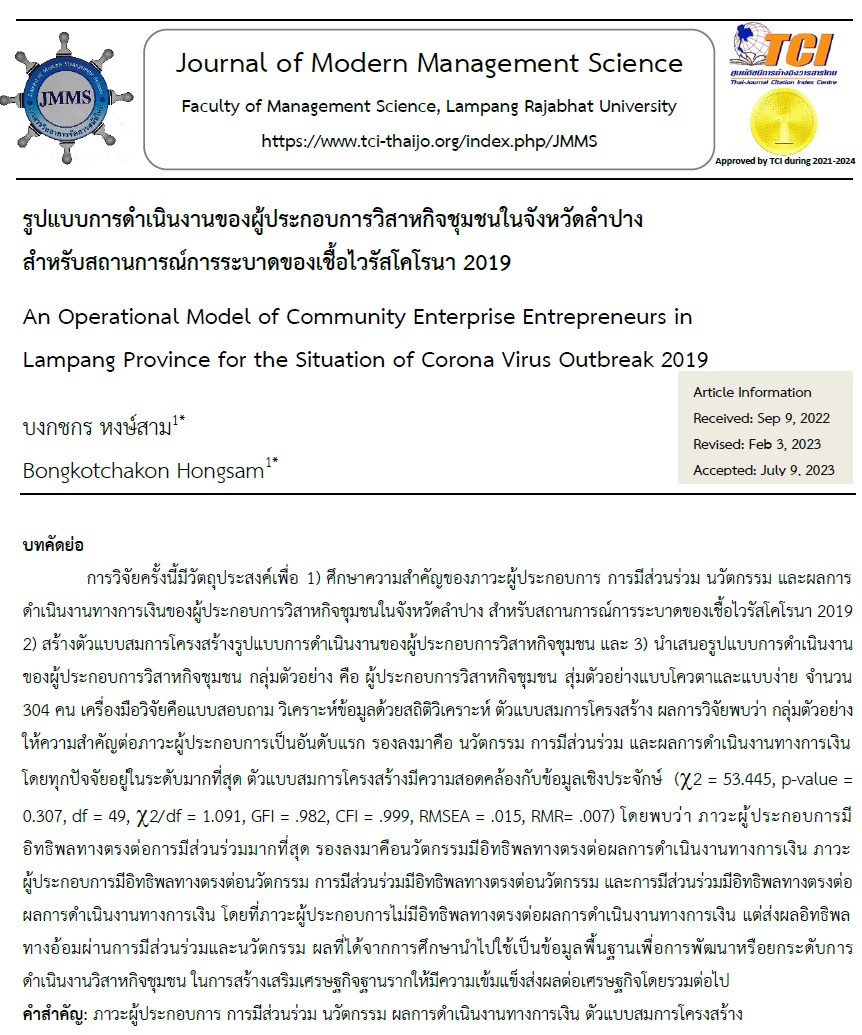
การวิจัยครั้งนี้มีวัตถุประสงค์เพื่อ 1) ศึกษาความสำคัญของภาวะผู้ประกอบการ การมีส่วนร่วม นวัตกรรม และผลการดำเนินงานทางการเงินของผู้ประกอบการวิสาหกิจชุมชนในจังหวัดลำปาง สำหรับสถานการณ์การระบาดของเชื้อไวรัสโคโรนา 2019 2) สร้างตัวแบบสมการโครงสร้างรูปแบบการดำเนินงานของผู้ประกอบการวิสาหกิจชุมชน และ 3) นำเสนอรูปแบบการดำเนินงานของผู้ประกอบการวิสาหกิจชุมชน กลุ่มตัวอย่าง คือ ผู้ประกอบการวิสาหกิจชุมชน สุ่มตัวอย่างแบบโควตาและแบบง่าย จำนวน 304 คน เครื่องมือวิจัยคือแบบสอบถาม วิเคราะห์ข้อมูลด้วยสถิติวิเคราะห์ ตัวแบบสมการโครงสร้าง ผลการวิจัยพบว่า กลุ่มตัวอย่างให้ความสำคัญต่อภาวะผู้ประกอบการเป็นอันดับแรก รองลงมาคือ นวัตกรรม การมีส่วนร่วม และผลการดำเนินงานทางการเงิน โดยทุกปัจจัยอยู่ในระดับมากที่สุด ตัวแบบสมการโครงสร้างมีความสอดคล้องกับข้อมูลเชิงประจักษ์ (c2 = 53.445, p-value = 0.307, df = 49, c2/df = 1.091, GFI = .982, CFI = .999, RMSEA = .015, RMR= .007) โดยพบว่า ภาวะผู้ประกอบการมีอิทธิพลทางตรงต่อการมีส่วนร่วมมากที่สุด รองลงมาคือนวัตกรรมมีอิทธิพลทางตรงต่อผลการดำเนินงานทางการเงิน ภาวะผู้ประกอบการมีอิทธิพลทางตรงต่อนวัตกรรม การมีส่วนร่วมมีอิทธิพลทางตรงต่อนวัตกรรม และการมีส่วนร่วมมีอิทธิพลทางตรงต่อผลการดำเนินงานทางการเงิน โดยที่ภาวะผู้ประกอบการไม่มีอิทธิพลทางตรงต่อผลการดำเนินงานทางการเงิน แต่ส่งผลอิทธิพลทางอ้อมผ่านการมีส่วนร่วมและนวัตกรรม ผลที่ได้จากการศึกษานำไปใช้เป็นข้อมูลพื้นฐานเพื่อการพัฒนาหรือยกระดับการดำเนินงานวิสาหกิจชุมชน ในการสร้างเสริมเศรษฐกิจฐานรากให้มีความเข้มแข็งส่งผลต่อเศรษฐกิจโดยรวมต่อไป
Article Details

อนุญาตภายใต้เงื่อนไข Creative Commons Attribution-NonCommercial-NoDerivatives 4.0 International License.
บทความจะต้องผ่านการพิจารณายอมรับให้ตีพิมพ์ได้โดยกองบรรณาธิการของวารสารการจัดการ คณะวิทยาการ มหาวิทยาลัยราชภัฎลำปาง และได้รับการตรวจอ่านโดยผู้ทรงคุณวุฒิ(Peer review) และผู้เขียนบทความต้องปรับปรุงตามข้อเสนอแนะหากมีก่อนตีพิมพ์ บทความที่ไม่ผ่านการพิจารณา กองบรรณาธิการจะแจ้งให้ทราบผลการพิจารณา แต่จะไม่ส่งต้นฉบับคืนผู้เขียน
วารสารวิทยาการจัดการสมัยใหม่ คณะวิทยาการจัดการ มหาวิทยาลัยราชภัฏลำปาง ตีพิมพ์เผยแพร่ทั้งฉบับพิมพ์และฉบับออนไลน์ เราอนุญาตให้นำบทความไปใช้ประโยชน์ทางวิชาการได้ ภายใต้ขอบเขตของกฏหมายลิขสิทธิ์
เอกสารอ้างอิง
กองส่งเสริมวิสาหกิจชุมชน กรมส่งเสริมการเกษตร. (2564). รายงานสรุปประเภทกิจการวิสาหกิจชุมชน/เครือข่ายวิสาหกิจชุมชน. สืบค้นเมื่อ 9 มกราคม 2565, จาก https://smce.doae.go.th/smce1/report.
จันทิรา พรศิรินนท์. (2562). การพัฒนาศักยภาพความเป็นผู้ ประกอบการเพื่อสร้างความได้ เปรียบ ทางการแข่งขันของกลุ่มผู้ผลิตสินค้า OTOP จังหวัด บุรีรัมย์. Electronic Journal of Open and Distance Innovative Learning, 9(2), 31-37.
จินตวีร์ เกษมศุข. (2561). แนวคิดการมีส่วนร่วมของประชาชนเพื่อการพัฒนาชุมชนที่ยั่งยืน Public Participation Approach for Sustainable Community Development. วารสารวิชาการ มนุษยศาสตร์และสังคมศาสตร์ มหาวิทยาลัยบูรพา, 26(50), 169-186.
ณัชชา เจริญศรี. (2563). “ผลกระทบโควิด 19 ด้านเศรษฐกิจและโอกาสทางธุรกิจ”. สืบค้นเมื่อ 4 กุมภาพันธ์ 2565, จาก https://www.storehub.com/blog/covid-19.
ธันยมัย เจียรกุล. (2557). ปัญหาและการปรับตัวของ OTOP เพื่อพร้อมรับการเปิด AEC. วารสารนักบริหาร, 34(1), 177-191.
บุญฑวรรณ วิงวอน. (2550). การจัดการธุรกิจขนาดย่อม. ลำปาง: สาขาวิชาการจัดการทั่วไป คณะวิทยาการจัดการ มหาวิทยาลัยราชภัฏลำปาง.
บุญฑวรรณ วิงวอน. (2555). การเป็นผู้ประกอบการยุคโลกาภิวัฒน์. (พิมพ์ครั้งที่ 1). กรุงเทพฯ: สำนักพิมพ์แห่งจุฬาลงกรณ์มหาวิทยาลัย, 213-214.
สำนักงานส่งเสริมวิสาหกิจขนาดกลางและขนาดย่อม. (2563). “บทที่ 7 วิสาหกิจขนาดกลางและขนาดย่อมกับสถานการณ์การแพร่ระบาดของโรคเชื้อไวรัสโคโรนา 2019”. รายงานส่งเสริมวิสาหกิจขนาดกลางและขนาดย่อม. 19(1), 80-87.
Banyte, J., Salickaite, R. (2008). Successful diffusion and adoption of innovation as a means to increase competitiveness of enterprises. Inzinerine Ekonomika-Engineering Economics, 1, 48-56.
Butler, R. (1988). Enhancing and undermining intrinsic motivation: The effects of task-involving and ego-involving evaluation of interest and performance. British Journal of Educational Psychology, 58(1), 1–14.
Byrne, B. M. (2001). Structural equation modeling with AMOS: Basic concepts, applications, and programming. Mahwan, NJ: Lawrence Erlbaum Associates.
Chen, J. S., H. T. Tsou & Russell K. H. Ching. (2011). Co-Production and Its Effects on Service Innovation. Industrial Marketing Management, 40, 1331-1346.
Chen, Y. R. R., & Hung-Baesecke, C. J. F. (2014). Examining the internal aspect of corporate social responsibility (CSR): Leader behavior and employee CSR participation. Communication research reports, 31(2), 210-220.
Chow, C. W., & Van der Stede, W. A. (2006). The use and usefulness of nonfinancial performance measures. Management Accounting Quarterly, 7(3), 1–8.
Cohen, John M. & Uphoff, Norman T. (1980). Participation’s Place in Rural Development: Seeking Clarity Through Specificity. World Development. 8(3), 213-235.
Covin, J.G. & Slevin, D.P. (1991). A Conceptual Model of Entrepreneurship as a Firm Behavior. Entrepreneurship Theory and Practice, 16, 7-25.
Creighton, J. L. (2005). The public participation handbook: Making better decisions through citizen involvement. San Francisco, CA: Jossey-Bass.
Della Corte, V., Zamparelli, G., & Micera, R. (2013). Innovation in tradition-based firms: dynamic Knowledge for international competitiveness. European Journal of Innovation Management, 16(4), 405-439.
Dess, G. G., Lumpkin, G. T., & Taylor, M. L. (2005). Strategic management: Creating competitive advantage (2nd ed.). New York: McGraw-Hill.
Hair, J.F., Black, W.C., Babin, B.J. & Anderson, R.E. (2010). Multivariate Data Analysis. (7th ed.). Pearson: New York.
Hambleton, R. K. (1984). Validating the test scores. In R. A. Berk (Ed.), A guide to criterion-referenced test construction. Baltimore and London: The Johns Hopkins University Press.
Hidayato, A.N., & Setyady, S.T. (2014). Impact of collaborative tools utilization on group performance in University students. TOJET: The Turkish Online Journal of Educational Technology. 13(2), 88-98.
Hongqi, Z. and Ruoyu, L. (2012). Empirical research of the relationship between customer participation, customer satisfaction and service innovation performance in China. African Journal of Business Management, Vol. 6(4), 1449-1454.
Husnah, Subroto B., Aisjah. S., & Djumahir. (2013). Intangible Assets, Competitive Strategy And Financial Performance: Study On Rattan SMEs In Palu City Of Central Sulawesi (Indonesia). Journal of Business and Management, 7(4), 14-27.
Kaplan, R. S., & Norton, D. P. (1996). Linking the balanced scorecard to strategy. California Management Review, 39(1), 53–79.
Kline, R. B. (2005). Principles and practice of structural equation modeling (2nd ed.). New York: Guilford Press. (Chapter 1, Introduction).
Lertpachin, C. and Wingwon, B. (2011). The effects of entrepreneurs and strategic management toward the business success of SMEs in northern region of Thailand. African Journal of Marketing Management, 3(12), 312-323.
Likert, R. N. (1970). A technique for the measurement of attitude. Attitude Measurement. Chicago: Ronal McNally & Company.
Low, M. B. & MacMillan, I. C. (1988). Entrepreneurship: Past Research and Future Challenges. Journal of Management, 14, 139-162.
Melnikas, B. (2008). The knowledge-based economy in the European Union: Innovations, networking and transformation strategies. Transformations in Business and Economics, 7(3), 170-192.
Nooteboom, B., & Stam, E. (2008). Innovation, the economy and policy. In B. Nooteboom, & E. Stam (Eds.), Microfoundations for Innovation Policy, 17-51. Amsterdam University Press.
Nunnally, J. C., & Bernstein, I. H. (1994). Psychometric theory (3 rd ed.). New York: McGraw-Hill.
Raymond, L., & St-Pierre, J. (2003). Entrepreneurial Antecedents and Performance Outcomes of Organizational Development in Manufacturing SMEs. Retrieved. (December 8, 2014)
Schollhammer, H. (1982). Internal Corporate Entrepreneurship. Encyclopedia of entrepreneurship. Englewood Cliffs, N.J.: Prentice-Hall.
Schumpeter, J. A. (1934). The Theory of Eonomic Development. Cambridge Mass: Harvard University Press.
Stevenson H. H. and J. C. Jarillo. (1990). A paradigm of entrepreneurship: Entrepreneurial management. Strategic Management Journal, 11, 17-27.
Tanaka, J. S., & Huba, G. J. (1989). A general coefficient of determination for covariance structure models under arbitrary GLS estimation. British Journal of Mathematical and Statistical Psychology, 42(2), 233-239.
