
Confirmatory Factor Analysis of Consumer Brand Tribalism: A Case Study of a Premium Smartphone Brand in Thailand
Article Sidebar
Main Article Content
Abstract
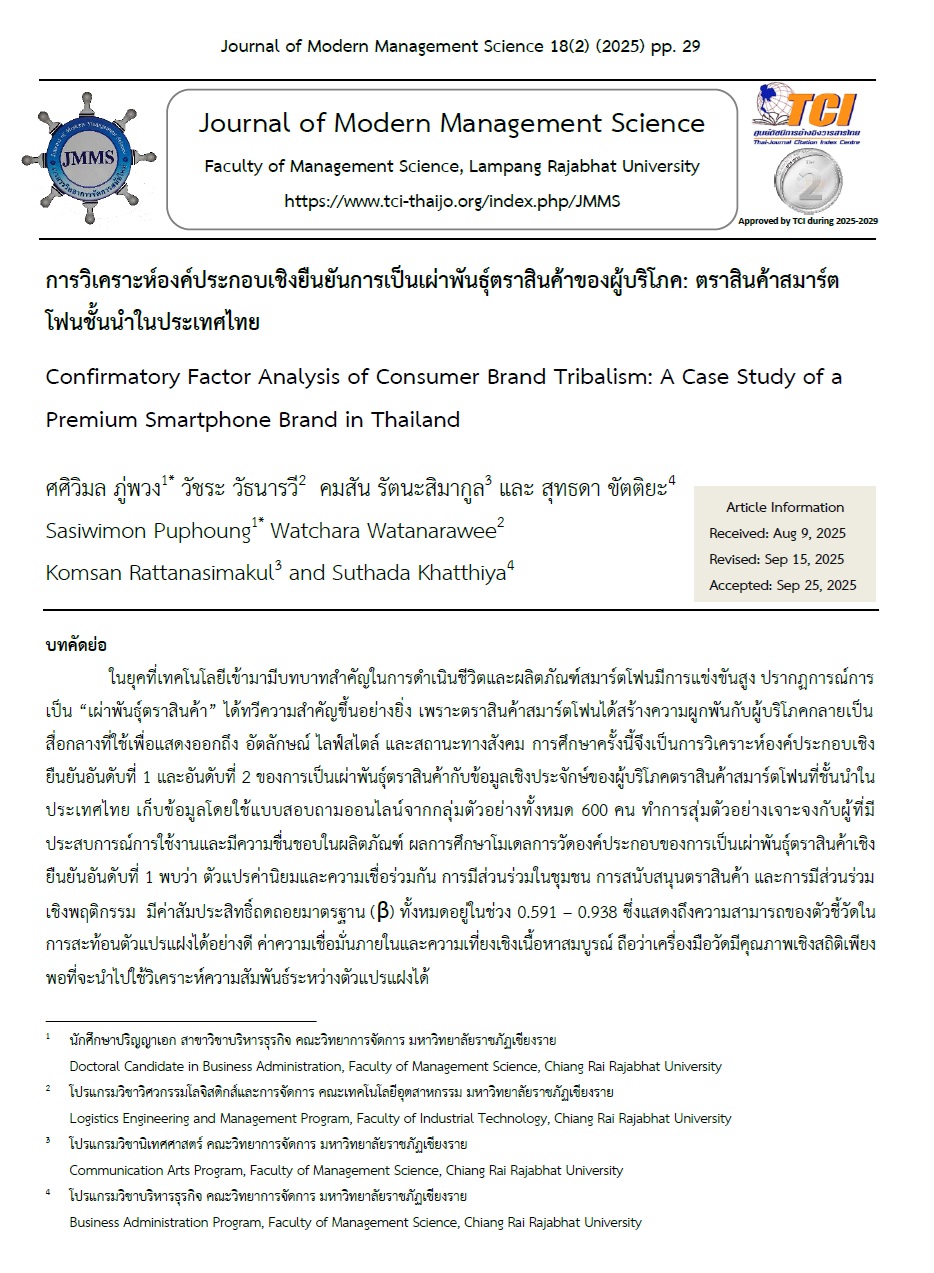
In an era where technology plays a crucial role in daily life and smartphone products face intense competition, the phenomenon of "brand tribalism" has become increasingly significant. Smartphone brands have created emotional bonds with consumers, serving as a medium through which consumers express their identity, lifestyle, and social status. This study therefore analyzes the first-order and second-order confirmatory factor components of brand tribalism using empirical data from consumers of a premium smartphone brands in Thailand. Data collection was conducted through online questionnaires from a total sample of 600 respondents, using purposive sampling targeting individuals with experience using and expressing preference for the products. The results of the first-order confirmatory factor analysis measurement model for brand tribalism revealed that the variables of shared values and beliefs, community participation, brand advocacy, and behavioral engagement all demonstrated standardized regression coefficients (β) ranging from 0.591 to 0.938, indicating the indicators' strong ability to reflect the latent variables effectively. The internal reliability and content validity were deemed complete, confirming that the measurement instrument possessed sufficient statistical quality for analyzing relationships between latent variables.
The second-order confirmatory factor analysis revealed that the brand tribalism model comprising four variables showed positive factor loadings across all values, ranging from 0.783 to 0.975. Shared values and beliefs exhibited the highest loading, followed by community participation, brand advocacy, and behavioral engagement, explaining 61.30% to 95.10% of the variance. Model fit testing demonstrated that all values met the established criteria. The study findings confirm that the brand tribalism model demonstrates a good fit with empirical data and can be effectively measured through all four components, with shared values and beliefs having the greatest impact on brand tribalism. This strong influence occurs because the shared values they embrace-innovation, quality, and social identity expression-align with the symbolic values that the brand communicates. The resulting model provides valuable insights for marketers in developing approaches to build brand tribal communities and designing strategies to create and maintain long-term brand-loyal customer groups.
Article Details

This work is licensed under a Creative Commons Attribution-NonCommercial-NoDerivatives 4.0 International License.
The article must be considered and accepted for publication by the editorial board of the Faculty of Management Science, Lampang Rajabhat University. The articles have been reviewed by a peer (peer review) and the author must update according to the suggestion if available before publication. Articles that are not considered the editorial team will inform the results of the consideration but will not send the original to the author.
JMMS is the Faculty of Management Science journal, Lampang Rajabhat University. Jmms published both print and online editions. We allow the use of articles for academic use under the scope of copyright law.
References
Ali, M. A., Hussin, N., & Hamid, A. B. A. (2020). Brand tribe paradoxes: An overview with empirical evidence from Pakistan. Asian Social Science, 16(4), 37–50. https://doi.org/10.5539/ass.v16n4p49
Amellia, A., & Berlianto, M. P. (2023). Factors That Affect Customer Satisfaction and Brand Loyalty for The Apple Brand in Indonesia. Manajemen Bisnis, 13(2), 09–24.
Ariel, B. M. A. D. B., Siagian, V., & Malau, H. (2024). The influence of brand awareness, brand image, and customer loyalty on purchasing decisions for Apple brand products. Journal Mantik, 8(1), 369–380.
Canalys. (2025). Southeast Asia's smartphone shipments up 11% in 2024 as OPPO takes lead for first time. Retrieved February 2, 2025, from https://www.canalys.com/newsroom/southeast-asia-smartphone-market-q4-2024
Cova, B., & Cova, V. (2002). Tribal marketing: The tribalisation of society and its impact on the conduct of marketing. European Journal of Marketing, 36(5/6), 595–620.
Fornell, C., & Larcker, D. F. (1981). Evaluating structural equation models with unobservable variables and measurement error. Journal of marketing research, 18(1), 39–50.
Ghar, S. (2024). Apple’s innovation odyssey: Deciphering the route to market leadership [Unpublished master’s thesis]. ResearchGate. https://www.researchgate.net/publication/380098858
Giovandhi, L., & Adlina, H. (2023). The effect of product quality and brand love on repurchase intention on Apple brand (Study on Generation Z students using Apple products at the University of North Sumatra). Journal of Economics and Business (JECOMBI), 3(2), 64–72. https://doi.org/10.58471/jecombi.v3i02.46
Gonçalves Filho, C., Chinelato, F. B., & Couto, T. M. M. (2022). Brand loyalty through brand tribalism: An anthropological perspective. Management Research Review, 45(6), 735–759.
Hair, J. F., Black, W. C., Babin, B. J. & Anderson, R. E. (2010). Multivariate Data Analysis (7th ed.). Prentice Hall.
Kalra, G., Jhamb, D., & Mittal, A. (2024). Emotional brand attachment, brand tribalism, and co-creation in luxury hotels: Insights from emerging economies. The Open Psychology Journal, 17, e18743501301683. https://doi.org/10.2174/0118743501301683240516055354
Kenny, D. A., Kaniskan, B., & McCoach, D. B. (2015). The performance of RMSEA in models with small degrees of freedom. Sociological methods & research, 44(3), 486–507.
Khamwon, A., Hayeemad, M., & Kuwatchanakul, P. (2020). The Effect of Character of Online Game, Brand Tribalism, Word of Mouth,on Intention to Purchase. Modern Management Journal, 18(2), 40–53.
Khamworn, A., & Kamkliang, O. (2018). Brand experience, brand tribes, and brand loyalty: A case study of Amway business owners in Thailand. Journal of Business Administration, 41(157), 22–38.
Kim, H., Park, J., & Lee, Y. (2021). Social influence and media exposure in brand community engagement. Journal of Consumer Marketing, 38(4), 412–423.
Kline, R. B. (2016). Principles and Practice of Structural Equation Modeling (4th ed.). New York, NY: The Guilford Press.
Kotler, P., & Armstrong, G. (2020). Marketing: An Introduction (14th ed.). Pearson.
Magni, P. (2024). Apple Brand Community: 5 Takeaways for Building Loyal Customers. https://arena.im/brand-community/apple-brand-community/
National Statistical Office, Ministry of Digital Economy and Society. (2024). Survey on information and communication technology use in households, 2024 (Q4). https://www.nso.go.th/nsoweb/storage/survey_detail/2025/20250228090924_27941.pdf
Pathirana, L. P. D. S., & Abeysekera, N. (2021). Reviewing the concepts of brand community, brand tribalism and brand cult on relationship marketing in Sri Lankan building material sector. Asian Journal of Management Studies, 1(2), 75–97.
Schau, H. J., Muñiz, A. M., & Arnould, E. J. (2009). How brand community practices create value. Journal of Marketing, 73(5), 30–51.
Schumacker, R. E., & Lomax, R. G. (2016). A Beginner’s Guide to Structural Equation Modeling (4th Ed.). Routledge.
Suksawang, P. (2014). Principles of structural equation modeling analysis. Narathiwat Rajanagarindra University Journal, 6(2), 136–145. https://li01.tci-thaijo.org/index.php/pnujr/article/view/53852
Taute, H. A., & Sierra, J. J. (2014). Brand tribalism: An anthropological perspective. Journal of Product & Brand Management, 23(1), 2–15.
Yang, Z. (2020). The impact of brand innovativeness on customer loyalty: Take Apple Inc. as an example. In Proceedings of the 4th International Seminar on Education, Management and Social Sciences (ISEMSS 2020) (pp.398–402). Atlantis Press. https://doi.org/10.2991/assehr.k.200826.088
Zou, Y. (2023). Apple’s brand marketing strategy: A case study on brand image and customer engagement. Highlights in Business Economics and Management, 23, 712–715. https://doi.org/10.54097/sbcggy69
