July - December (In progress)
Vol. 45 No. 2 (2026)
January - June
Vol. 45 No. 1 (2026)
July - December
Vol. 44 No. 2 (2025)
January - June
Vol. 44 No. 1 (2025)
Our new issue of the Journal of Language and Culture offers a range of research articles that are all related to each other, as they look at how language, culture, and education influence cognitive, communicative, and social experiences. Many of these articles focus on how Thai undergraduate and graduate students' critical thinking and problem-solving skills have grown and how they are tested. Other papers also cover topics such as the creative language of English internet slang, the impact of Christian ethics on literary representations of the environment, the communication needs of southern Thai tourism professionals, and interactive museum exhibit design. All of these pieces have one main theme in common, which is the fact that language and cultural frameworks are vital for promoting critical thinking, ethical behaviour, and working together in school, at work, as well as in different social situations.
July - December
Vol. 43 No. 2 (2024)
Editorial Note
The Journal of Language and Culture, Vol.43 No.2 (2024), adopts the theme of "Intercultural Communication," presenting diverse and thought-provoking research articles that explore the multifaceted relationship between language, culture, and communication in a globalized world. This volume comprises eight scholarly articles, each contributing unique insights into the complexities of intercultural interactions, language education, and cultural dynamics across various contexts.
Among the articles, topics include the integration of cultural content in English language education, the intersection of gender bias in translation practices, and the role of teacher and gender identities in shaping pedagogical effectiveness. These studies highlight the growing importance of fostering cultural awareness and inclusivity in education and communication.
In addition to the research articles, this issue features a review of the book Language, Culture, and Society: An Introduction to Linguistic Anthropology (7th Edition) by James Stanlaw, Nobuko Adachi, and Zdenek Salzmann. The book offers a comprehensive introduction to linguistic anthropology, bridging concepts of language, culture, and society while addressing contemporary issues such as digital communication and globalization. The review emphasizes its value as a foundational resource for students and professionals alike.
The editorial team extends its deepest gratitude to the authors, reviewers, and production staff for their dedicated contributions to this volume. Their efforts ensure that the journal continues to serve as a premier platform for the dissemination of high-quality research on language and culture.
We invite our readers to explore the articles and book review in this volume, which collectively aim to inspire further research and dialogue in the field of intercultural communication.
Asst. Prof. Sunida Sivapathomchai, Ph.D.
Guest Editor
January - June
Vol. 43 No. 1 (2024)
Editorial note
The Journal of Language and Culture, Vol.43 No.1 (2024) does not have a specific theme but still accepts research articles within the scope specified by the journal. There are those interested in submitting articles about linguistics and applied linguistics, translation studies, language education, cultural studies, and anthropology.
In addition to the eight research articles, there is also a book review entitled Believability: Sexual Violence, Media, and the Politics of Doubt, written by Sarah Banet-Weiser and Kathryn Claire Higgins. The editors sincerely hope that readers will receive academic benefits from this journal in terms of concepts, research methods, study results, and various recommendations from the articles that can serve as guidelines for thinking about research issues related to the fields of humanities and social sciences in the future.
The editorial team of the journal is dedicated to establishing it as a premier venue for high-quality academic publications on language and culture. Articles can be submitted through ThaiJo at https://so03.tci-thaijo.org/index.php/JLC.
In conclusion, representing the journal, we extend our heartfelt gratitude to the authors, reviewers, and production staff who have helped establish The Journal of Language and Culture as a vital platform for sharing knowledge, high-quality research on language and culture, and valuable academic articles. Their contributions have allowed the journal to continuously evolve and offer enriching insights to its readership. Additionally, we are delighted to mark the 50th anniversary of RILCA's founding this year.
Associate Professor Dr. Siripen Ungsitipoonporn
Editor
July - December
Vol. 42 No. 2 (2023)
Editorial Notes
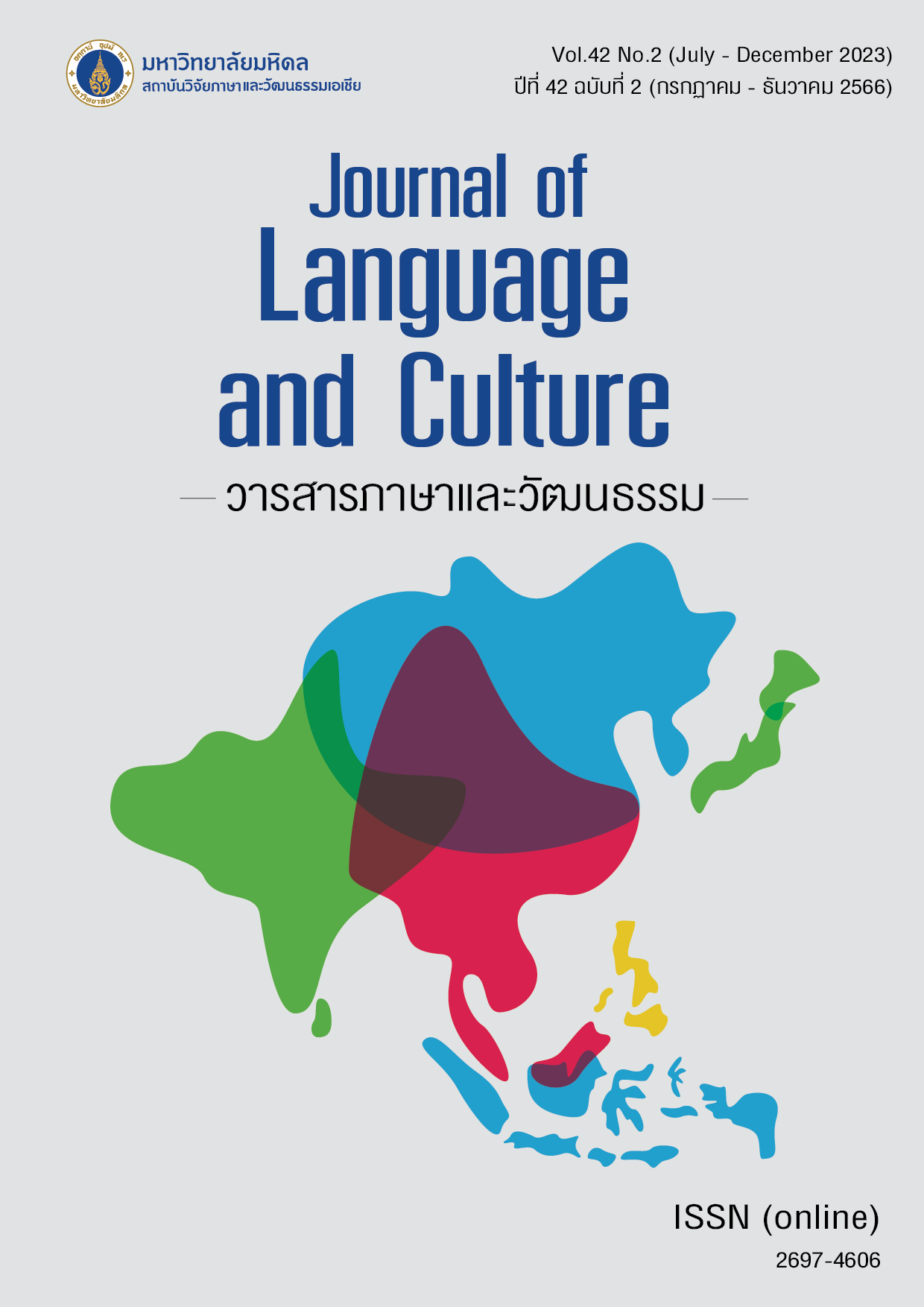
Northeast Asia and Southeast Asia are two global regions located with a certain geographical symmetry on the western Pacific rim of Eurasia. Each region comprises continuums of internal ethnic and material diversities, the interconnected natures of which have given rise to their longterm historico-cultural coherence. The two regions are the object of extensive research at both national and international levels across a range of disciplines, yet to date there has only been limited research conducted between the two areal fields. Such bilateral research currently focuses on direct transregional connections premised on early maritime trade, common practices of Buddhism, and historical interactions with China and other cultures in Eastern Eurasia.
Significant as these connections are to transasian history and culture, the two regions further share a number of structural parallels, including between their ethno-linguistic topographies, archaeologies, and historical trajectories from early history to modern nation states. Such parallels are at once a product of geographical symmetry, forces of global history, and common international research trends. We believe that through comparative investigation these parallels can yield fresh insights towards both transasian commonalities and regional specificities. Studying such parallels, however, requires sustained cooperative research to enable mutual exchange of knowledge and methods, as has been initiated in the current issue of Journal of Language and Culture.
January - June
Vol. 42 No. 1 (2023)
Editorial note from special theme co-editors
“Revisiting Tourism Culture”
This issue of Journal of Language and Culture has three papers under the special theme ‘Revisiting tourism Culture.’ The theme emerged from a workshop under the same name that took place virtually in July 2022 — the time when tourism culture has entered a new era as the pandemic started easing. We proposed this topic during a Journal of Language and Culture editorial board meeting as the journal is also entering a new phrase of welcoming regular papers as well as proposed-theme issues. This allows the journal to further address the cross-over research areas within its aims and scope and reach out more directly to international and interdisciplinary scholars. While the focus of this theme issue is on ‘tourism,’ the two of us come from different research areas outside tourism studies. Sirijit’s background is in women studies and migration, while Wikanda’s is in East Asian cinema and screen industries. With the prominence of Thailand’s mass tourism since the 1980s, the rise of media tourism and global mobilities since the 1990s, and more complex and diverse forms of tourism practices from the 2000s onwards, in one way or another our works touch on the complex socio-cultural conditions shaping tourism culture. During the pandemic, Sirijit conducted research on gendered labour and woman workers in service and care industries in the town of Hua Hin, Thailand, while Wikanda has just completed a project on film fan tourism, looking at fan paratexts and responses to this kind of tourism from local businesses. This special issue allows us to further engage with socio-cultural questions around tourism practices that have been somewhat underdiscussed within the domain of tourism development in the context of Thailand. Following the workshop, which was kindly joined by two keynote speakers Associate Professor Sangkyun Kim from Edith Cowan University, Western Australia and Professor Mary Mostafanezhad from University of Hawaiʻi at Mānoa, we have worked with the authors and external reviewers to produce three articles that illuminate recent cultural politics in Thai tourism.
The first article by Narong Ardsmiti and Kritsada Loekbubpa elucidates environmental and socio-economic changes that have drawn the Maniq, an indigenous people in the South of Thailand, to participate in different forms of charity, ethnic and festival tourism. The paper offers rich information on how tourism creates circumstances that contradict with the Maniq’s traditional way of life and spiritual connection with the forest. Through careful ethnographic research, the authors describe and analyze the ways in which the Maniq negotiates with more powerful actors who are in control of tourism activities. Their strategies range from subtly refusing to engage or actively asking certain mediators to help solve various conflicts. The paper raises further questions on the economic reason that drives local entrepreneurs and organizations to conduct ethnic tourism in the forest and the impacts on those being subjected to perform as well as the power-play among different parties involved.
Resonating with the first paper in terms of exploring the impact of tourism development at a specific site in Thailand, the second paper by Alexandra Denes and Sorayut Aiemueayut draws attention to the phenomenon of nostalgic heritage tourism, which emerged around the same time as the growth of online media and visual culture in tourism promotion. Focusing on the historic town of Chiang Khan in Loei Province, situated on the Thai-Lao border, the paper discusses the impact that mass tourism brought to the local community, particularly in terms of changing jobs and traditional way of life as different groups enter the tourism sector. Through participatory research using visual ethnography as a way to engage with different partners ranging from a local video production company, cultural stakeholders, businesses, and governmental agencies, the research team were able to explore different layers of community relations involving with the tradition of sticky rice almsgiving. The experimental co-creative method problematizes the issue of media stereotype of the town and offers a platform for stakeholders to work together to help shape future tourism practices.
The final paper in this theme issue engages with a different kind of conflict emerging from the growth of tourism business in relation to World War II and war crimes. Focusing on the globally known site of the Thai-Burmese Death Railway across the river Khwae in Kanchanaburi Province in Thailand, the paper by Lukas C. Husa surveys related sites and tourists’ experiences as they encountered the ‘touristification’ of wartime atrocities. As the memories of the war have been mediated in vastly different ways by different groups, the author reflects on the accidental growth of tourism after the success of the 1957 Hollywood film and conflicting messages that emerged from the commercialization of the key historical site at the bridge. The mixed responses from the tourists of different nationalities with different expectations on the practice of memorialization reveal the complicated situation of Thailand in narrating this particular war history due to its political alliances. At the same time, and similar to the other two case studies, this paper also highlights the way economic growth dominates the important question of cultural sensitivity. Altogether, these papers encourage us to put culture and co-creation at the forefront of tourism businesses. Various methods proposed by these papers also highlight agents of change within local communities as well as the tourists themselves in being aware of their contributions and impact as they take part in tourism activities.
We kindly appreciate all the participants who joined us at the workshop and all the contributors who share their valuable research with us.
Wikanda Promkhuntong and Sirijit Sunanta
July - December
Vol. 41 No. 2 (2022)