

About the Journal

Interdisciplinary Academic and Research Journal
Old ISSN 2774-0374 (Online): New ISSN 2985-2749 (Online)
Crossref Member name: Dr. Ken Institute of Academic Development and Promotion
DOI prefix (Crossref): 10.60027
Doi Prefix (DataCite): 10.14456
CrossRef Participation Reports
Publisher Research Organization Registry (ROR): https://ror.org/01hcs0b49

 
Warning

Currently, there are scammers claiming to be able to contact journals to issue publication receipts.  The journal would like to inform authors that we will only provide the Acceptance Letter in electronic form by the DR.KEN Institute of Academic Development and Promotion from E-mail: dr.keninstitute@gmail.com. And if the author's affiliated organization wishes to recheck (Must do), please contact the journal's email: E-mail: dr.keninstitute@gmail.com, so that the journal will promptly respond.

 Note: Please do not trust anyone claiming to be able to contact the journal to provide the Acceptance Letter. Our journal strictly follows TCI policies and standards. All articles submitted will go through the Review process according to the Peer Review policy until the process is complete, then the Acceptance Letter can be issued.


Publishing Policy - Aims and Scope

The Interdisciplinary Academic and Research Journal (IARJ) publishes research articles, academic articles, review articles, and book reviews across three broad subject areas. The journal welcomes disciplinary and interdisciplinary contributions within the following fields:

1. Social Sciences, Humanities, Law, and Interdisciplinary Studies

1.1 General Social Sciences: Anthropology (cultural, biological, linguistic, and archaeology); Sociology (theory, inequality, and demography); Political Science (comparative politics, political theory, international relations, and public administration); Human Geography (cultural, economic, and political); Economics (microeconomics, macroeconomics, and development economics); Social Psychology; Communication and Media Studies; and Education (sociology and policy).

1.2 Religion and Philosophy: Ethics and Applied Philosophy; Philosophy of Law and Politics; Religious Education; Comparative Religion; Interfaith Dialogue and Peacebuilding; Philosophy of Science and Technology; Bioethics and Environmental Ethics; and Spiritual Counseling and Community Leadership.

1.3 Law: Criminal Law and Criminology; Civil and Commercial Law; Constitutional and Administrative Law; International Law; Human Rights Law; Environmental Law; Labour and Employment Law; and Legal Studies and Jurisprudence.

1.4 Linguistics: Applied Linguistics; Sociolinguistics; Psycholinguistics; Language Education and TESOL; Translation and Interpretation; Computational Linguistics; Language Policy and Planning; and Forensic Linguistics.

1.5 Interdisciplinary Social Studies: Gender and Sexuality Studies; Cultural Studies; Environmental Studies; Peace and Conflict Studies; Global and Area Studies; Public Health (social science perspective); Science, Technology and Society (STS); and Migration and Diaspora Studies.

2. Public Administration, Political Science, Business Administration, and Development

2.1 Public Administration: Public Policy Analysis; Public Sector Management; Governance and Institutional Development; Fiscal Administration and Public Finance; Human Resource Management in Government; E-Government and Digital Governance; Nonprofit and NGO Management; and Public Service Ethics and Accountability.

2.2 Political Science: Public Policy and Governance; International Relations and Diplomacy; Comparative Politics; Political Economy; Political Communication; Public Administration; Security and Strategic Studies; and Peace and Conflict Resolution.

2.3 Business Administration: Management and Leadership; Marketing; Finance and Accounting; Operations and Supply Chain Management; Human Resource Management; Entrepreneurship and Innovation; Strategic Management; and International Business.

2.4 Development Studies: International Development; Community Development; Rural and Urban Development; Sustainable Development; Economic Development Planning; Social Policy and Development; Capacity Building and Institutional Strengthening; and Monitoring and Evaluation of Development Programs.

3. Education and Applied Social Sciences

3.1 Education: Educational Policy and Leadership; Curriculum and Instruction; Educational Psychology; Special and Inclusive Education; Adult and Continuing Education; Comparative and International Education; Sociology of Education; and Teacher Education and Professional Development.

3.2 Applied Social Sciences: Criminology; Social Work; Public Policy; International Development; Urban and Regional Planning; Human Resource Management; Counseling and Community Services; Gender and Cultural Studies; Public Health; Health Policy and Management; Health Education and Promotion; Community Health; Epidemiology (social perspective); Health Communication; Medical Sociology; Mental Health Services; Sports Management; Sports Psychology; Physical Education; Exercise and Fitness Science; Rehabilitation and Sports Therapy; Coaching and Performance Analysis; Sports Sociology; and Event and Facility Management.


Type of Articles

1. A Research Article is a report of the results of a systematic study, research, or development.

2. An Academic Article is a work of writing an interesting topic in which the author presents new knowledge by using theories, concepts, and related research results as information sources.

3. A Review Article is an article that combines theories, concepts, and research results on many subjects. The author will synthesize the literature to compile it into a conclusion or argument on a particular matter, which is a review of the academic progress of that matter.


Guidelines on AI-Generated Content

IARJ permits responsible use of generative AI and AI-assisted technologies with appropriate human oversight and disclosure. AI tools cannot be listed as authors. Authors remain fully responsible for the accuracy, originality, references, and ethical integrity of their manuscripts.

Material AI use must be disclosed in the Declaration Form according to the revised template, applicable from Volume 7, Issue 1 (2027) onward. AI must not be used to fabricate evidence, conceal plagiarism, compromise confidentiality, or manipulate peer review.

For disclosure requirements, author contributions, and manuscript preparation, see Publication Ethics and Author Instructions.

Article Retraction Policy

IARJ may retract articles when serious errors, misconduct, plagiarism, redundant publication, ethical violations, or compromised peer review undermine their reliability or integrity.

Retraction normally preserves the article with a clear retraction marking and a linked notice explaining the reasons. Errors that do not invalidate the principal findings may receive a correction; unresolved serious concerns may warrant an expression of concern.

For assessment procedures, notices, and appeals, see Publication Ethics. Authors should also consult Author Instructions.


Publication Frequency
Interdisciplinary Academic and Research Journal is a bimonthly  journal (6 issues per year)

Issue 1 January–February  

 Issue 2 March–April  

Issue 3 May–June  

Issue 4 July – August 

Issue 5 September–October  

Issue 6 November-December  


Criteria for the consideration and selection of articles

Each article will be reviewed by 2 to 3 peer reviewers with expertise in a related field and will receive editorial approval before publication. The article review will use a format in which the reviewer does not know the author's information, such as name, surname, work experience, etc., and the author of the article does not know the name of the reviewer (Double-Blind Peer Review).

Articles submitted for publication in a journal must not have been published or be under consideration by a peer reviewer for publication in another journal. The author of the article must comply with the journal's article submission guidelines and must follow the journal's format.

The opinions and opinions of the authors of articles are the responsibility of their authors and not the responsibility of the editors.


Journal History

The Interdisciplinary Academic and Research Journal (IARJ), ISSN 2774-0374 (Online), was established in 2021 by the DR.KEN Institute of Academic Development and Promotion, Thailand. The journal publishes six issues annually (bi-monthly) and serves as an international academic platform for interdisciplinary research and scholarly communication.

The journal was initially developed in 2020 as a printed publication with two issues per year: Issue 1 (January–June 2020) and Issue 2 (July–December 2020). During this early stage, the journal was not yet included in the ThaiJO system.

Since its establishment, the journal has achieved several important milestones:

2021

  • The publication frequency was revised from two issues per year to six issues annually to align with the requirements of the Thai-Journal Citation Index Center (TCI).
  • Indexed in Google Scholar.
  • Digital Object Identifiers (DOIs) were registered through the DataCite database.

2022

  • Evaluated and accepted into the Thai-Journal Citation Index Center (TCI) Tier 2 database in June 2022.
  • Articles published from 1 January 2022 onward were officially recognized in the TCI Tier 2 database.

2023

  • The journal revised its publication and printing format to align with international academic publishing standards, beginning with Volume 3, Issue 1.
  • From Volume 3, Issue 6 onward, the journal improved its abstract writing format to enhance international readability and academic presentation.
  • On 13 November 2023, the journal updated its ISSN from 2774-0366 to 2985-2749, effective from Volume 3, Issue 6 onward.
  • The English title of the journal was officially standardized as Interdisciplinary Academic and Research Journal.
  • Beginning with Volume 3, Issue 6, the journal adopted Crossref DOI registration for all published articles to ensure permanent digital identification and global discoverability.

2024

  • The journal adopted APA Style 7th Edition as its official citation and referencing format.
  • Expanded indexing and visibility through platforms including ResearchGate, Semantic Scholar, and SciSpace AI.

2025

  • On 4 February 2025, the Interdisciplinary Academic and Research Journal successfully passed the 5th round of journal quality assessment conducted by the Thai-Journal Citation Index Center (TCI) and was classified as TCI Tier 2 (2025–2029).

2026

  • In 2026, IARJ revised and refined its Aims and Scope to provide a more focused academic direction in interdisciplinary studies, educational research, social sciences, innovation, digital transformation, and applied research. The journal also strengthened its emphasis on methodological rigor, interdisciplinary integration, and research with practical implications for education, society, policy, and sustainable development.

Through continuous development and commitment to academic excellence, the Interdisciplinary Academic and Research Journal continues to strengthen its role as an emerging international journal supporting interdisciplinary knowledge and global academic collaboration.


Plagiarism Policy

The Interdisciplinary Academic and Research Journal is part of the Thai-Journal Citation Index Center database, which has a CopyCatch system for checking plagiarism. All the manuscripts submitted for publication are checked for plagiarism within 24 hours. If plagiarism is identified by the editor-in-chief, editor, reviewer, etc., at any step of the article before or after the peer review process and acceptance, in that case, we will alert the author(s) and will request them to rewrite the content in the article or to cite the references from where the content has been copied. If more than 20% of the content is plagiarized, the article may be suggested to be rewritten or rejected, and the same is informed to the author.


Peer Review Policy

The Interdisciplinary Academic and Research Journal (IARJ) applies peer review to all research articles and most other article types to assess their academic quality, originality, methodological soundness, and contribution to their respective fields.

The journal uses a double-blind peer review process involving at least two independent expert reviewers. The identities of authors and reviewers are concealed from one another throughout the review process.

Reviewers are selected based on their subject expertise, scholarly reputation, relevant recommendations, absence of conflicts of interest, and previous reviewing performance. The journal values timely, thorough, constructive, and well-reasoned evaluations conducted with professionalism and respect.

All communication between authors and reviewers is mediated by the Editor. Authors and reviewers must not communicate directly about a manuscript under review. Reviewers provide recommendations to support editorial assessment; the final publication decision rests with the Editor.

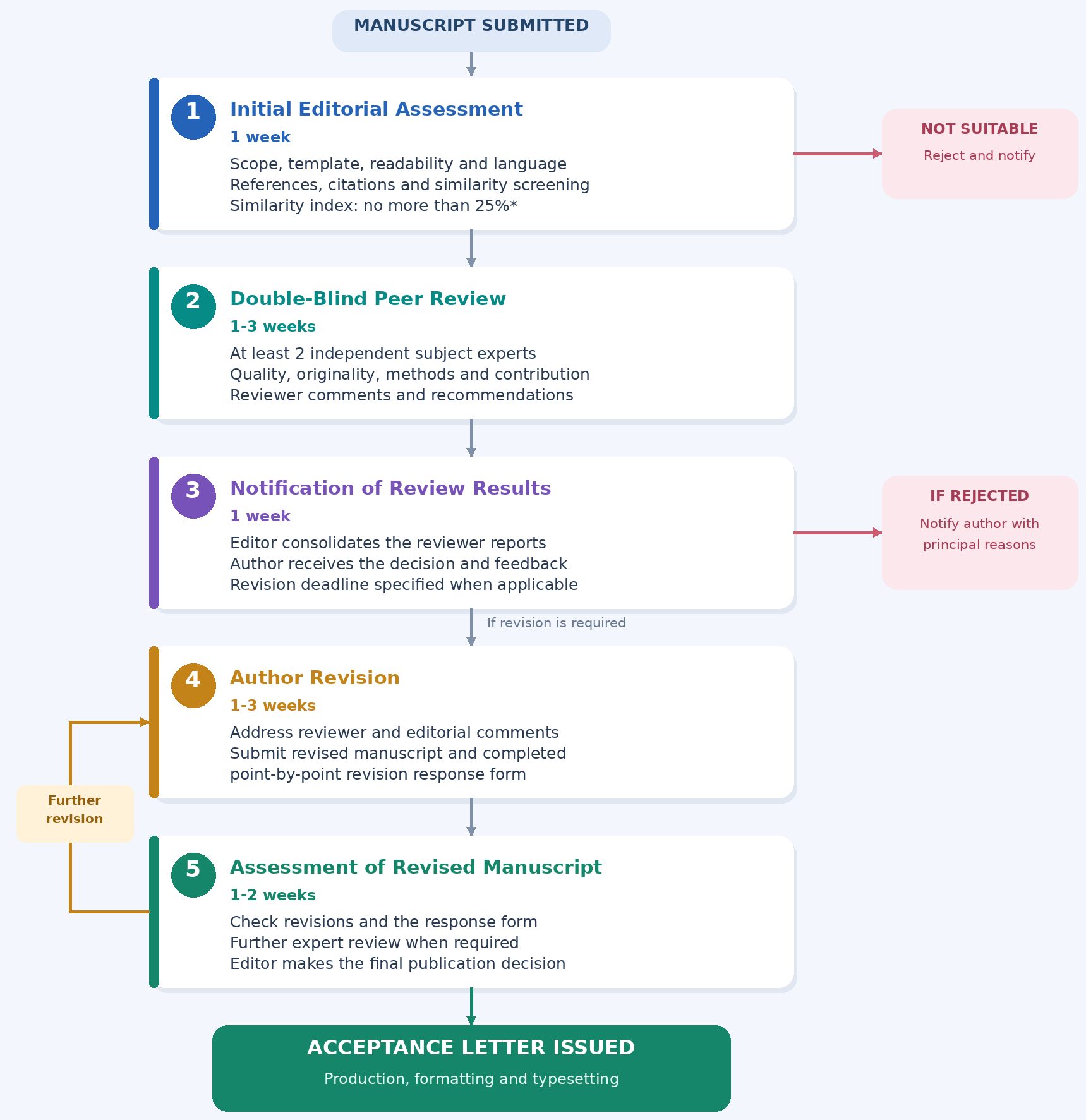
The Five Steps of the Peer Review and Publication Process

1. Initial Editorial Assessment (1 week)

The editorial team screens each submitted manuscript to determine its suitability for further consideration. This assessment covers:

  • Alignment with the journal’s aims and scope.

  • Compliance with the journal template and Author Guidelines.

  • Clarity, organization, and readability.

  • Quality and appropriateness of language.

  • Textual similarity screening, with a similarity index not exceeding 25%.

  • Sufficiency, relevance, and credibility of references.

  • Accuracy and consistency of reference formatting.

  • Correct use of in-text citations and correspondence between citations and the reference list.

The similarity report is examined in context to identify potentially inappropriate textual overlap; the percentage alone does not establish whether plagiarism has occurred.

Manuscripts with incorrectly arranged citations, excessive redundancy or repetition, or substantial noncompliance with the journal’s requirements may be rejected at this stage. Authors will be informed of the screening outcome and any further action required.

2. Double-Blind Peer Review (1–3 weeks)

Manuscripts that pass the initial editorial assessment are submitted to at least two independent reviewers with expertise relevant to the manuscript’s subject matter.

Reviewers assess the manuscript’s originality, scholarly significance, engagement with relevant literature, appropriateness of methods or analytical approach, clarity of presentation, and strength of its conclusions. Evaluation criteria are applied as appropriate to the article type.

Reviewers submit their comments and select one of the following recommendations:

  • Accept Submission: The manuscript is suitable for publication in its current form.

  • Revision Required: The manuscript requires revisions before it can be accepted.

  • Resubmit for Review: The manuscript requires substantial revisions and a further round of peer review.

  • Resubmit Elsewhere: The manuscript would be more appropriate for another journal.

  • Decline Submission: The manuscript is not recommended for publication.

  • See Comment: The reviewer provides a qualified or additional recommendation in the accompanying comments.

3. Notification of Review Results (1 week)

After receiving the complete reviewer reports, the editorial team considers the recommendations and supporting comments and prepares a consolidated editorial decision.

The corresponding author is notified of the outcome and receives the relevant feedback. Where revision is required, the notification identifies the issues to be addressed and specifies the submission deadline. Where the manuscript is rejected, the author is informed of the decision and its principal reasons.

4. Author Revision (1–3 weeks)

Authors must revise their manuscript in response to the reviewers’ comments and any additional editorial suggestions.

The revised submission must include:

  • The revised manuscript prepared according to the journal’s requirements.

  • A completed revision response form explaining, point by point, how each comment has been addressed.

Authors should clearly indicate the changes made and provide a reasoned explanation for any suggestion they have not adopted. Both the revised manuscript and the completed response form must be returned within the specified deadline.

5. Assessment of the Revised Manuscript (1–2 weeks)

The editorial team examines the revised manuscript and response form to determine whether the reviewers’ and editors’ comments have been addressed adequately and accurately. Where further peer review is required, the revised manuscript is returned to the relevant reviewers for reassessment.

Once all required revisions have been satisfactorily completed and the manuscript meets the journal’s publication requirements, the Editor issues an official acceptance letter. The manuscript then proceeds to production, including formatting and typesetting for publication.

The timeframes above are indicative and may vary depending on reviewer availability, the extent of revisions, and the need for further assessment.


Article Processing Charges (APCs)

There are Article Processing Charges (APCs) for publishing articles in the IARJ.

Publishing Fee (Article Processing Charges: APCs)

IARJ is a self-funded journal and does not receive any public funding, so Article Processing Fees (APCs) from authors are the only source of funds for the journal to cover the cost of maintaining it. As IARJ is an open-access journal, the journal charges Article Processing Fees (APCs), which allow all readers to access articles online for free without having to pay a subscription fee.

However, IARJ also charges annual and per-article peer reviewer fees, ThaiJo database fees, and CrossRef membership fees. In addition, the journal waives publication fees for editors and authors from low-income countries and offers discounts for authors from middle- and lower-income countries. The journal also uses part of its income to support scholarships for underprivileged people who lack financial resources and to support other academic promotion activities. Therefore, the Article Processing Fees (APCs) listed are primarily to raise funds for the efficient management of the journal and the distribution of articles to databases worldwide, which are not primarily for financial gain.

The article's author must pay an academic paper publication fee at the rate of 4,500 baht per article (four thousand and five hundred baht only), or if transferring from overseas, pay 200 USD (Two hundred dollars only), including the international transfer fees. The Fee Payment is required after notification of the reviewing results has been completed and accepted for publication. The payment can be made at


The bank's name is "KASIKORNBANK"

Branch “Sermthai Complex Maha Sarakham Branch”

Account's Name: “DR.KEN Institute of Academic Development and Promotion”

Account No. 212-1-43238-5

Or

The bank's name is "Bangkok Bank"

Branch “Sermthai Complex Maha Sarakham Branch”

Account's Name: “DR.KEN Institute of Academic Development and Promotion”

Account No.: 569-7-26130-2

Transfer from Overseas: Payment Details:

If transfer from overseas pays 200USD (Two hundred dollars only), including the international transfer fees

The Bank's name: "KASIKORNBANK"

The Account's name is “DR.KEN Institute of Academic Development and Promotion”

Account/Beneficiary Name: KASIKORNBANK

Current Account No.: 212-1-43238-5

SWIFT No.: KASITHBK

Branch: Sermthai Complex Maha Sarakham Branch

Bank Address: 76/1-7 Sermthai Complex Shopping Center Building, 1st Floor, Room No. R136, Nakhon Sawan Road, Talat Subdistrict, Mueang Maha Sarakham District, Maha Sarakham Province, 44000, Thailand

Payee address: No. 139/26 Theenanon, Talat Sub-district, Mueang Mahasarakham District,
Mahasarakham Province, Thailand, 44000.

The author will charge a fee for submitting articles from July 1, 2022, onwards. Notifying fee payment results, please fill in payment information in the form in the link [Click Here]. [such as name, address, phone number, email, money transfer slip, etc.] This is so that the accounting department can see the results of the fee payments in a timely manner.

In addition, Article Processing Fees (APCs), once paid, will not be refunded to authors under any circumstances.

Scan this QR code to contact us via the LINE application.

Open Access Statement

Interdisciplinary Academic and Research Journal is loyal to open access for academic work, permitting any users to read, download, copy, distribute, print, search, or link to the full texts of its articles and to use them for any other lawful purpose. All the articles published in this journal are free to access immediately from the date of publication. We do not charge any fees for any reader to download articles for their own scholarly use. Interdisciplinary Academic and Research Journal operates under the Creative Commons Attribution-NonCommercial-NoDerivatives 4.0 International License. This allows for the reproduction of articles, free of charge, for non-commercial use only, and with the appropriate citation information. All authors publishing with the Interdisciplinary Academic and Research Journal accept these as the terms of publication.


Data Availability Statement

The raw data supporting the conclusions of this article will be made available by the authors without undue reservation.


Conflicts of Interest

The authors declare that the research was conducted in the absence of any commercial or financial relationships that could be construed as a potential conflict of interest.


Publisher’s Note

All claims expressed in this article are solely those of the authors and do not necessarily represent those of their affiliated organizations, or those of the publisher, the editors, and the reviewers. Any product that may be evaluated in this article, or claim that may be made by its manufacturer, is not guaranteed or endorsed by the publisher.


Copyright Notice

Articles published in the Interdisciplinary Academic and Research Journal (IARJ) are copyrighted by the IARJ. Articles that have already been accepted for publication in the IARJ must not appear in any other publication before their appearance in the IARJ. The editors will send authors a link to the journal containing the author's published article, or if the author wishes, the published article can be downloaded or printed on the IARJ website.


Licensing Notice

Permission to use the text, content, images, etc. of the publication. Any user to read, download, copy, distribute, print, search, or link to the full texts of articles, crawl them for indexing, pass them as data to software, or use them for any other lawful purpose. But do not use it for commercial use or with the intent to benefit any business. Published under a Creative Commons Attribution-NonCommercial-NoDerivatives 4.0 International License.

This work is licensed under a Creative Commons Attribution-NonCommercial-NoDerivatives 4.0 International License.


Archiving Policy
This journal utilizes both the LOCKSS (Lots of Copies Keep Stuff Safe) system and Portico to ensure long-term digital preservation of its published content. All articles are permanently archived in these trusted preservation networks to guarantee accessibility even if the journal’s primary website experiences technical issues or ceases operation.

  • LOCKSS: Provides a distributed archiving system through a worldwide network of participating libraries, preserving multiple copies of content for redundancy and security.

  • Portico: Offers a community-supported digital preservation service that ensures the long-term survival and accessibility of scholarly literature for future generations.


Ownership and Management

DR.KEN Institute of Academic Development and Promotion
No. 139/26 Theenanon, Talad Sub-district, Mueang Mahasarakham District,
Mahasarakham Province, Thailand, 44000

Tel: +6681-741-3978, +66946398978

Email: dr.keninstitute@gmail.com 
Facebook: https://web.facebook.com/Kenaphoom/

Website:  https://drkeninstitute.or.th/home