Factors Affecting Academic Dropout of Undergraduate Students in Science and Technology Cluster at Suranaree University of Technology
Keywords:
Academic dropout, Science and Technology studentsAbstract
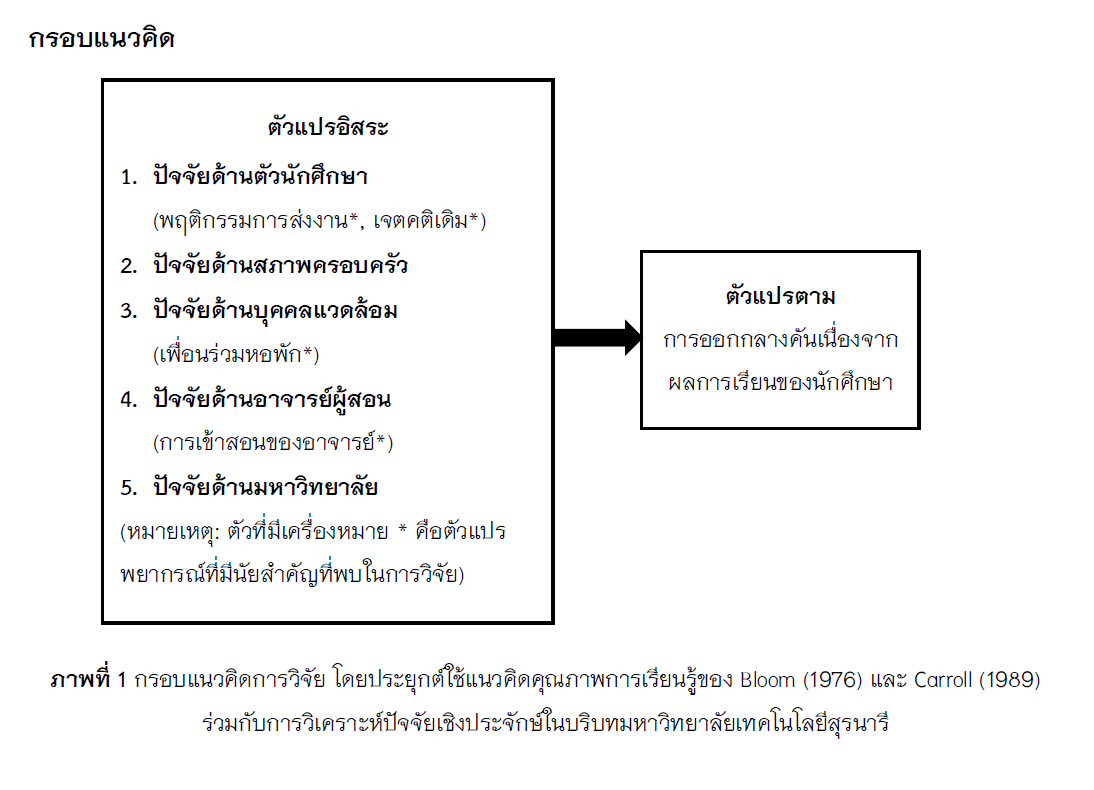
This research aimed to examine the levels of factors affecting academic dropout, compare these factors based on demographic characteristics, and analyze the predictive variables influencing academic dropout among undergraduate students in the Science and Technology Cluster at Suranaree University of Technology. The sample consisted of 218 students on academic probation (GPAX below 1.80) in the 2019 academic year. The research instrument was a questionnaire on factors affecting academic dropout, which demonstrated a reliability coefficient of 0.88. Data were analyzed using descriptive statistics, t-test, One-way ANOVA, and Stepwise Multiple Regression Analysis. The results indicated that the overall factors affecting academic dropout were at a moderate level, with the "instructor factor" receiving the highest mean score. Comparative analysis revealed that students in different year levels were affected by "surrounding environment" and "instructor" factors with a statistical significance at the 0.05 level, whereas gender and specific institutes showed no significant differences. Regarding the predictive analysis, four variables significantly predicted academic dropout at the 0.05 level: assignment submission behavior (X1) (p < .001), attitude toward prior academic performance (X2) (p < .001), dormitory roommates (X3) (p < .001), and instructor attendance (X4) (p < .05). These predictors yielded a multiple correlation coefficient (R) of .332 and a coefficient of determination (R2) of .110 (Adjusted R2 = .093), collectively explaining 11.0% of the variance in academic dropout. The effect size suggests a level that requires institutional attention. These findings highlight the necessity for educational institutions to prioritize monitoring individual student behavior alongside enhancing faculty advisor support systems to effectively and sustainably reduce student dropout rates.
References
กฤตธัช อันชื่น. (2557). คุณภาพชีวิตของนักศึกษามหาวิทยาลัยเทคโนโลยีสุรนารี (รายงานการวิจัย). นครราชสีมา: มหาวิทยาลัยเทคโนโลยีสุรนารี.
กัลยา วานิชย์บัญชา. (2561). สถิติสำหรับงานวิจัย (พิมพ์ครั้งที่ 12). กรุงเทพฯ: สามลดา.
กานดา คำมาก และ ภัทราวรรณ์ สุนทราศรี. (2558). ปัจจัยที่ส่งผลต่อผลสัมฤทธิ์ทางการเรียนของนักศึกษาระดับปริญญาตรี มหาวิทยาลัยเทคโนโลยีสุรนารี (รายงานการวิจัย). นครราชสีมา: มหาวิทยาลัยเทคโนโลยีสุรนารี.
ชาญชัย ทองโสภา. (2554). บทวิเคราะห์ปัญหานักศึกษาตกออกชั้นปีที่ 1 ของมหาวิทยาลัยเทคโนโลยีสุรนารี (มทส.) ในปี 2554 (รายงานการวิจัย). นครราชสีมา: มหาวิทยาลัยเทคโนโลยีสุรนารี.
ชาญชัย อินทรประวัติ, ไพฑูรย์ นิยมนา, ชุติกาญจน์ ชำนาญกิจ, สุดา ผ่องแผ้ว, ดวงฤดี พ่วงแสง และ ธัญเทพ พรหมสอน. (2548). การเปรียบเทียบปัจจัยในการเรียนของนักศึกษามหาวิทยาลัยเทคโนโลยีสุรนารี ที่ใช้เวลาในการศึกษาไม่เกิน 4 ปีและมากกว่า 4 ปี (รายงานการวิจัย). นครราชสีมา: มหาวิทยาลัยเทคโนโลยีสุรนารี.
บุญชม ศรีสะอาด. (2535). การวิจัยเบื้องต้น (พิมพ์ครั้งที่ 2). กรุงเทพฯ: สุวีริยาสาส์น.
บุรทิน ขำภิรัฐ. (2556). ยุทธศาสตร์และระบบบริหารเพื่อการดำรงนักศึกษา มหาวิทยาลัยเทคโนโลยีสุรนารี (รายงานการวิจัย). นครราชสีมา: มหาวิทยาลัยเทคโนโลยีสุรนารี.
มหาวิทยาลัยเทคโนโลยีสุรนารี. (2561). รายงานประจำปี 2561 มหาวิทยาลัยเทคโนโลยีสุรนารี. นครราชสีมา: มหาวิทยาลัยเทคโนโลยีสุรนารี.
มหาวิทยาลัยเทคโนโลยีสุรนารี. (2564). สรุปมติการประชุมสภาวิชาการ ครั้งที่ 11/2564. นครราชสีมา: มหาวิทยาลัยเทคโนโลยีสุรนารี.
มะลิวัลย์ สินน้อย. (2550). ปัจจัยที่มีผลต่อการตกออกของนักศึกษาระดับปริญญาตรี มหาวิทยาลัยอุบลราชธานี (รายงานการวิจัย). อุบลราชธานี: มหาวิทยาลัยอุบลราชธานี.
วรุณ กันยา, คุณากร วิรุฬห์ และ นวรัตน์ การะเกษ. (2561). ปัจจัยที่มีผลต่อการออกกลางคันของนักศึกษามหาวิทยาลัยเทคโนโลยีราชมงคลพระนคร ประจำปีการศึกษา 2557 (รายงานการวิจัย). กรุงเทพฯ: กองนโยบายและแผน มหาวิทยาลัยเทคโนโลยีราชมงคลพระนคร.
สมคิด รักษาทรัพย์, สุภาภรณ์ ตันจ้อย และ วาสนา ด้วงเหมือน. (2557). สาเหตุการออกกลางคันของนักศึกษามหาวิทยาลัยเทคโนโลยีราชมงคลกรุงเทพ (รายงานการวิจัย). กรุงเทพฯ: มหาวิทยาลัยเทคโนโลยีราชมงคลกรุงเทพ.
สาวิตรี สอาดเทียน. (2562). สาเหตุการออกกลางคันของนักศึกษาสาขาวิชาสังคมวิทยา (การพัฒนาชุมชน) คณะมนุษยศาสตร์และสังคมศาสตร์ มหาวิทยาลัยราชภัฏนครสวรรค์. วารสาร มจร การพัฒนาสังคม, 4(1), 260-271.
สุทธิรักษ์ ไชยรักษ์. (2556). ปัญหาการปรับตัวของนักศึกษาชั้นปีที่ 1 มหาวิทยาลัยเทคโนโลยีสุรนารี (รายงานการวิจัย). นครราชสีมา: มหาวิทยาลัยเทคโนโลยีสุรนารี.
Arias, E., Escamilla, J., López, A., & Moon, J. (2020). Academic engagement and intention to drop out in undergraduate students. Sustainability, 12(23), Article 9904. Form https://doi.org/10.3390/su12239904.
Behr, A., Gieseke, J., & Theune, K. (2020). Dropout intentions of German first-year students and the role of academic confidence. Journal of College Student Retention: Research, Theory & Practice, 22(4), 1-25. Form https://doi.org/10.1177/1521025120935544.
Bloom, B. S. (1976). Human characteristics and school learning. New York: McGraw-Hill.
Carroll, J. B. (1989). The Carroll model: A 25-year retrospective and prospective view. Educational Researcher, 18(1), 26–31.
Comrey, A. L., & Lee, H. B. (1992). A first course in factor analysis (2nd ed.). Hillsdale, NJ: Lawrence Erlbaum Associates.
Cronbach, L. J. (1951). Coefficient alpha and the internal structure of tests. Psychometrika, 16(3), 297–334. Form https://doi.org/10.1007/BF02310555.
Cruze, W. W. (1974). Psychology of education and growth. New York: Ronald Press.
Good, C. V. (1959). Dictionary of education (2nd ed.). New York: McGraw-Hill.
Heider, F. (1958). The psychology of interpersonal relations. New York: John Wiley & Sons.
Linderman, R. H., Merenda, P. F., & Gold, R. Z. (1978). Introduction to bivariate and multivariate analysis. Glenview, IL: Scott, Foresman.
Rokeach, M. (1970). Beliefs, attitudes, and values: A theory of organization and change. San Francisco, CA: Jossey-Bass.
Venegas-Muggli, J. I. (2020). Socio-demographic and academic predictors of first-year higher education dropout. Journal of Further and Higher Education, 44(4), 456-468. Form https://doi.org/10.1080/0309877X.2018.1564024.
Weiner, B. (1972). Attribution theory, achievement motivation, and the educational process. Review of Educational Research, 42(2), 203–215.
Downloads
Published
How to Cite
Issue
Section
License
Copyright (c) 2026 Phayao University

This work is licensed under a Creative Commons Attribution-NonCommercial-NoDerivatives 4.0 International License.
Authors are responsible for the content of their manuscripts. The University of Phayao does not necessarily endorse or agree with the views expressed in published articles. Interested parties may reproduce or use the content; however, they must obtain prior written permission from the copyright holder and provide proper citation and acknowledgment.