Content Validity of the Social and Emotional Learning Competency Measurement Instrument for Pre-Service Teachers at Rajabhat University
Keywords:
Content validity, Expert validation, Social and emotional learning competency, Pre-service teachersAbstract
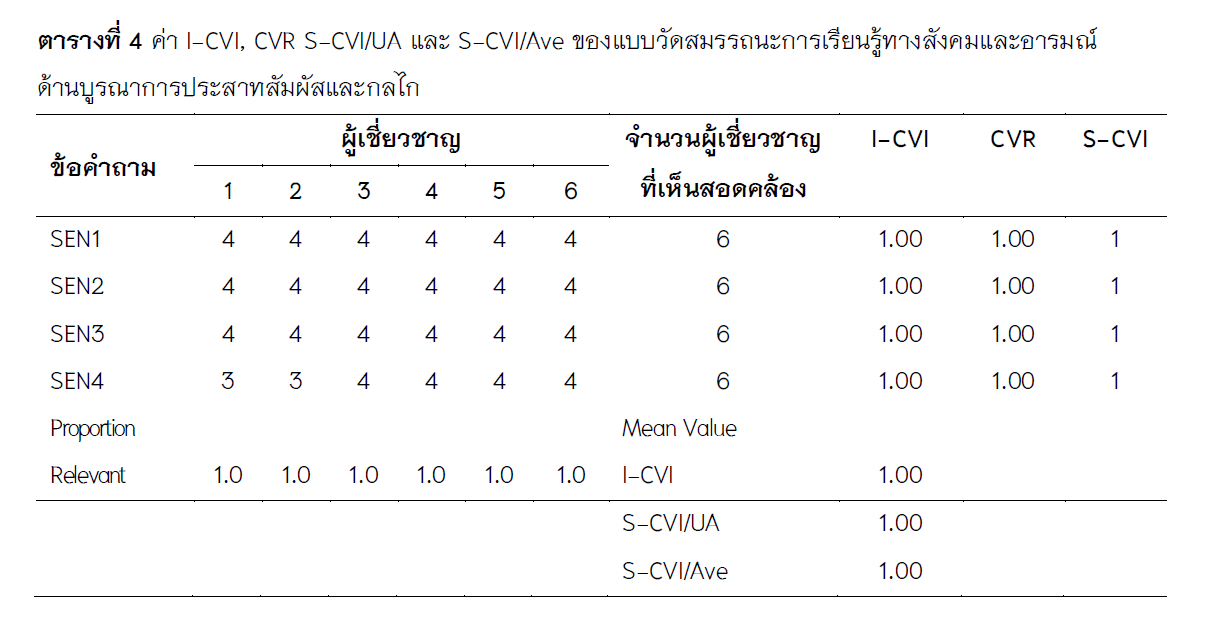
The purpose of this study was to analyze the content validity of the Social and Emotional Learning Competency Assessment for Pre-service Teachers at Rajabhat University. The analysis employed the Item-level Content Validity Index (I-CVI), Content Validity Ratio (CVR), Scale-level Content Validity Index based on Universal Agreement (S-CVI/UA), and Scale-level Content Validity Index based on Average (S-CVI/Ave), based on evaluations from six experts. The main assessment instrument comprised seven core competencies: (1) sensory and mechanism integration, (2) deep understanding, (3) self-regulation, (4) collaboration, (5) communication, (6) critical thinking, and (7) mindset. The instrument consisted of 28 items. The results revealed that all experts unanimously agreed that the items were comprehensive, congruent, and representative of the construct of social and emotional learning competencies among pre-service teachers, with I-CVI, CVR, S-CVI/UA, and S-CVI/Ave values all equal to 1.00.
References
กรวรานนท์ บุญโต และ วิรัช วันบรรเจิด. (2568). การพัฒนาทักษะทางสังคมและอารมณ์ของผู้เรียน. วารสารสังคมศึกษาปริทรรศน์, 1(2), 62-71.
ธวัลรัตน์ ยศเรือง. (2567). ผลของโปรแกรมการเรียนรู้ทางอารมณ์และสังคมรูปแบบเว็บไซต์ต่อการเสริมสร้างพฤติกรรมและความรู้ในการเรียนรู้ทางอารมณ์และสังคมของนักเรียนชั้นมัธยมศึกษาปีที่ 4. (วิทยานิพนธ์มหาบัณฑิต สาขาวิชาจิตวิทยา). กรุงเทพฯ: จุฬาลงกรณ์มหาวิทยาลัย. จาก https://digital.car.chula.ac.th/chulaetd/74443.
มนตรี อินตา และ สุพัตรา สกุลศรีประเสริฐ. (2561). การเรียนรู้ทางอารมณ์และสังคมตามแนวคิดของ CASEL ของนักเรียนมัธยมศึกษาตอนต้น สังกัดสำนักงานคณะกรรมการการศึกษาขั้นพื้นฐาน. วารสารศรีนครินทรวิโรฒวิจัยและพัฒนา สาขามนุษยศาสตร์และสังคมศาสตร์, 10(20), 98–116. จาก https://ejournals.swu.ac.th/index.php/swurd/article/view/10846.
วิไลภรณ์ วิชญาวัฒน์ และ ลำไย สีหามาตย์. (2025). การพัฒนารูปแบบการจัดการเรียนรู้โดยใช้แนวคิดทางอารมณ์และสังคม และทฤษฎีการเรียนรู้ทางสังคมเชิงพุทธิปัญญาเป็นฐาน เพื่อเสริมสร้างสุขภาวะทางอารมณ์และสังคมของนิสิตครู. Journal of Inclusive and Innovative Education, 9(2), 128–147. จาก https://so01.tci-thaijo.org/index.php/cmujedu/article/view/281592.
สิริภัทร ชื่นค้า, ดวงใจ สีเขียว และ ประพันธ์ศิริ สุเสารัจ. (2565). การพัฒนาตัวบ่งชี้สมรรถนะทางสังคมและอารมณ์ของนักเรียนระดับชั้นมัธยมศึกษาตอนปลายในประเทศไทย. วารสารสังคมศาสตร์และมานุษยวิทยาเชิงพุทธ, 7(8), 401-420.
Baharuddin, M. F., Masrek, M. N., & Shuhidan, S. M. (2020). Content validity of assessment instrument for innovative work behaviour of Malaysian school teachers. International Journal of Scientific and Technology Research, 9(4), 1940-1946.
Becker, W. J. (2022). The impact of trust on team collaboration: A meta-analytic review. Journal of Organizational Behavior, 43(5), 789–805. Form https://doi.org/10.1002/job.2598.
Byrne, B. M. (2016). Structural equation modeling with AMOS (3rd ed.). New York: Routledge.
Collaborative for Academic, Social, and Emotional Learning (CASEL). (2020). Core SEL competencies. Chicago, IL: Author. Retrieved July 13, 2025, From https://casel.org.
Collaborative for Academic, Social, and Emotional Learning (CASEL). (2020). What is SEL?. Chicago, IL: Author. Retrieved July 13, 2025, From https://casel.org.
Collie, R. J., Shapka, J. D., & Perry, N. E. (2012). School climate and social–emotional learning: Predicting teacher stress, job satisfaction, and teaching efficacy. Journal of Educational Psychology, 104(4), 1189–1204. From https://psycnet.apa.org/buy/2012-18639-001.
Daniel, B. (2015). Big data and analytics in higher education: Opportunities and challenges. British journal of educational technology, 46(5), 904-920. From https://doi.org/10.1111/bjet.1223.
DeVellis, R. F. (2016). Scale development: Theory and applications (4th ed.). Thousand Oaks, CA: Sage.
Dweck, C. S. (2006). Mindset: The new psychology of success. New York: Random House. From https://psycnet.apa.org/record/2006-08575-000.
Ekman, P., & Friesen, W. V. (2003). Unmasking the face: A guide to recognizing emotions from facial clues. Los Altos, CA: Malor Books.
Gökel, Ö., & Dağlı, G. (2017). Effects of social skill training program on social skills of young people. Eurasia Journal of Mathematics, Science and Technology Education, 13(11), 7365-7373. From https://doi.org/10.12973/ejmste/79615.
Goleman, D. (2005). Emotional intelligence: Why it can matter more than IQ (10th ed.). New York: Bantam Book.
Hair, J. F., Black, W. C., Babin, B. J., & Anderson, R. E. (2019). Multivariate data analysis (8th ed.). Andover, Hampshire, UK: Cengage Learning.
Hofstede, G. (2001). Culture´s Consequences: Comparing Values, Behaviors, Institutions, and Organizations across Nations (2nd ed.). London: SAGE.
Immordino‐Yang, M. H., & Damasio, A. (2007). We feel, therefore we learn: The relevance of affective and social neuroscience to education. Mind, Brain, and Education, 1(1), 3–10. Form https://doi.org/10.1111/j.1751-228X.2007.00004.x.
Jennings, P. A., & Greenberg, M. T. (2009). The prosocial classroom: Teacher social and emotional competence in relation to student and classroom outcomes. Review of Educational Research, 79(1), 491–525. From https://doi.org/10.3102/0034654308325693.
Lawshe, C. H. (1975). A quantitative approach to content validity. Personnel Psychology, 28(4), 563–575. From https://parsmodir.com/wp-content/uploads/2015/03/lawshe.pdf.
Lynn, M. R. (1986). Determination and quantification of content validity. Nursing Research, 35(6), 382–385. From https://doi.org/10.1097/00006199-198611000-00017.
Nguyen, T. T., & Ng, K. T. (2022). The role of trust and communication in collaborative learning Environments. Education Sciences, 12(1), 87. Form https://doi.org/10.3390/educsci12010087.
Organisation for Economic Co-operation and Development (OECD). (2021). Beyond academic learning: First results from the survey of social and emotional skills. Paris, France: OECD Publishing. Form https://doi.org/10.1787/92a11084-en.
Oliver, B. M., & Berger, C. T. (2020). Indiana social-emotional learning competencies: A neurodevelopmental, culturally responsive framework. Professional School Counseling, 23(1_part_3), 1–10. Form https://doi.org/10.1177/2156759X20904486.
Pérez-González, J. C., Saklofske, D. H., & Mavroveli, S. (2020). Trait emotional intelligence: Foundations, assessment, and education. Frontiers in Psychology, 11, 608.
Polit, D. F., & Beck, C. T. (2006). The content validity index: Are you sure you know what's being reported? Critique and recommendations. Research in Nursing & Health, 29(5), 489–497.
Polit, D. F., Beck, C. T., & Owen, S. V. (2007). Is the CVI an acceptable indicator of content validity Appraisal and recommendations. Research in Nursing & Health, 30(4), 459–467. Form http://doi.org/10.1002/nur.
Ogurlu, Ü., Sevgi-Yalın, H., & Yavuz-Birben, F. (2018). The relationship between social-emotional learning ability and perceived social support in gifted students. Gifted Education International, 34(1), 76-95. From https://doi.org/10.1177/0261429416657221.
Rogers, C. R. (1980). A way of being. New York: Houghton Mifflin.
Rubio, D. M., Berg-Weger, M., Tebb, S. S., Lee, E. S., & Rauch, S. (2003). Objectifying content validity: Conducting a content validity study in social work research. Social work research, 27(2), 94-104. From http://doi.org/10.1093/swr/27.2.94.
Schonert-Reichl, K. A. (2017). Social and emotional learning and teachers. The Future of Children, 27(1), 137–155. From http://www.jstor.org/stable/44219025.
Tekke, M. (2026). Beyond emotion: Social awareness and wellbeing. Humanities and Social Sciences Communications, 13, 174. From https://doi.org/10.1057/s41599-025-06475-3.
Tilden, V. P., Nelson, C. A., & May, B. A. (1990). Use of qualitative methods to enhance content validity. Nursing research, 39(3), 172-175. From https://doi.org/10.1097/00006199-199005000-00015.
Ülvay, G. F., & Özkul, A. E. (2018). Social-Emotional learning competencies scale of secondary school students. Eurasia Journal of Mathematics, Science and Technology Education, 14(4), 1295-1304. From https://doi.org/10.29333/ejmste/82938.
Van de Vijver, F., & Leung, K. (1997). Methods and data analysis for cross-cultural research. Thousand Oaks, CA: Sage Publications.
Weissberg, R. P., Durlak, J. A., Domitrovich, C. E., & Gullotta, T. P. (2015). Social and emotional learning: Past, present, and future. In J. A. Durlak et al. (Eds.), Handbook of social and emotional learning (pp. 3–19). New York: Guilford Press.
Wilson, F. R., Pan, W., & Schumsky, D. A. (2012). Recalculation of the critical values for Lawshe’s content validity ratio. Measurement and Evaluation in Counseling and Development, 45(3), 197–210.
Yusoff MSB. (2019). ABC of content validation and content validity index calculation. Education in Medicine Journal, 11(2), 49–54. From https://doi.org/10.21315/eimj2019.11.2.6.
Zhou, M., & Ee, J. (2012). Development and validation of the Social Emotional Competence Questionnaire (SECQ). The International Journal of Emotional Education, 2, 27-42.
Zimmerman, B. J. (2000). Attaining self-regulation: A social cognitive perspective. In M. Boekaerts, P. R. Pintrich, & M. Zeidner (Eds.), Handbook of self-regulation (pp. 13–39). San Diego, CA: Academic Press. From https://doi.org/10.1016/B978-012109890-2/50031-7.
Downloads
Published
How to Cite
Issue
Section
License
Copyright (c) 2026 Phayao University

This work is licensed under a Creative Commons Attribution-NonCommercial-NoDerivatives 4.0 International License.
Authors are responsible for the content of their manuscripts. The University of Phayao does not necessarily endorse or agree with the views expressed in published articles. Interested parties may reproduce or use the content; however, they must obtain prior written permission from the copyright holder and provide proper citation and acknowledgment.