The Development of Mechanisms for Driving a Highland Community toward Becoming a Low-Carbon Community: A Case Study of Ban Pha Tang, Por Subdistrict, Wiang Kaen District, Chiang Rai Province
Keywords:
Highland communities, Low-carbon communities, Community operational mechanismsAbstract
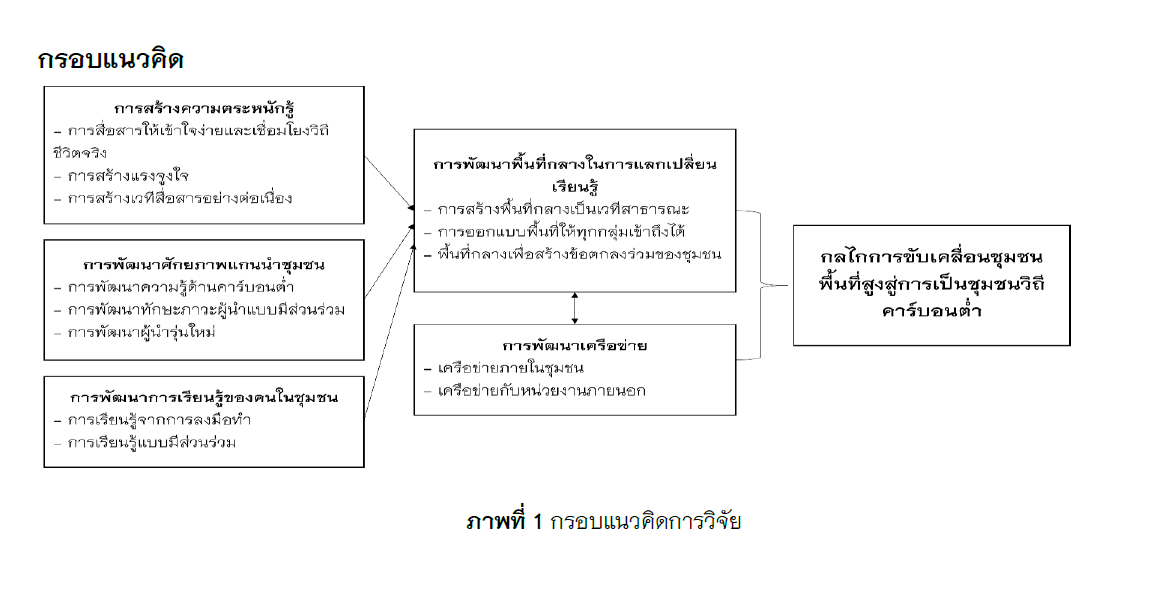
This study aimed to examine the development of mechanisms for driving a highland community toward becoming a low-carbon community, using Ban Pha Tang in Por Subdistrict, Wiang Kaen District, Chiang Rai Province as a case study. The research employed a qualitative methodology integrated with participatory action research, which is particularly suitable for the context of highland communities. Data were collected through in-depth interviews, participant observation, and focus group discussions with 20 key informants, including three community leaders, ten community core members, two representatives from the Royal Project Development Center, three homestay entrepreneurs, and two representatives from the Por Subdistrict Administrative Organization. The data were analyzed using content analysis. The findings reveal that the development of mechanisms for transitioning a highland community toward a low-carbon community consists of five key components: (1) fostering awareness of low-carbon concepts; (2) developing local leaders to drive low-carbon initiatives; (3) enhancing community learning processes to support low-carbon transformation; (4) developing common spaces as institutional mechanisms for collective action; and (5) strengthening collaborative networks to advance low-carbon community development. In-depth synthesis indicates that the creation of a low-carbon way of life in highland areas requires an integrated approach encompassing public awareness, leadership roles, collective learning processes, spatial governance mechanisms, and collaborative networks. The transition toward a low-carbon community enables highland communities to reduce risks associated with climate change, restore natural resources and ecosystems, enhance local economic security, and improve overall quality of life.
References
กรมทรัพยากรน้ำ. (2565). รายงานสถานการณ์ทรัพยากรน้ำแห่งชาติ ประจำปี 2565. กรุงเทพฯ: กระทรวงทรัพยากรธรรมชาติและสิ่งแวดล้อม.
กรมพัฒนาชุมชน. (2567). รายงานผลการพัฒนาหมู่บ้านเศรษฐกิจพอเพียงพื้นที่สูงจังหวัดเชียงราย. กรุงเทพฯ: กระทรวงมหาดไทย.
ฉันทมน โพธิพิทักษ์. (2562). มาตรการการส่งเสริมต่อจิตใจสร้างความตระหนักในการจัดการสิ่งแวดล้อมเพื่อเป็นชุมชนคาร์บอนต่ำอย่างยั่งยืน. วารสารชุมชนวิจัย, 13(2), 1–14.
ชาญชัย จิตรเหล่าอาพร, จิดาภา ถิรศิริกุล, และ สกล สุขเสริมส่งชัย. (2564). การพัฒนาที่ยั่งยืนและการเปลี่ยนแปลงเศรษฐกิจโลก. วารสารวิชาการไทยวิจัยและการจัดการ, 2(3), 77–93.
ศูนย์วิจัยภูมิสารสนเทศเพื่อการพัฒนาอย่างยั่งยืน. (2564). รายงานการประเมินพื้นที่เสี่ยงต่อการเกิดไฟป่าและหมอกควันในพื้นที่ภาคเหนือ. เชียงใหม่: มหาวิทยาลัยเชียงใหม่.
ศุภินธน์การย์ ระวังวงศา และ นภพร เชื้อขำ. (2566). การพัฒนาอย่างมีส่วนร่วม: การพัฒนาชุมชนอย่างยั่งยืน. วารสารวิชาการคณะมนุษยศาสตร์และสังคมศาสตร์, 7(1), 290–306.
เสถียร ฉันทะ, สุภัทณี เปี่ยมสุวรรณกิจ, สุรัสวดี นางแล, อรุณี อินเทพ, สุทธิพร เปี่ยมสุวรรณกิจ, สำราญ เชื้อเมืองพาน และ สุรินทร์ ทองคำ. (2567). การจัดการขยะมูลฝอยแบบมีส่วนร่วมของชุมชนชาติพันธุ์ขมุบ้านวังผา ตำบลท่าข้าม อำเภอเวียงแก่น จังหวัดเชียงราย. วารสารการวิจัยกาสะลองคำ, 18(1), 49-66.
สาธกา ตาลชัย. (2568). ผลกระทบของการเปลี่ยนแปลงสภาพภูมิอากาศต่อสังคมและชุมชนในพื้นที่เสี่ยง. วารสารกว๊านพะเยา, 2(2), 36–45.
สุภางค์ จันทวานิช. (2557). วิธีการวิจัยเชิงคุณภาพ (พิมพ์ครั้งที่ 21). กรุงเทพฯ: สำนักพิมพ์แห่งจุฬาลงกรณ์มหาวิทยาลัย.
แสงดาว กองใจ, สมคิด แก้วทิพย์, เฉลิมชัย ปัญญาดี และ บงกชมาศ เอกเอี่ยม. (2565). รูปแบบที่เหมาะสมขององค์การบริหารส่วนจังหวัดเชียงใหม่ในการหนุนเสริมขับเคลื่อนหุ้นส่วนทางสังคมเพื่อป้องกันและแก้ไขปัญหาฝุ่นควันจังหวัดเชียงใหม่. วารสารพุทธศาสตร์ศึกษา, 13(2), 1–16.
Arnstein, S. R. (1969). A ladder of citizen participation. Journal of the American Institute of Planners, 35(4), 216–224.
Bhaktikul, K., Aroonsrimorakot, S., & Laiphrakpam, M. (2021). Sustainable low-carbon community development: A case study of the Royal Project Foundation in Thailand. Environment, Development and Sustainability, 23(1), 12025–12044.
Cornwall, A. (2008). Unpacking “participation”: Models, meanings and practices. Community Development Journal, 43(3), 269–283.
Goosen, Z., & Cilliers, E. J. (2020). Social infrastructure and community development: The role of shared public spaces in building social capital. Land Use Policy, 95(2), 110-126.
Granovetter, M. S. (1973). The strength of weak ties. American Journal of Sociology, 78(6), 1360–1380.
Gray, B. (1989). Collaborating: Finding common ground for multiparty problems. San Francisco, CA: Jossey-Bass.
Habermas, J., Lennox, S., & Lennox, F. (1974). The public sphere: An encyclopedia article (1964). New German Critique, 3(1), 49–55.
International Energy Agency. (2021). Net zero by 2050: A roadmap for the global energy sector. Paris, France: IEA.
OECD. (2019). Accelerating climate action: Refocusing policies through a well-being lens. Paris, France: OECD Publishing.
Pretty, J. N. (1995). Participatory learning for sustainable agriculture. World Development, 23(8), 1247–1263.
Putnam, R. D. (2000). Bowling alone: The collapse and revival of American community. New York: Simon & Schuster.
Sitthisuntikul, K., Aroonsrimorakot, S., Bhaktikul, K., Satienpeerakul, K., Rungreuangwong, W., Mensin, S., Jewaou, P., Outong, W., & Sathawong, S. (2023). Participatory management for sustainable low-carbon community in highland community, Thailand. Interdisciplinary Research Review, 18(5), 9–15.
Wasserman, S., & Faust, K. (1994). Social network analysis: Methods and applications. Cambridge: Cambridge University Press.
Yuan, X., Zhou, D., & Zhou, P. (2011). What is low-carbon development? A conceptual analysis. Energy Policy, 39(12), 7481–7488.
Zhang, Z. X. (2010). The U.S. proposed carbon tariffs, WTO scrutiny and China’s responses. Energy Policy, 38(5), 2168–2174.
Downloads
Published
How to Cite
Issue
Section
License
Copyright (c) 2026 Phayao University

This work is licensed under a Creative Commons Attribution-NonCommercial-NoDerivatives 4.0 International License.
Authors are responsible for the content of their manuscripts. The University of Phayao does not necessarily endorse or agree with the views expressed in published articles. Interested parties may reproduce or use the content; however, they must obtain prior written permission from the copyright holder and provide proper citation and acknowledgment.