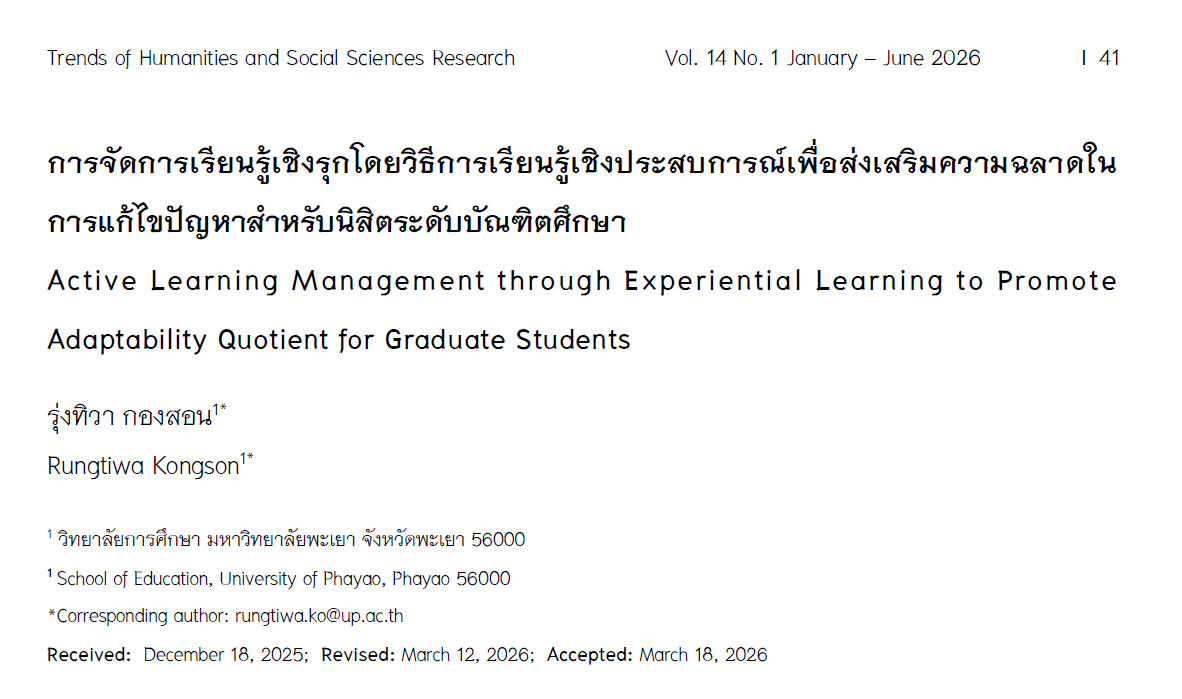
Active Learning Management through Experiential Learning to Promote Adaptability Quotient for Graduate Students
Keywords:
Active learning, Experiential learning, Adaptability quotient, Graduate studentAbstract
The objective of this research was to compare the adaptability quotient for graduate students before and after learning with active learning management through the experiential learning method. The sample group was 19 graduate students in the Department of Curriculum and Instruction, during the first semester of the 2024 academic year. The research instruments included the experiential learning activities to promote adaptability quotient and adaptability quotient questionnaire. The study was conducted according to the active learning management through the experiential learning method, based on the one-group pretest-posttest research design. Data were analyzed by calculating the mean and standard deviation, and the t-test (Paired Samples t-test).
The results of the research revealed that the graduate students who underwent active learning management had statistically significantly higher adaptability quotient scores after learning than before learning, at the .05 level. (t = 37.15). Furthermore, their adaptability quotient were rated at a "highest" quality level, with a mean score of 91.38%.
References
กระทรวงศึกษาธิการ. (2562). แนวทางการนิเทศเพื่อพัฒนาและส่งเสริมการจัดการเรียนรู้เชิงรุก (Active Learning) ตามนโยบายลดเวลาเรียน เพิ่มเวลารู้. กรุงเทพฯ: สำนักงานคณะกรรมการการศึกษาขั้นพื้นฐาน. จาก https://academic.obec.go.th/images/document/1603180137_d_1.pdf.
กระทรวงศึกษาธิการ. (2566). Action plan 2023 แผนปฏิบัติราชการประจำปีงบประมาณ พ.ศ. 2566. กรุงเทพฯ: สำนักงานเลขาธิการสภาการศึกษา. จาก https://backoffice.onec.go.th/uploaded2/Information/202304/20230315_ActionPlan2023_Rv.1.pdf.
คุรุสภา. (2564). หลักเกณฑ์และวิธีการทดสอบและประเมินสมรรถนะทางวิชาชีพครู (ฉบับที่ 2) พ.ศ. 2564. กรุงเทพฯ: สำนักงานเลขาธิการคุรุสภา.
ทิศนา แขมมณี. (2555). ศาสตร์การสอน : องค์ความรู้เพื่อการจัดการกระบวนการเรียนรู้ที่มีประสิทธิภาพ (พิมพ์ครั้งที่ 6). กรุงเทพฯ: จุฬาลงกรณ์มหาวิทยาลัย.
ไพศาล สุวรรณน้อย. (2558). การเรียนรู้โดยใช้ปัญหาเป็นฐาน (Problem–based Learning: PBL). ขอนแก่น: มหาวิทยาลัยขอนแก่น. จาก https://ph.kku.ac.th/thai/images/file/km/pbl-he-58-1.pdf.
บุญชม ศรีสะอาด. (2553). การวิจัยเบื้องต้น (พิมพ์ครั้งที่ 8). กรุงเทพฯ: สุวีริยาสาส์น.
ยุทธ ไกยวรรณ์. (2546). ออกแบบเครื่องมือวิจัย. กรุงเทพฯ: พิมพ์ดี.
ศราวุธ เอี่ยมเซี่ยม. (2565, 23 มิถุนายน). AQ (เอคิว) ทักษะในการปรับตัว สกิลที่สำคัญในโลกวันนี้. Spring News. จาก https://www.springnews.co.th/spring-life/826297.
สำนักงานเลขาธิการคุรุสภา. (2564). หลักสูตรการพัฒนาสมรรถนะครูมืออาชีพด้านการจัดการเรียนรู้ยุคใหม่โดยใช้แหล่งเรียนรู้นอกชั้นเรียนและเทคโนโลยีเป็นฐาน. กรุงเทพฯ: สำนักงานเลขาธิการคุรุสภา.
อชิรญา ชนะสงคราม. (2564). AQ ทักษะสำคัญในยุคเทคโนโลยี AI. สถาบันส่งเสริมการสอนวิทยาศาสตร์และเทคโนโลยี (สสวท.). สถาบันส่งเสริมการสอนวิทยาศาสตร์และเทคโนโลยี. จาก https://www.scimath.org/article-technology/item/11643-aq-ai.
อุทุมพร ภักดีวงศ์. (2562). การพัฒนารูปแบบการเรียนการสอนภาษาอังกฤษเพื่อส่งเสริมความผูกพันของผู้เรียนและความสามารถทางการอ่านและการเขียนภาษาอังกฤษของนักศึกษาระดับปริญญาตรี. (ปริญญานิพนธ์ศึกษาศาสตรดุษฎีบัณฑิต). กรุงเทพฯ: มหาวิทยาลัยธุรกิจบัณฑิตย์.
อรุณฉัตร คุรุวาณิชย์ และ ชนันญา น้อยสันเทียะ. (2567). ทฤษฎีการเรียนรู้จากประสบการณ์ หรือ Experiential Learning Theory (ELT). Life Education. Form https://www.lifeeducation.in.th/positive-education/.
Creswell, J. W. (2009). Research design: Qualitative, quantitative, and mixed methods approaches (3rd ed.). London: SAGE.
Depasquale, C., Arnold, A., Cunningham, S., Kerr, A., Jacob, S. A., Boyter, A., Boyd, M., Power, A., & Addison, B. (2025). An exploration into student pharmacists’ experiences of practice-based interprofessional education during experiential learning placements. American Journal of Pharmaceutical Education, 89(6), 1–8. Form https://doi.org/10.1016/j.ajpe.2025.101418.
D-Prep International School. (2566). Experiential learning หลักสูตรการเรียนรู้จากประสบการณ์จริงที่ D-Perp. Form https://www.dprep.ac.th/th/experiential-learning-course/.
Kolb, D. A. (1984). Experiential learning: Experience as the source of learning and development (Vol. 1). Englewood Cliffs, New York: Prentice-Hall.
Kugele, S. (2025). Constructivist procedural learning for grounded cognitive agents. Cognitive Systems Research, 90(1), 1–11. Form https://doi.org/10.1016/j.cogsys.2025.101321.
Mcleod, Saul. (2024). Kolb’s learning styles and experiential learning cycle. Simply Psychology. Form https://www.simplypsychology.org/learning-kolb.html.
Otto, S., Lavi, R., & Bertel, L. B. (2025). Human-GenAI interaction for active learning in STEM education: State-of-the-art and future directions. Computers & Education, 239(1), 1–16. Form https://doi.org/10.1016/j.compedu.2025.105444.
Peng, Q., Zhang, Y., Liang, S., & Xu, M. (2025). Influence of adversity quotient, emotional support, mental toughness and blunt sensitivity on college students' well-being: A framework based on structural equation modeling and multi-criteria decision-making. Acta Psychologica, 259(1), 1–9. Form https://doi.org/10.1016/j.actpsy.2025.105437.
UNESCO. (2018). Building tomorrow’s digital skills - what conclusions can we draw from international comparative indicators?. Paris, France: United Nations Educational, Scientific and Cultural Organization.
Wang, X.-M., Huang, X.-T., Han, Y.-H., & Hu, Q.-N. (2025). Promoting students’ creative self-efficacy, critical thinking and learning performance: An online interactive peer assessment approach guided by constructivist theory in maker activities. Thinking Skills and Creativity, 52(1), 1–18. Form https://doi.org/10.1016/j.tsc.2024.101548.
Wang, X., Li, Y., Wang, J., Zhang, P., Zhang, X., Zhang, J., & Huang, X. (2025). The relationship between nursing students’ psychological capital and occupational stigma in the Chinese context: A potential profiling analysis. Nurse Education in Practice, 88(1), 1–8. Form https://doi.org/10.1016/j.nepr.2025.104532.
World Economic Forum. (2015). The skills needed in the 21st century. World Economic Forum. Form https://widgets.weforum.org/nve-2015/chapter1.html.
Xu, Y., & Li, K. (2025). Teacher engagement and learning in materials development: A qualitative study of four primary school English teachers’ experiences. System, 133(1), 1–17. Form https://doi.org/10.1016/j.system.2025.103751.
Zhang, Y., Li, R., Pi, Z., & Yang, J. (2025). Active learning strategies in video learning: A meta-analysis. Educational Research Review, 48(1), 1–17. Form https://doi.org/10.1016/j.edurev.2025.100708.
Downloads
Published
How to Cite
Issue
Section
License
Copyright (c) 2026 Phayao University

This work is licensed under a Creative Commons Attribution-NonCommercial-NoDerivatives 4.0 International License.
Authors are responsible for the content of their manuscripts. The University of Phayao does not necessarily endorse or agree with the views expressed in published articles. Interested parties may reproduce or use the content; however, they must obtain prior written permission from the copyright holder and provide proper citation and acknowledgment.