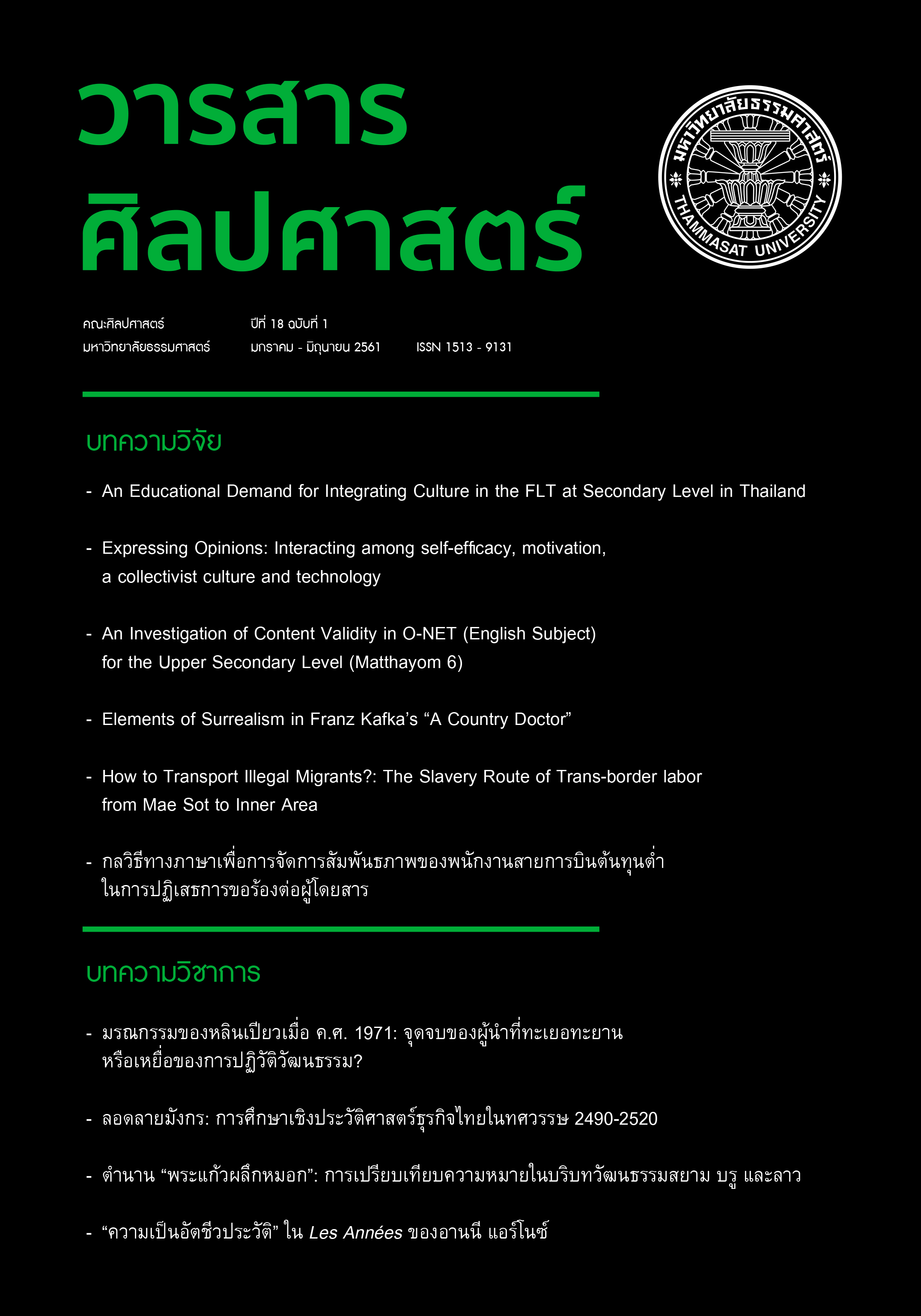
An Investigation of Content Validity in O-NET (English Subject) for the Upper Secondary Level (Matthayom 6)
Article Sidebar
Main Article Content
Abstract
The O-NET (Ordinary National Educational Test) for the upper secondary level (Matthayom 6) plays the role of accountability as well as gatekeeping in the Thai educational system. It has been used to hold schools accountable, and to be one of the criteria to determine students who are qualified for admission to universities. The results of the test have a great impact on stakeholders and especially on Thai students. Therefore, the O-NET test must be rigorously aligned with the Basic Education Core Curriculum in order to ensure a high degree of test validity. However, little is known about the validity of the test. Thus, the purpose of this study was to investigate content validity of the O-NET tests in the subject of English for the upper secondary level by using the test-curriculum alignment method. The test samples used in this study were the 2009 and 2010 O-NET tests. Five participants were purposively selected to match the O-NET test items with the Basic Education Core Curriculum. The results demonstrated that the O-NET test items were partially aligned with the national curriculum. The alignment between the test items and the national curriculum as well as the distribution of the test items on the curriculum domains are discussed.
Downloads
Article Details

This work is licensed under a Creative Commons Attribution-NonCommercial-NoDerivatives 4.0 International License.
References
วรรณกวินท์ อริยฤทธิ์วิกุล, ชาติ แจ่มนุช, ไพเราะมี บางยาง, นฤเทพ ใจสุทธิ และอิทธิฤทธิ์ พงษ์ปิยะรัตน์. (2557). การออกแบบการจัดการเรียนรู้ตามหลักสูตรอิงมาตรฐานหลักสูตรโรงเรียนมาตรฐานสากลและแนวการจัดการเรียนรู้สู่ประชาคมอาเซียน. กรุงเทพมหานคร: สกสค. ลาดพร้าว.
ศึกษาธิการ, กระทรวง. (2551). หลักสูตรแกนกลางการศึกษาขั้นพื้นฐานพุทธศักราช 2551.กรุงเทพมหานคร: กระทรวงศึกษาธิการ.
สำนักงานคณะกรรมการการศึกษาขั้นพื้นฐาน. (2554). แนวปฏิบัติ การวัดและการประเมินผลการเรียนรู้ตามหลักสูตรแกนกลางการศึกษาขั้นพื้นฐานพุทธศักราช 2551.พิมพ์ครั้งที่ 3. กร ุงเทพมหานคร: โรงพิมพ์ชุมนุมสหกรณ์การเกษตรแห่งประเทศไทย.
เอื้อมพร หลินเจริญ, สิริศักดิ์ อาจวิชัยและภีรภา จันทร์อินทร์. (2552). ปัจจัยเชิงสาเหตุที่ทำให้คะแนนการทดสอบ O-NET ของนักเรียนชั้นประถมศึกษาปีที่ 6 และมัธยมศึกษาปีที่ 6 ต่ำ. สถาบันทดสอบทางการศึกษาแห่งชาติ (องค์การมหาชน).
Adair‐Hauck, B., Glisan, E. W., Koda, K., Swender, E. B., & Sandrock, P. (2006). The Integrated Performance Assessment (IPA): Connecting assessment to instruction and learning. Foreign Language Annals, 39(3), 359-382.
Adunyarittigun, D. (2001). Trends in EFL Reading Assessment. Journal of Language and Linguistics, 19(2), 69-75.
Bhola, D. S., Impara, J. C., & Buckendahl, C. W. (2003). Aligning tests with states' content standards: Methods and issues. Educational Measurement: Issues and Practice, 22(3), 21-29.
Brown, H. D., & Abeywickrama, P. (2010). Language Assessment, Principles and Classroom Practices (2nd ed.). NY: Pearson Education.
Brown, J. D. (2005). Testing In Language Programs: A Comprehensive Guide To English Language Assessment. NY: McGraw-Hill College.
Case, B. J., Jorgensen, M. A., & Zucker, S. (2004). Alignment in educational assessment. Retrieved June, 5, 2005, from www.pearsonassessments.com.
D'Agostino, J. V., Welsh, M. E., Cimetta, A. D., Falco, L. D., Smith, S., Van Winkle, W. H., & Powers, S. J. (2008). The rating and matching item-objective alignment methods. Applied Measurement in Education, 21(1), 1-21.
Foley, J. A. (2005). English in...Thailand. Regional Language Centre Journal, 36(2). 223-234.
Gronlund, N. E. (1998). Assessment of student achievement (6th ed.). Boston: Allyn & Bacon.
Hughes, A. (2012). Testing for language teachers (2nd ed.). Cambridge: Cambridge University Press.
Li, S., & Sireci, S. G. (2004). Evaluating the fit between test content, instruction, and curriculum frameworks: A review of methods for evaluating test alignment (Center for Educational Assessment Research Report No. 558). Amherst, MA: University of Massachusetts, Center for Educational Assessment.
Lopez, Alexis A. (2013). Alignment between standardized assessments and academic standards: The case of the Saber Mathematics Test in Colombia. RELIEVE, 19(2). DOI: 10.7203/relieve.19.1.3026
Martone, A., & Sireci, S. G. (2009). Evaluating alignment between curriculum, assessment, and instruction. Review of Educational Research, 79(4), 1332-1361. Messick, S. (1989).
Validity. In R. L. Linn (Ed.), Educational measurement (3rd ed., pp. 13-103).NY: Macmillan.
______. (1993). Foundations of validity: Meaning and consequences in psychological assessment. ETS Research Report Series, 1993(2).
______. (1994). Alternative modes of assessment, uniform standards of validity. ETS Research Report Series, 1994(2).
______. (1996). Validity and washback in language testing. ETS Research Report Series, 1996(1), i-18.
______. (1998). Test validity: A matter of consequence. Social Indicators Research, 45(1),35-44.
O'Malley, J. M., & Pierce, L. V. (1996). Authentic assessment for English language learners: Practical approaches for teachers. Boston, MA: Addison-Wesley Publishing Company.
Polit, D. F., Beck, C. T., & Owen, S. V. (2007). Is the CVI an acceptable indicator of content validity? Appraisal and recommendations. Research in Nursing & Health, 30(4), 459-467.
Sireci, S., & Faulkner-Bond, M. (2014). Validity evidence based on test content. Psicothema, 26(1), 100-107.
Smith, M. L., & Fey, P. (2000). Validity and accountability in high-stakes testing. Journal of Teacher Education, 51(5), 334-344.
Wall, D. (2000). The impact of high-stakes testing on teaching on teaching and learning: can this be predicted or controlled? System, 28, 499-509.
Webb, N. L. (1997). Criteria for Alignment of Expectations and Assessments in Mathematics and Science Education. (Research Monograph No. 6). Council of Chief State School Officers: Washington, DC.
