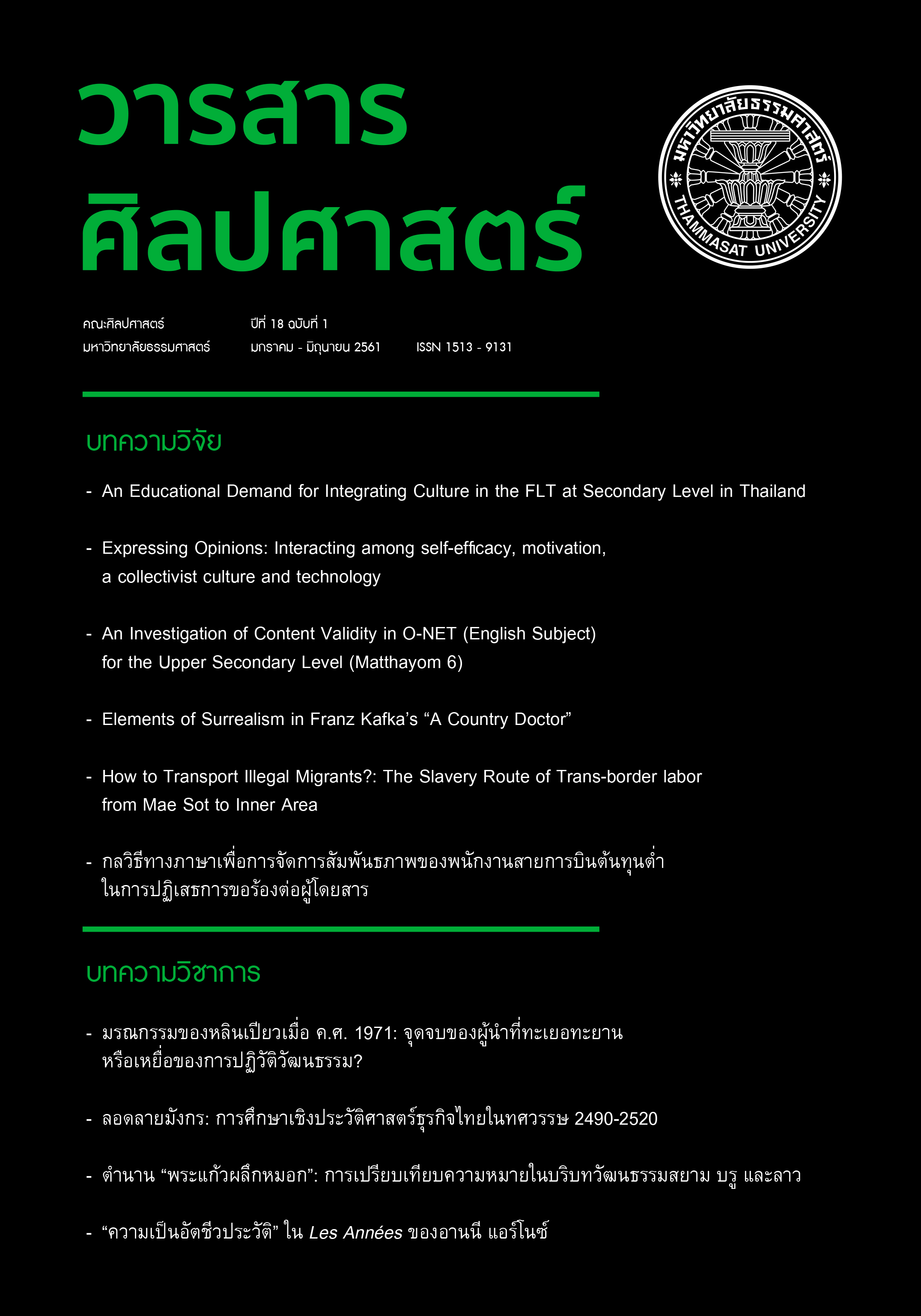
มรณกรรมของหลินเปียวเมื่อ ค.ศ. 1971: จุดจบของผู้นำ ที่ทะเยอทะยานหรือเหยื่อของการปฏิวัติวัฒนธรรม?
Article Sidebar
Main Article Content
บทคัดย่อ
การเสียชีวิตของหลินเปียว รองประธานพรรคคอมมิวนิสต์และรัฐมนตรีว่าการกระทรวงกลาโหมของจีน ผู้เป็นดาวรุ่งในยุคของการปฏิวัติวัฒนธรรมเมื่อ ค.ศ. 1971 เป็นปริศนาสำคัญในประวัติศาสตร์การเมืองจีนสมัยใหม่ ประวัติศาสตร์ฉบับของทางการจีนอธิบายว่าเขาเป็นผู้นำที่ทะเยอทะยานและพยายามก่อรัฐประหารด้วยการลอบสังหารเหมาเจ๋อตงแต่ล้มเหลว ขณะที่บทความนี้พยายามฉายภาพให้เห็นมุมมองอีกด้านซึ่งเสนอว่า หลินเปียวมิได้เป็นผู้ที่มีความทะเยอทะยาน จุดจบของเขาเป็นผลมาจากบทบาทของสมาชิกในครอบครัวซึ่งนำไปสู่ความขัดแย้งกับกลุ่มของเจียงชิง รวมทั้งความยากลำบากที่เขาต้องเผชิญในการจัดการความสัมพันธ์กับผู้นำที่เปี่ยมด้วยบารมีอย่างเหมาเจ๋อตง
Downloads
Article Details

อนุญาตภายใต้เงื่อนไข Creative Commons Attribution-NonCommercial-NoDerivatives 4.0 International License.
เอกสารอ้างอิง
เขียน ธีระวิทย์. (2527). จีนผลัดแผ่นดิน.กรุงเทพฯ: ไทยวัฒนาพานิช.
จุลชีพ ชินวรรโณ. (2542). การเมืองสาธารณรัฐประชาชนจีน: อดีตปัจจุบันและอนาคต. ในประทุมพร วัชรเสถียร และไชยวัฒน์ คํ้าชู (บรรณาธิการ), จีนในโลกที่กำลังเปลี่ยนแปลง (น. 1-54). กรุงเทพฯ: ศูนย์จีนศึกษา สถาบันเอเชียศึกษา จุฬาลงกรณ์มหาวิทยาลัย.
โจวเอินไหล. (24 สิงหาคม 1973). คำรายงานต่อที่ประชุมสมัชชาผู้แทนทั่วประเทศครั้งที่ 10 ของพรรคคอมมิวนิสต์แห่งประเทศจีน. ในเอกสารสมัชชาผู้แทนทั่วประเทศครั้งที่ 10 ของพรรคคอมมิวนิสต์แห่งประเทศจีน. เอกสารการประชุมสภาผู้แทนประชาชนแห่งชาติสมัยที่ 1 ชุดที่ 4 แห่งสาธารณรัฐประชาชนจีน. (ม.ป.ป., น. 3-56). กรุงเทพฯ: กลุ่มเยาวชนรักชาติ.
บุญศักดิ์ แสงระวี. (2528). หมายเหตุผู้แปล. ในหยาวหมิงเล่อ. หลินเปียวเบื้องลึกแผนลับโค่นประธานเหมาฯ (น. 205-207). กรุงเทพฯ: หลักไท.
มติเกี่ยวกับปัญหาทางประวัติศาสตร์บางประการของพรรคคอมมิวนิสต์จีนนับแต่สถาปนาสาธารณรัฐประชาชนจีนเป็นต้นมา. (1981). ปักกิ่ง: สำนักพิมพ์ภาษาต่างประเทศ.
วรศักด ิ์มหัทธโนบล. (2547). เศรษฐกิจการเมืองจีน. กรุงเทพฯ: สำนักงานกองทุนสนับสนุนการวิจัยและศูนย์จีนศึกษา สถาบันเอเชียศึกษา จุฬาลงกรณ์มหาวิทยาลัย โดยความร่วมมือของคณะรัฐศาสตร์ จุฬาลงกรณ์มหาวิทยาลัย.
สิทธิพล เครือรัฐติกาล. (2556). “หลิวเส้าฉี: การต่อสู้สองแนวทางและการปฏิวัติวัฒนธรรม.” วารสารศิลปศาสตร์, 13(2), 58-75.
หยาวหมิงเล่อ. (2528). หลินเปียวเบื้องลึกแผนลับโค่นประธานเหมาฯ (บุญศักด ิ์แสงระวี, ผู้แปล). กรุงเทพฯ: หลักไท.
หลิวหุยเหนียน จ้าวฉี ฉี่ซินหวา โจวฉือปู้ และหยางจินโจว. (1980, 24 พฤศจิกายน). บันทึกความพินาศแห่งการรัฐประหารปฏิปักษ์ปฏิวัติของหลินเปียว. เหรินหมินรึเป้า.ในหยาวหมิงเล่อ. (2528). หลินเปียวเบื้องลึกแผนลับโค่นประธานเหมาฯ (บุญศักดิ์ แสงระวี, ผู้ แปล, น. 209-236). กรุงเทพฯ: หลักไท.
A Chronology of the People’s Republic of China. (1989). Beijing: New Star Publishers.
A Great Trial in Chinese History: The Trial of the Lin Biao and Jiang Qing Counter-Revolutionary Cliques, Nov. 1980 – Jan. 1981. (1981). Beijing: New World Press.
Chan Shih-pu. (1976). Great Victory for the Military Line of Chairman Mao Tsetung – A Criticism of Lin Piao’s Military Line in the Liaohsi-Shenyang and Peiping-Tientsin Campaigns. Peking: Foreign Languages Press.
Fei Hsiao Tung. (1981). Reflections of a Judge – By Way of a Preface. In A Great Trial in Chinese History: The Trial of the Lin Biao and Jiang Qing Counter-Revolutionary Cliques, Nov. 1980 – Jan. 1981 (pp. 1-11). Beijing: New World Press.
Gao Wenqian. (2007). Zhou Enlai: The Last Perfect Revolutionary (Peter Rand & Lawrence R. Sullivan, Trans.). New York, NY: Public Affairs.
Hamrin, C. L. (1994). Elite Politics and the Development of China’s Foreign Relations. In Thomas W. Robinson & David Shambaugh (Eds.), Chinese Foreign Policy: Theory and Practice. Oxford: Clarendon Press.
Hannam, P., & S. V. Lawrence. (1994, January 31). Solving a Chinese Puzzle: Lin Biao’s final days and death, after two decades of intrigue. U.S. News & World Report. Retrieved October 25, 2012, from http://www.usnews.com.
Hu Sheng. (1994). A Concise History of the Communist Party of China. Beijing: Foreign Languages Press.
Jin Qiu. (1999). The Culture of Power: The Lin Biao Incident in the Cultural Revolution. Stanford, CA: Stanford University Press.
MacFarquhar, R. (1991). The Succession to Mao and the End of Maoism. In Roderick MacFarquhar & John K. Fairbank (Eds.), The Cambridge History of China, Volume 15, The People’s Republic, Part 2, Revolutions within the Chinese Revolution, 1966-1982 (pp. 305-401). NY: Cambridge University Press.
Mao Zedong. (1998). Mao Zedong on Diplomacy. Beijing: Foreign Languages Press.
Pye, L. W. (2000, Jul). The Thin Line between Loyalty and Treachery in Mao’s China [Review of the book The Culture of Power: The Lin Biao Incident in the Cultural Revolution and The Tragedy of Lin Biao: Riding the Tiger during the Cultural Revolution, 1966-1971]. The China Journal, 44, 145-152.
Ross, R. S. (2009). Chinese Security Policy: Structure, Power and Politics. London: Routledge.
Sun, W. (1998). Lin Biao. In Colin Mackerras & Donald H. Mcmillen (Eds.). Dictionary of the Politics of the People’s Republic of China (pp. 140-141). London: Routledge.
Teiwes, F. C. (2010). Mao and His Followers. In Timothy Cheek (Ed.), A Critical Introduction to Mao (pp. 129-168). NY: Cambridge University Press.
Teiwes, F. C., & W. Sun. (1996). The Tragedy of Lin Biao: Riding the Tiger during the Cultural Revolution, 1966-1971. HI: University of Hawaii Press.
Weigelin-Schwiedrzik, S. (2007). In Search of a Master Narrative for 20th-Century Chinese History. In Julia Strauss (Ed.), The History of the PRC (1949-1976)(pp. 216-237). Cambridge: Cambridge University Press.
Zhang Yunsheng. (1993, March-April). True Account of Maojiawan: Reminiscences of Lin Biao’s Secretary. Chinese Law and Government, 26(2), 11-82.
Zong Huaiwen. (1989). Years of Trial, Turmoil and Triumph – China from 1949 to 1988.Beijing: Foreign Languages Press.
Bianxiezu (编写组). (2010). Zhongguo jinxiandai lishi gangyao (中国近代历史纲要)[เค้าโครงประวัติศาสตร์จีนสมัยใหม่]. Beijing: Gaodeng Jiaoyu Chubanshe.
Guan Weixun (官伟勋). (1993). Wo suo zhidao de Ye Qun(我所知道的叶群) [เย่ฉวินที่ข้าพเจ้ารู้จัก]. Beijing: Zhongguo Wenxue Chubanshe.
Zhang Yunsheng (张云生). (1988). Maojiawan jishi: Lin Biao mishu huiyilu(毛家湾纪实):林彪秘书回忆录[บันทึกเหตุการณ์ในเหมาเจียวันผ่านความทรงจําของเลขานุการของหลินเปียว]. Beijing: Chunqiu Chubanshe.
