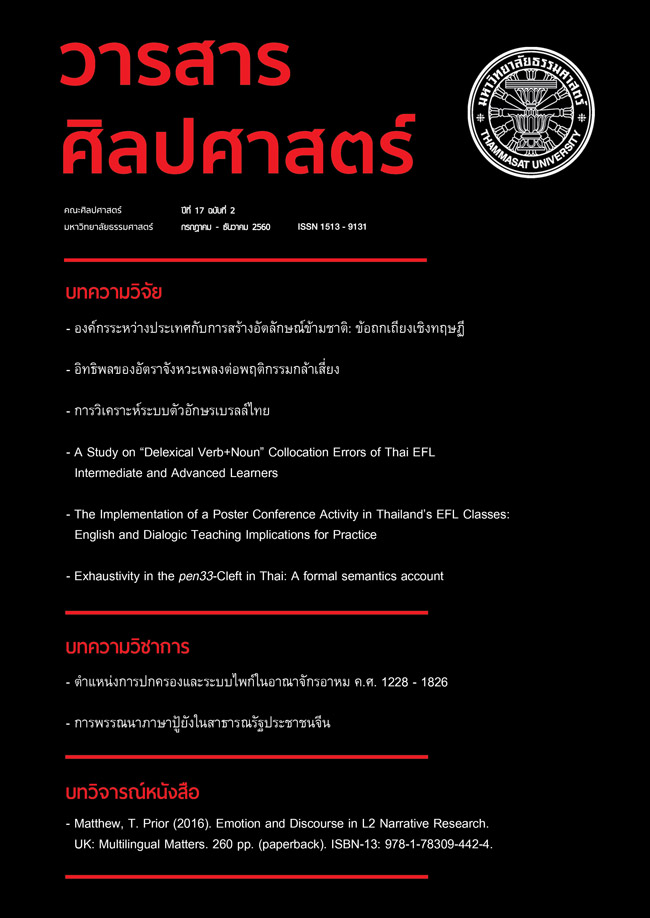
Exhaustivity in the pen33-Cleft in Thai: A formal semantics account
Article Sidebar
Main Article Content
Abstract
This paper addresses exhaustivity derived through the pen33-cleft construction in Thai. Based on a formal semantic account, the paper is aimed at analysing the meaning and nature of exhaustivity observed in this particular construction. The analyses show that exhaustivity in the pen33-cleft is not truth-conditional. Moreover, applying Büring and Križ’s (2013) parthood relation approach, the paper proposes that the exhaustive meaning in pen33-cleft suggests that the clefted argument is not a proper part of the sum of the arguments that share the property as determined in the cleft clause.
Downloads
Article Details

This work is licensed under a Creative Commons Attribution-NonCommercial-NoDerivatives 4.0 International License.
References
Atlas, J. & Levinson, S. (1981). It-clefts, informativeness and logical form: radical pragmatics (revised standard version). Radical pragmatics, 1-62. Academic Press.
Bolinger, D. (1972). A look at equations and cleft sentences. In E. Firchow (Ed.),Studies for Einar Haugen (pp. 96-114). The Hague: Mouton.
Büring, D., & Kriz, M. (2013). It’s that, and that’s it! Exhaustivity and homogeneity presuppositions in clefts (and definites). Semantics and Pragmatics, 6(6), 1-29.
Büring, D. (2011). Conditional exhaustivity presuppositions in clefts (and definites). Unpublished manuscript.
Coppock, E. & Beaver, D. (2011). Sole sisters. Semantics and Linguistic Theory (SALT), 21, 197–217.
Destruel, E. (2012). The French c’est-cleft: An empirical study on its meaning and use. Empirical issues in Syntax and Semantics, 9, 95-112.
Drenhaus, H., Zimmermann, M., & Vasishth, S. (2011). Exhaustiveness effects in clefts are not truth-functional. Journal of Neurolinguistics, 24(3), 320-337.
Gabriel, C. (2010). On focus, prosody and word-order in Argentinian Spanish: A minimalist OT account. ReVEL, 4, 183-222.
Groenendijk, J., & Stokhof, M. (1984). Studies in the semantics of questions and the pragmatics of answers. University of Amsterdam PhD thesis.
Halvorsen, P. (1978). The syntax and semantics of cleft constructions. Texas Linguistics Forum, 11. Austin: University of Texas Department of Linguistics.
Horn, L. (1981). Exhaustiveness and the semantics of clefts. North Eastern Linguistic Society, 14, 108-31.
Kuno, S., & Wongkhomthong, P. (1981). Characterizational and identificational sentences in Thai. Studies in Language, 5, 65-109.
Onea, E. (2009). Exhaustiveness of Hungarian focus: Experimental evidence from Hungarian and German. In A. Riester & E. Onea (Eds.), Proceedings of focus at the syntax-semantics interface. Publikationen des SFB 732, Stuttgart.
Onea, E. & Beaver, D. (2011). Hungarian focus is not exhausted. In E. Cormany, S. Ito & D. Lutz (Eds.), Semantics and Linguistic Theory (SALT), 19, 342-359.
Rooth, M. (1985). Association with focus. Amherst, MA: University of Massachusetts PhD thesis.
Ruangjaroon, S. (2007). Thai Wh-Expressions at the Left Edge of the Clause: Contrastive and Identificational Wh-Clefts. Concentric: Studies in Linguistics, 33(2), 121-157.
von Stechow, A. & Zimmermann, T.E. (1984). Term answers and contextual change. Linguistics, 22(1), 3-40.
Szabolcsi, A. (1981). The semantics of topic-focus articulation. In J. Groenendijk, M. Stokhof & T. Janssen (Eds.), Formal methods in the study of language 2(pp. 513-540). Amsterdam: Mathematisch Centrum.
Tawilapakul, U. (2014). Exhaustivity and definiteness in the wh-cleft construction in Thai. Unpublished manuscript.
Velleman, D., Beaver, D., Destruel, E., Bumford, D., Onea, E., & Coppock, L. (2012). It-clefts are IT (inquiry terminating) constructions. Semantics and Linguistic Theory, 22, 441-460.
