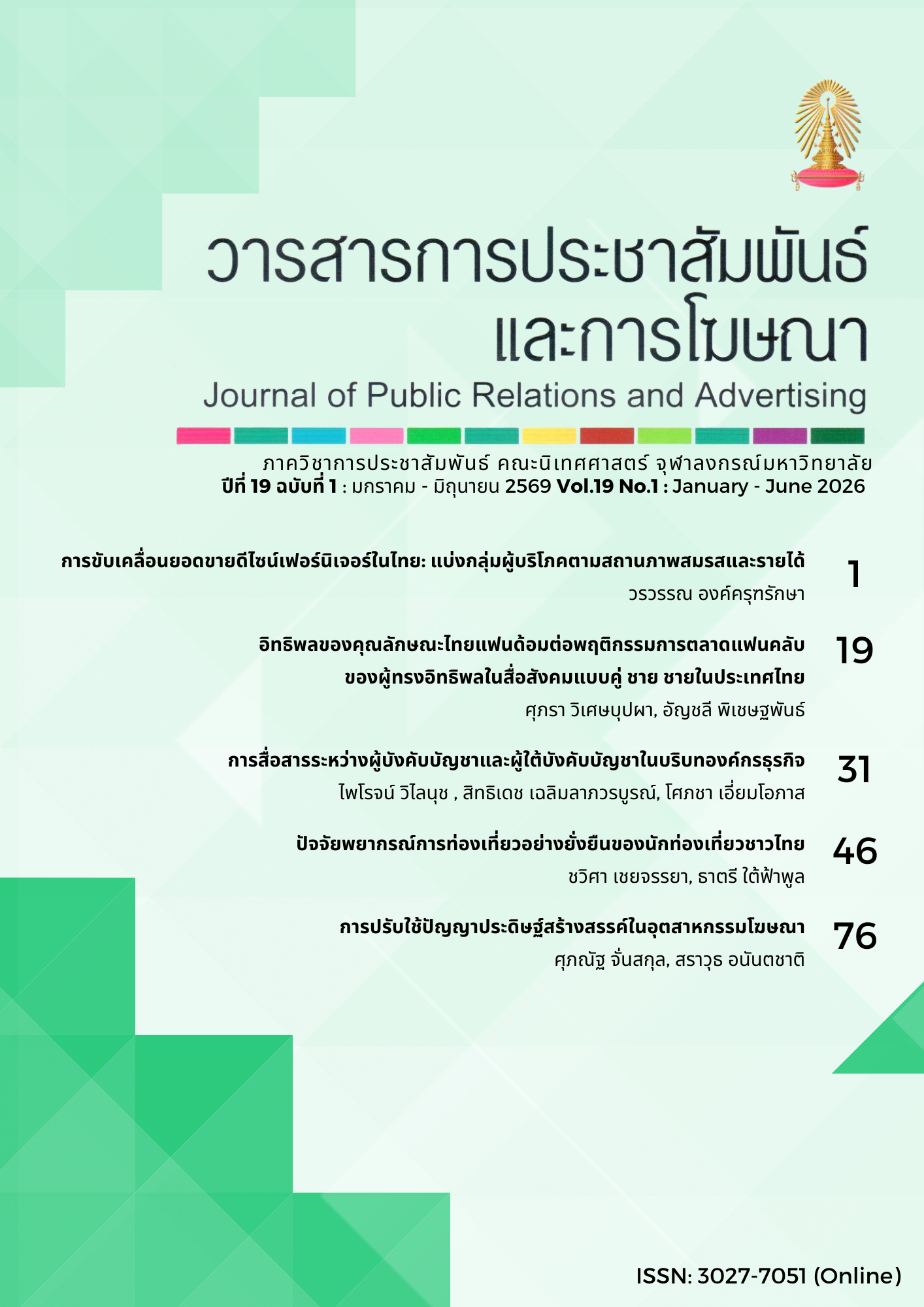
การปรับใช้ปัญญาประดิษฐ์สร้างสรรค์ในอุตสาหกรรมโฆษณา
Article Sidebar
Main Article Content
บทคัดย่อ
การวิจัยครั้งนี้ มีวัตถุประสงค์เพื่อศึกษาความรู้ ความเข้าใจ ทัศนคติ ความคิดเห็น และแนวทางการปรับใช้เทคโนโลยีปัญญาประดิษฐ์สร้างสรรค์ในการสร้างสรรค์ผลงานโฆษณาของบุคลากรในอุตสาหกรรมโฆษณา ใช้วิธีการวิจัยเชิงคุณภาพ โดยการสัมภาษณ์เชิงลึกกับผู้เชี่ยวชาญจากบริษัทตัวแทนโฆษณาจำนวน 5 ท่าน และผู้เชี่ยวชาญด้านเทคโนโลยีเพื่อการสื่อสารการตลาดจำนวน 5 ท่าน รวม 10 ท่าน ผลการวิจัยพบว่า ปัญญาประดิษฐ์สร้างสรรค์มีศักยภาพในการเพิ่มประสิทธิภาพ และลดขั้นตอนการทำงานของกระบวนการสร้างสรรค์โฆษณา จากคุณสมบัติในการทำงานได้แบบอัตโนมัติ ในด้านทัศนคติและความคิดเห็นของผู้เชี่ยวชาญทั้งสองกลุ่มที่มีต่อปัญญาประดิษฐ์สร้างสรรค์พบว่า ส่วนใหญ่เป็นไปในเชิงบวก จากความคิดเห็นที่ว่า การทำงานในอุตสาหกรรมโฆษณาทำให้มีทัศนคติที่ดีต่อเทคโนโลยีใหม่เป็นทุนเดิม อีกทั้งปัญญาประดิษฐ์สร้างสรรค์ยังมีความสามารถที่หลากหลาย เพื่อใช้ในการทำงาน และเพิ่มประสิทธิภาพในการผลิตผลงานโฆษณาอีกด้วย ด้านแนวทางการปรับใช้งานในอุตสาหกรรมโฆษณาพบว่า ทักษะการใช้งานปัญญาประดิษฐ์สร้างสรรค์จะกลายเป็นทักษะที่สำคัญในอนาคต แต่ถึงอย่างไรก็ตาม แม้ว่าปัญญาประดิษฐ์สร้างสรรค์จะสามารถเพิ่มประสิทธิภาพในการทำงานได้เป็นอย่างมาก แต่การใช้งานยังคงต้องการการควบคุม และการตัดสินใจโดยมนุษย์ เพื่อให้ผลลัพธ์มีความถูกต้อง และมีคุณภาพสูง ผลการวิจัยจึงได้เน้นย้ำถึงความสำคัญของการทำงานร่วมกันระหว่างมนุษย์และปัญญาประดิษฐ์สร้างสรรค์ ในด้านการบริหารจัดการองค์กรเพื่อส่งเสริมการปรับใช้งานปัญญาประดิษฐ์สร้างสรรค์ โดยองค์กรควรเน้นการฝึกอบรม และการพัฒนาทักษะการใช้งานปัญญาประดิษฐ์สร้างสรรค์ของบุคลากร เพื่อให้กระบวนการทำงานเกิดประสิทธิภาพสูงสุด
Article Details
เอกสารอ้างอิง
กระทรวงวิทยาศาสตร์และเทคโนโลยี. (2553). สำนักงานนวัตกรรมแห่งชาติ (องค์การมหาชน). http://oldweb.most.go.th/main/index.php/intro/structural-units/public-organizations/nia.html
คณะกรรมการขับเคลื่อนนวัตกรรมของสำนักงานเลขาธิการสภาผู้แทนราษฎร. (2566). หลักเกณฑ์การประเมินคุณภาพข้อเสนอนวัตกรรมของสำนักงานเลขาธิการสภาผู้แทนราษฎรประจำปีงบประมาณ พ.ศ. 2566. https://web.parliament.go.th/assets/portals/55/files/หลักเกณฑ์การประเมินคุณภาพข้อเสนอนวัตกรรม%20ประจำปีงบประมาณ%20พ_ศ_%202566.pdf
ฐานเศรษฐกิจ. (2566, 29 พฤศจิกายน). นักวิชาการฯ เผย AI ไม่ได้ฉุดรั้งอุตสาหกรรมสื่อ แต่ช่วยพัฒนาให้ดีขึ้น. https://www.thansettakij.com/technology/582072
Data Wow. (2567). ผู้ใช้กว่า 75% กังวลเกี่ยวกับข้อมูลที่ผิดพลาดจาก AI. https://www.datawow.co.th/blogs/over-75-of-users-are-concerned-about-inaccurate-data-from-ai
ทีมห้องสมุด TCDC Resource Center. (2566). Generative AI ผู้ช่วยคนใหม่ในยุคแห่งอนาคต สำหรับนักสร้างสรรค์. https://www.cea.or.th/th/single-research/Generative-AI
ประชาชาติธุรกิจ. (2567). ปฐมา Accenture : มนุษย์กับ AI ต้องทำงานร่วมกัน ไม่มีทางแทนที่กันได้. https://www.prachachat.net/ict/news-1593569
ปริญญา มิ่งสกุล. (2566). Generative AI เทคโนโลยีพลิกโฉมโลก. https://www.krungsri.com/th/research/research-intelligence/generative-ai-2023
สโรจ เลาหศิริ. (2566). ปรับวิธีคิด 4 มิติ ของการทำการตลาดในยุคสมัย AI Disruption. https://adaddictth.com/exclusive/4-AI-Marketing-Transformation
Mediatrust. (2567). ปิดจุดเสี่ยงละเมิดลิขสิทธิ์ ยุค Generative AI. https://mediatrust.thaimediafund.or.th/social-movement/4044/.
Ajzen, I., & Fishbein, M. (1975). Belief, attitude, intention and behavior--An introduction to theory and research. Addison-Wesley.
Ajzen, I., & Fishbein, M. (1980). Understanding attitudes and predicting social behavior. Prentice-Hall.
Ajzen, I., & Madden, T. J. (1986). Prediction of goal-directed behavior: Attitudes, intentions, and perceived behavioral control. Journal of Experimental Social Psychology, 22(5), 453-474.
Anantrasirichai, N., & Bull, D. R. (2022). Artificial intelligence in the creative industries: a review. Artificial Intelligence Review, 55(1), 589–656.
Baek, T. H. (2023). Digital advertising in the age of Generative AI. Journal of Current Issues & Research in Advertising, 44(3), 249–251. https://doi.org/10.1080/10641734.2023.2243496
Bankins, S., Ocampo, A. C., Marrone, M., Restubog, S. L. D., & Woo, S. E. (2023). A multilevel review of artificial intelligence in organizations: Implications for organizational behavior research and practice. Journal of Organizational Behavior, 45(2), 159–182. https://doi.org/10.1002/job.2735
Belch, G. E., & Belch, M. A. (2024). Advertising and promotion: An integrated marketing communications perspective (13th ed.). McGraw-Hill.
Brynjolfsson, E., Li, D., & Raymond, L. (2023). Generative AI at work. https://doi.org/10.3386/w31161
Cahan, P., & Treutlein, B. (2023). A conversation with ChatGPT on the role of computational systems biology in stem cell research. Stem Cell Reports, 18(1), 1–2. https://doi.org/10.1016/j.stemcr.2022.12.009
Caprasi. (2023). Artificial intelligence, machine learning, deep learning, GenAI and more. https://medium.com/womenintechnology/ai-c3412c5aa0ac
Chen, G., Xie, P., Dong, J., & Wang, T. (2019). Understanding programmatic creative: The role of AI. Journal of Advertising, 48(4), 348. https://doi.org/10.1080/00913367.2019.1654421
Davis, F. D., Bagozzi, R. P., & Warshaw, P. R. (1989). User acceptance of computer technology: A comparison of two theoretical models. Management Science, 35(8), 982-1003. http://www.jstor.org/stable/2632151
Duncan, T. (2005). Principles of Advertising & IMC (2nd ed.). McGraw-Hill/Irwin.
Grassini, S., & Koivisto, M. (2024). Artificial creativity? Evaluating AI against human performance in creative interpretation of visual stimuli. International Journal of Human-computer Interaction, 1–12.
Gupta, V., & Yang, H. (2024). Generative Artificial Intelligence (AI) technology adoption model for entrepreneurs: Case of ChatGPT. Internet Reference Services Quarterly, 28(2), 223–242. https://doi.org/10.1080/10875301.2023.2300114
Hanna, D. (2023). The use of artificial intelligence art generator “Midjourney” in artistic and advertising creativity. Journal of Design Sciences and Applied Arts, 4(2), 42-58. https://doi.org/10.21608/jdsaa.2023.169144.1231
Hart. (2023). Intro to AI: What is artificial intelligence and how can your business use it? https://www.emergentsoftware.net/blog/intro-to-artificial-intelligence/
Katz, D. (1960). The functional approach to the study of attitudes. Public Opinion Quarterly, 24(2), 163–204.
Klimova B., Pikhart, M., & Al-Obaydi, L. H. (2024) Exploring the potential of ChatGPT for foreign language education at the university level. Frontiers in Psychology, 15, Article 1269319. https://doi.org/10.3389/fpsyg.2024.1269319
Leckenby, J., & Li, H. (2000). Why we need the Journal of Interactive Advertising. Journal of Interactive Advertising, 1(1), 1-3.
Leszczynski, G., Salamon, K., & Zielinski, M. (2022, May 30-31). Acceptance of artificial intelligence in advertising agencies. Proceedings of the 37th International Business Information Management Association. Cordoba, Spain. https://www.researchgate.net/publication/365488605
Lim, C. V., Zhu, Y., Omar, M., & Park, H. W. (2024). Decoding the relationship of artificial intelligence, advertising, and generative models. Digit, 4, 244-270.
Lin, S. (2024). Research on the impact of artificial intelligence applications on the workflow of advertising agencies. Advances in Economics, Management and Political Sciences, 117(1), 106–110. https://doi.org/10.54254/2754-1169/117/20242031
Linkon, A. A., Shaima, M., Sarker, M. S. U., Badruddowza, Nabi, N., Rana, M. N. U., Ghosh, S. K., Rahman, M. A., Esa, H., & Chowdhury, F. R. (2024). Advancements and Applications of Generative Artificial Intelligence and large language Models on Business Management: A Comprehensive review. Journal of Computer Science and Technology Studies, 6(1), 225–232. https://doi.org/10.32996/jcsts.2024.6.1.26
Lloyd, C., & Payne, J. (2019). Rethinking country effects: Robotics, ai and work futures in Norway and the UK. New Technology, Work and Employment, 34(3), 208–225. https://doi.org/10.1111/ntwe.12149
Lutz, R. J. (1991). The role of attitude theory in marketing. In H. H. Kassarjian & T. S. Robertson (Eds.), Perspectives in consumer behavior (4th ed., pp. 317-339). Prentice Hall.
Maio, G. R., & Haddock, G. (2010). The psychology of attitudes and attitude change. Sage.
Maslow, A. H. (1943). A theory of human motivation. Psychological Review, 50(4), 370–396.
McCarthy, J. (2007). What is artificial intelligence? http://jmc.stanford.edu/articles/whatisai/whatisai.pdf
Miyazaki, K., Murayama, T., Uchiba, T., An, J., & Kwak, H. (2024). Public perception of generative AI on Twitter: an empirical study based on occupation and usage. EPJ Data Science, 13(1).
Moch, M. K., & Morse, E. V. (1977). Size, centralization and organizational adoption of innovations. American Sociological Review, 42(5), 716-718. https://doi.org/10.2307/2094861
Orwig, W., Bellaiche, L., Spooner, S., Vo, A., Baig, Z., Ragnhildstveit, A., Schacter, D. L., Barr, N., & Seli, P. (2024). Does Human Creativity Matter in the Age of Generative AI? Center for Open Science. https://doi.org/10.31234/osf.io/ygzw6
Pemer, F. (2020). Enacting professional service work in times of digitalization and potential disruption. Journal of Service Research, 24(2), 249–268. https://doi.org/10.1177/1094670520916801
Qin, X., & Jiang, Z. (2019). The impact of AI on the advertising process: The Chinese experience. Journal of Advertising, 48(4), 338-346. https://doi.org/10.1080/00913367.2019.1652122
Rogers, E. M. (2003). Diffusion of innovations. (5th ed.). Free Press.
Sheeran, P., Maki, A., Montanaro, E., Avishai-Yitshak, A., Bryan, A., Klein, W. M. P., Miles, E., & Rothman, A. J. (2016). The impact of changing attitudes, norms, and self-efficacy on health-related intentions and behavior: A meta-analysis. Health Psychology, 35(11), 1178-1188. https://doi.org/10.1037/hea0000387
Shin, K. (2013). The executor of integrated marketing communications strategy: Marcom Manager’s working model. In SpringerBriefs in business. https://doi.10.1007/978-3-642-38091-4
Singh, A. (2024). 27 Amazing Generative AI Statistics (2024) You Should Know. https://techtipswithtea.com/data/generative-ai-statistics.
Solomon, M. R., & Russell, C. A. (2024). Consumer behavior: Buying, having, and being (14th ed.). Pearson.
Vinchon, F., Lubart, T., Bartolotta, S., Gironnay, V., Botella, M., Bourgeois-Bougrine, S., Burkhardt, J., Bonnardel, N., Corazza, G. E., Glăveanu, V., Hanson, M. H., Ivcevic, Z., Karwowski, M., Kaufman, J. C., Okada, T., Reiter‐Palmon, R., & Gaggioli, A. (2023). Artificial Intelligence & Creativity: A manifesto for collaboration. Journal of Creative Behavior, 57(4), 472–484. https://doi.org/10.1002/jocb.597
Wan, Q., Hu, S., Zhang, Y., Wang, P., Wen, B., & Lu, Z. (2024). It felt like having a second mind: Investigating human-AI co-creativity in prewriting with large language models. Proceedings of the ACM on Human-computer Interaction, 8(CSCW1), 1–26. https://doi.org/10.1145/3637361
Wulandari, A., Nurhaipah, T., & Ohorella, N. (2023). Perceived ease of use, social influencers, facilitating conditions, user experience on the influence of human-machine interaction on interaction efficiency, emotional impact of using Chat GPT. Journal of Digital Media Communication, 2, 61-75.
