
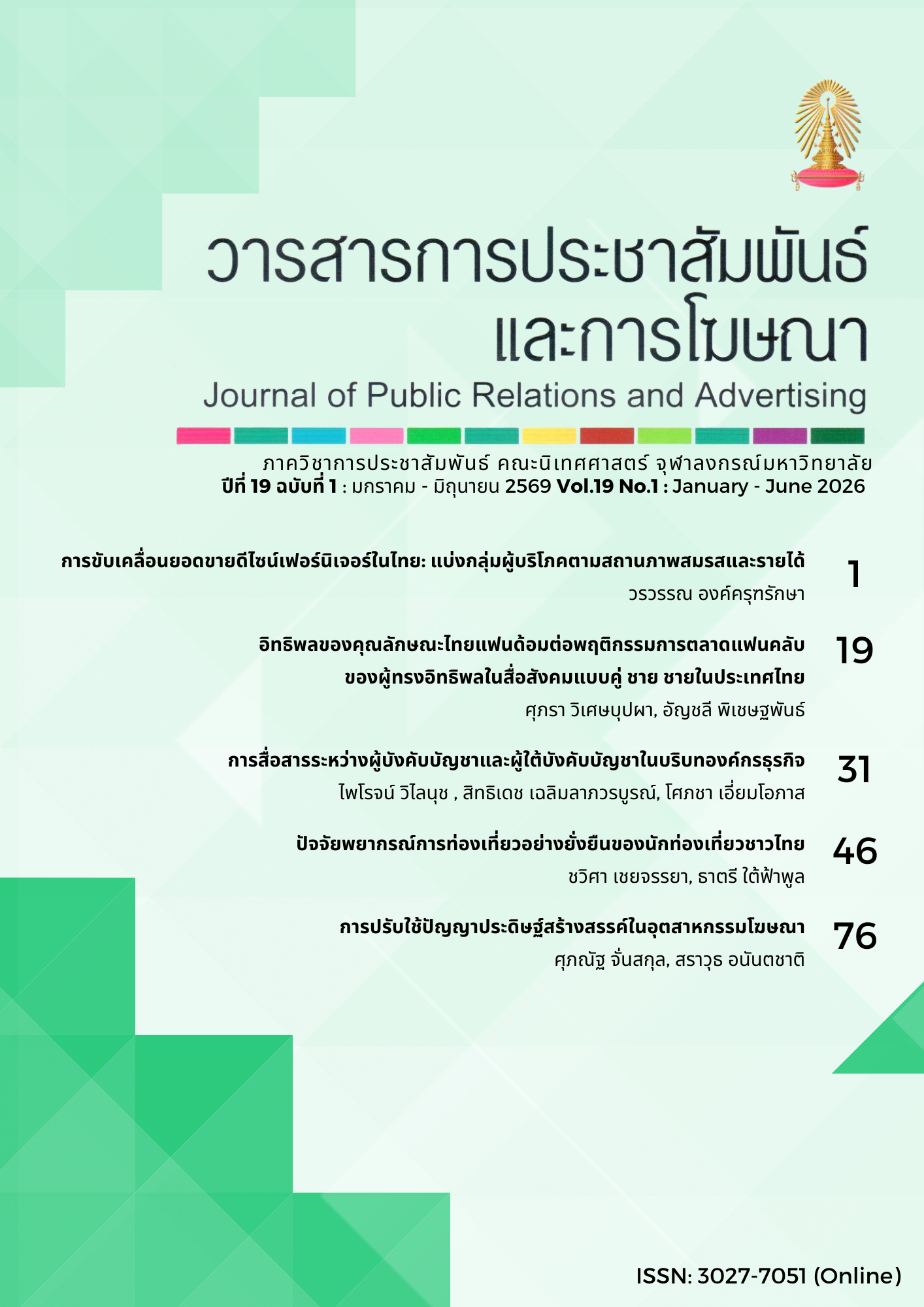
Segmenting Consumer and Purchase Intentions for Designer Furniture in Thailand
Article Sidebar
Main Article Content
Abstract
This study aimed to explain purchase intention toward Thai designer furniture through brand experience and customer. The research employed a quantitative research approach using a survey method. A questionnaire was developed as a research instrument, and data were collected from a sample of 200 respondents. The data were analyzed using multiple regression analysis with the stepwise method, segmented by marital status and income levels. The results revealed that behavioral brand experience was the strongest predictor of purchase intention toward Thai designer furniture among single without children’s consumers (β=.324, p<.01). While corporate brand image most strongly explained purchase intention among consumers with other marital statuses (β=.345, p<.001). Furthermore, both customer image and corporate image dimensions of brand image exerted the greatest influence on purchase intention among consumers with a monthly income of 10,000–50,000 THB (β=.300, p<.01). Meanwhile, corporate brand image was the most influential factor affecting purchase intention among consumers earning 50,001 THB or above (β=.326, p<.001). These findings provide crucial practical implications for targeted marketing strategies. Entrepreneurs should emphasize hands-on experiences like product trials for single consumers to reduce uncertainty. Conversely, when targeting other marital statuses or high-income groups, the focus should shift to building and communicating a strong, trustworthy corporate reputation through professional branding and industry endorsements. For middle-income buyers, communications must clearly emphasize functional value and product durability to build credibility.
Article Details
References
Aaker, D. A. (1996). Building strong brands. Free Press.
AnyMind Group. (2025). Thailand e-commerce and influencer marketing trends 2025. https://anymindgroup.com/
Bain & Company. (2024). Southeast Asia retail and e-commerce insights. https://www.bain.com/
Brakus, J. J., Schmitt, B. H., & Zarantonello, L. (2009). Brand experience: What is it? How is it measured? Does it affect loyalty? Journal of Marketing, 73(3), 52–68. https://doi.org/10.1509/jmkg.73.3.52
British Psychological Society. (2021). Ethics guidelines for internet-mediated research. https://www.bps.org.uk
Chanthasane, C., Poonrak, A., & Prasertsang, S. (2017). Research methodology in social sciences. Ramkhamhaeng University Press.
Çifci, S., Ekinci, Y., Gunay, G., & Kiyici, M. (2016). Antecedents and outcomes of brand promise perception in the luxury hotel market: The moderating role of marital status. Tourism Management Perspectives, 20, 294–302. https://doi.org/10.1016/j.tmp.2016.10.003
Creswell, J. W., & Poth, C. N. (2017). Qualitative inquiry and research design: Choosing among five approaches (4th ed.). SAGE Publications.
Daminger, A. (2019). The cognitive dimension of household labor. American Sociological Review, 84(4), 609–633. https://doi.org/10.1177/0003122419859007
DataReportal. (2025). Digital 2025: Thailand. https://datareportal.com/reports/digital-2025-thailand
ECDB. (2024). Thailand e-commerce market report. https://ecommercedb.com/
Erdem, T., & Swait, J. (2004). Brand credibility and its effects on consumer choice. Journal of Consumer Research. 31(3), 191–201. https://doi.org/10.1086/420792
He, H., Li, Y., & Harris, L. (2012). Social identity perspective on brand loyalty. Journal of Business Research, 65(5), 648–657. https://doi.org/10.1016/j.jbusres.2011.03.007
Huang, L., & Ge, J. (2019). Income level as moderator of brand experience effects: Evidence from Chinese luxury consumers. Journal of Consumer Marketing, 36(2), 247–259.
James, G., Witten, D., Hastie, T., & Tibshirani, R. (2014). An introduction to statistical learning: With applications in R. Springer.
Keller, K. L. (1993). Conceptualizing, measuring, and managing customer-based brand equity. Journal of Marketing, 57(1), 1–22. https://doi.org/10.2307/1252054
Ken Research. (2025). Thailand furniture market outlook to 2025. https://www.kenresearch.com/
Liang, S., Xu, J., & Huang, E. (2024). Social influence and trust in online purchase intention. SAGE Open.
Mandel, N., & Smeesters, D. (2008). The sweet escape: Effects of mortality salience on consumption quantities for high- and low-self-esteem consumers. Journal of Consumer Research, 35(2), 309–323.
Ongkrutraksa, W. (2024). YouTube content attributes and consumer engagement: Entertainment, informativeness, credibility, and interactivity effects on response behavior. PKRU Journal of Humanities and Social Sciences, 11(2), 45–62.
Pina, R., & Dias, Á. (2021). The influence of brand experiences on consumer-based brand equity. Journal of Brand Management, 28(1), 1–16. https://doi.org/10.1057/s41262-020-00227-0
Ronawech, M. (2020). Workshop document on statistics for research using statistical software. National Institute of Development Administration.
Rucker, D. D., & Galinsky, A. D. (2008). Desire to acquire: Powerlessness and compensatory consumption. Journal of Consumer Research, 35(2), 257–267. https://doi.org/10.1086/588569
Santpradit, P. (2024). The influence of brand experience, ethnocentrism, and cosmopolitanism on purchase intention of ‘designer furniture’ (Unpublished master’s thesis). Chulalongkorn University.
Schiffman, L. G., Kanuk, L. L., & Wisenblit, J. (2010). Consumer behavior (10th ed.). Pearson Education.
Schmitt, B. H. (1999). Experiential marketing. Free Press.
Sesar, V., Martinčević, I., & Boguszewicz-Kreft, M. (2022). Influencer credibility and purchase intention: Evidence from social commerce. Journal of Risk and Financial Management, 15(2), 1–15.
Suttichai, S., & Suriyawong, A. (2024). The relationship between brand identity and purchase intention of hand-woven fabric in Nakhon Si Thammarat province. Phuket Rajabhat University Academic Journal, 11(1), 123–145.
Thailand Digital Landscape. (2025). Thailand digital economy report 2025. Digital Economy Promotion Agency.
Wang, F., & Hariandja, E. S. (2016). The influence of brand ambassador on brand image and consumer purchasing decision: A case of Tous Les Jours in Indonesia. International Conference on Entrepreneurship, 1, 292–306.
Wang, Y.-H., & Tsai, C.-F. (2014). The relationship between brand image and purchase intention: Evidence from award-winning mutual funds. International Journal of Business and Finance Research, 8(2), 27–40.
Wanichbuncha, K. (2018). Statistics for research. Chulalongkorn University Press.
Weingarten, E., & Goodman, J. K. (2021). Re-examining the experiential advantage: The role of consumer income. Journal of Consumer Research, 48(2), 307–323.
Zeithaml, V. A. (1988). Consumer perceptions of price, quality, and value: A means-end model and synthesis of evidence. Journal of Marketing, 52(3), 2–22.
