
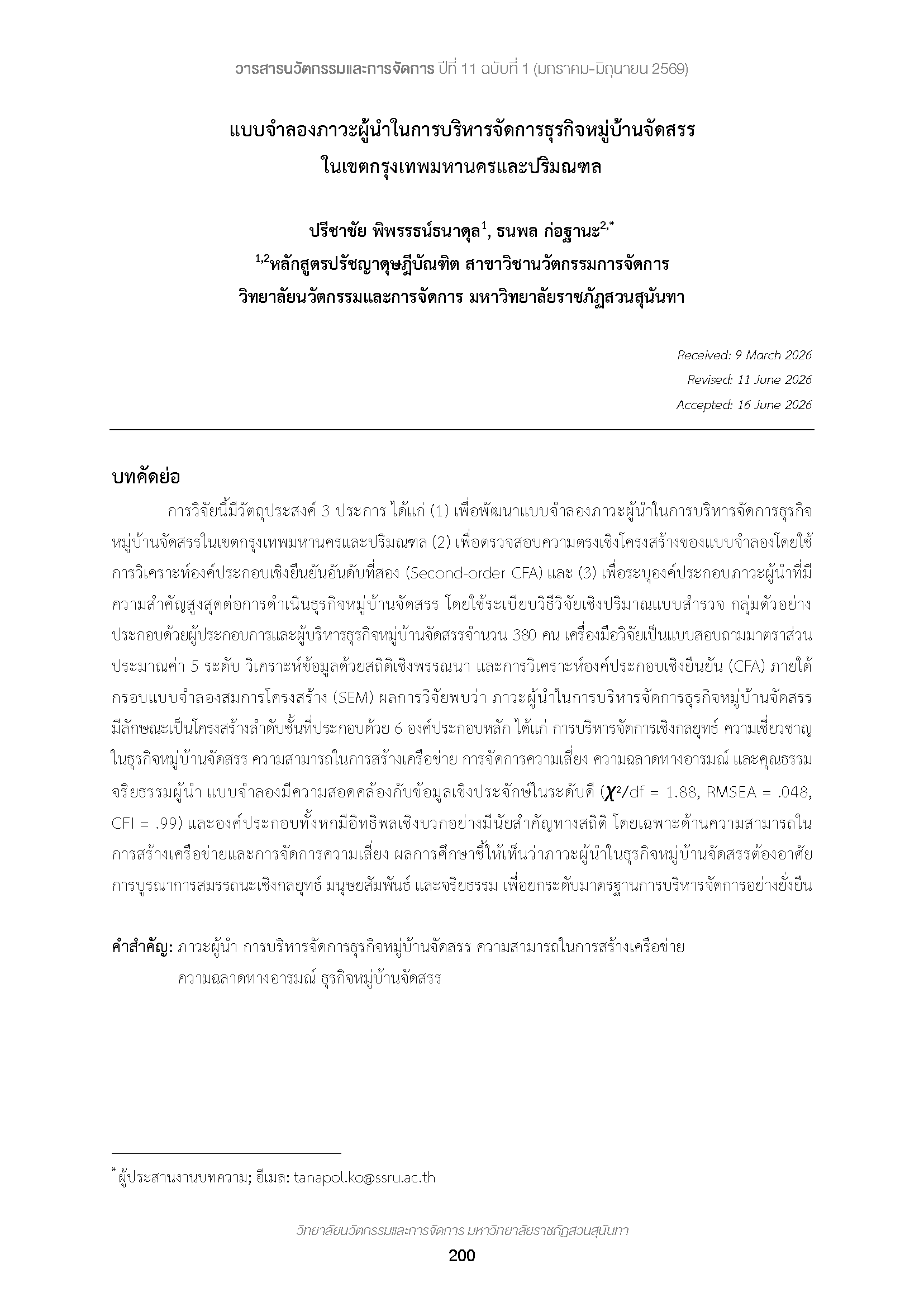
แบบจำลองภาวะผู้นำในการบริหารจัดการธุรกิจหมู่บ้านจัดสรร ในเขตกรุงเทพมหานครและปริมณฑล
คำสำคัญ:
ภาวะผู้นำ, การบริหารจัดการธุรกิจหมู่บ้านจัดสรร, ความสามารถในการสร้างเครือข่าย, ความฉลาดทางอารมณ์, ธุรกิจหมู่บ้านจัดสรรบทคัดย่อ
การวิจัยนี้มีวัตถุประสงค์ 3 ประการ ได้แก่ (1) เพื่อพัฒนาแบบจำลองภาวะผู้นำในการบริหารจัดการธุรกิจหมู่บ้านจัดสรรในเขต กรุงเทพมหานครและปริมณฑล (2) เพื่อตรวจสอบความตรงเชิงโครงสร้างของแบบจำลองโดยใช้การวิเคราะห์องค์ประกอบเชิงยืนยันอันดับที่สอง (Second-order CFA) และ (3) เพื่อระบุองค์ประกอบภาวะผู้นำที่มีความสำคัญสูงสุดต่อการดำเนินธุรกิจหมู่บ้านจัดสรร โดยใช้ระเบียบวิธีวิจัยเชิงปริมาณแบบสำรวจ กลุ่มตัวอย่างประกอบด้วยผู้ประกอบการและผู้บริหารธุรกิจหมู่บ้านจัดสรรจำนวน 380 คน เครื่องมือวิจัยเป็นแบบสอบถามมาตราส่วนประมาณค่า 5 ระดับ วิเคราะห์ข้อมูลด้วยสถิติเชิงพรรณนา และการวิเคราะห์องค์ประกอบเชิงยืนยัน (CFA) ภายใต้กรอบแบบจำลองสมการโครงสร้าง (SEM) ผลการวิจัยพบว่า ภาวะผู้นำในการบริหารจัดการธุรกิจหมู่บ้านจัดสรร มีลักษณะเป็นโครงสร้างลำดับชั้นที่ประกอบด้วย 6 องค์ประกอบหลัก ได้แก่ การบริหารจัดการเชิงกลยุทธ์ ความเชี่ยวชาญในธุรกิจหมู่บ้านจัดสรร ความสามารถในการสร้างเครือข่าย การจัดการความเสี่ยง ความฉลาดทางอารมณ์ และคุณธรรมจริยธรรมผู้นำ แบบจำลองมีความสอดคล้องกับข้อมูลเชิงประจักษ์ในระดับดี (χ²/df = 1.88, RMSEA = .048, CFI = .99) และองค์ประกอบทั้งหกมีอิทธิพลเชิงบวกอย่างมีนัยสำคัญทางสถิติ โดยเฉพาะด้านความสามารถในการสร้างเครือข่ายและการจัดการความเสี่ยง ผลการศึกษาชี้ให้เห็นว่าภาวะผู้นำในธุรกิจหมู่บ้านจัดสรรต้องอาศัยการบูรณาการสมรรถนะเชิงกลยุทธ์ มนุษยสัมพันธ์ และจริยธรรม เพื่อยกระดับมาตรฐานการบริหารจัดการอย่างยั่งยืน
เอกสารอ้างอิง
Abatecola, G., Astuti, F. D., and Caputo, A. (2013). Corporate real estate management: A systematic literature review and research agenda . Journal of Corporate Real Estate, 15(1), 46–63.
Ayugi, I. (2024). Ethical leadership and its impact on corporate governance. Eurasian Experiment Journal of Arts and Management, 5(3), 35–39.
Boyatzis, R. E. (2008). Leadership development from a complexity perspective. Consulting Psychology Journal: Practice and Research, 60(4), 298–313.
Chuensomboon, S. (2023). Moral leadership of property management executives. Journal of Yanasangvorn Research Institute, 14(2), 82–92. (in Thai)
Goleman, D., and Boyatzis, R. E. (2017). Emotional intelligence has 12 elements. Which do you need to work on? Harvard Business Review. [Online]. Retrieved from:
Hair, J. F., Black, W. C., Babin, B. J., and Anderson, R. E. (2019). Multivariate data analysis. 8th ed. Cengage Learning.
Hamzah, E. (2024). Winning leadership and management strategies in real estate organization. International Journal of Research and Innovation in Social Science, 8(12), 2879–2887. https://doi.org/10.47772/IJRISS.2024.81247
Hu, L. T., and Bentler, P. M. (1999). Cutoff criteria for fit indexes in covariance structure analysis: Conventional criteria versus new alternatives. Structural Equation Modeling, 6(1), 1–55. https://doi.org/10.1080/10705519909540118
Hughes, R. L., Ginnett, R. C., and Curphy, G. J. (2023). Leadership: Enhancing the lessons of experience. 10th ed. McGraw-Hill Education.
Institute for Housing and Urban Development Studies (IHS). (2024). About IHS: Institute for Housing and Urban Development Studies. Erasmus University Rotterdam. [Online]. Retrieved from: https://www.ihs.nl
Kline, R. B. (2016). Principles and practice of structural equation modeling. 4th ed. Guilford Press.
Land and Houses Bank Public Company Limited. (2022). Construction business: Trends and situation in 2024. [Online]. Retrieved from: https://www.lhbank.co.th/getattachment/ 81f35628-e20d-4de2-b815-d3914af71efa/economic-analysis-Industry-Outlook-2024-Construction-2024
Northouse, P. G. (2021). Leadership: Theory and Practice, Ninth Edition. SAGE Publications, Inc.
Park, S., and Kim, J. (2022). Data-driven decision making in housing management: Predictive maintenance systems and operational efficiency. Building Research and Information, 50(3), 311–327.
Real Estate Information Center. (2022). Construction industry value in 2023 is expected to expand. [Online]. Retrieved from: https://www.reic.or.th/News/RealEstate/456472
ดาวน์โหลด
เผยแพร่แล้ว
รูปแบบการอ้างอิง
ฉบับ
ประเภทบทความ
สัญญาอนุญาต
ลิขสิทธิ์ (c) 2026 วารสารนวัตกรรมและการจัดการ

อนุญาตภายใต้เงื่อนไข Creative Commons Attribution-NonCommercial-NoDerivatives 4.0 International License.
โปรดดูที่จริยธรรมการตีพิมพ์ https://so03.tci-thaijo.org/index.php/journalcim/Ethics



