
ตัวแบบความสัมพันธ์เชิงสาเหตุของการจัดการโซ่ความเย็นด้วยเทคโนโลยีเพื่อเพิ่มขีดความสามารถและศักยภาพในการแข่งขันอย่างยั่งยืนในประเทศไทย
คำสำคัญ:
การจัดการโซ่ความเย็น , เทคโนโลยีโซ่ความเย็น , ศักยภาพในการแข่งขัน , การแข่งขันอย่างยั่งยืนบทคัดย่อ
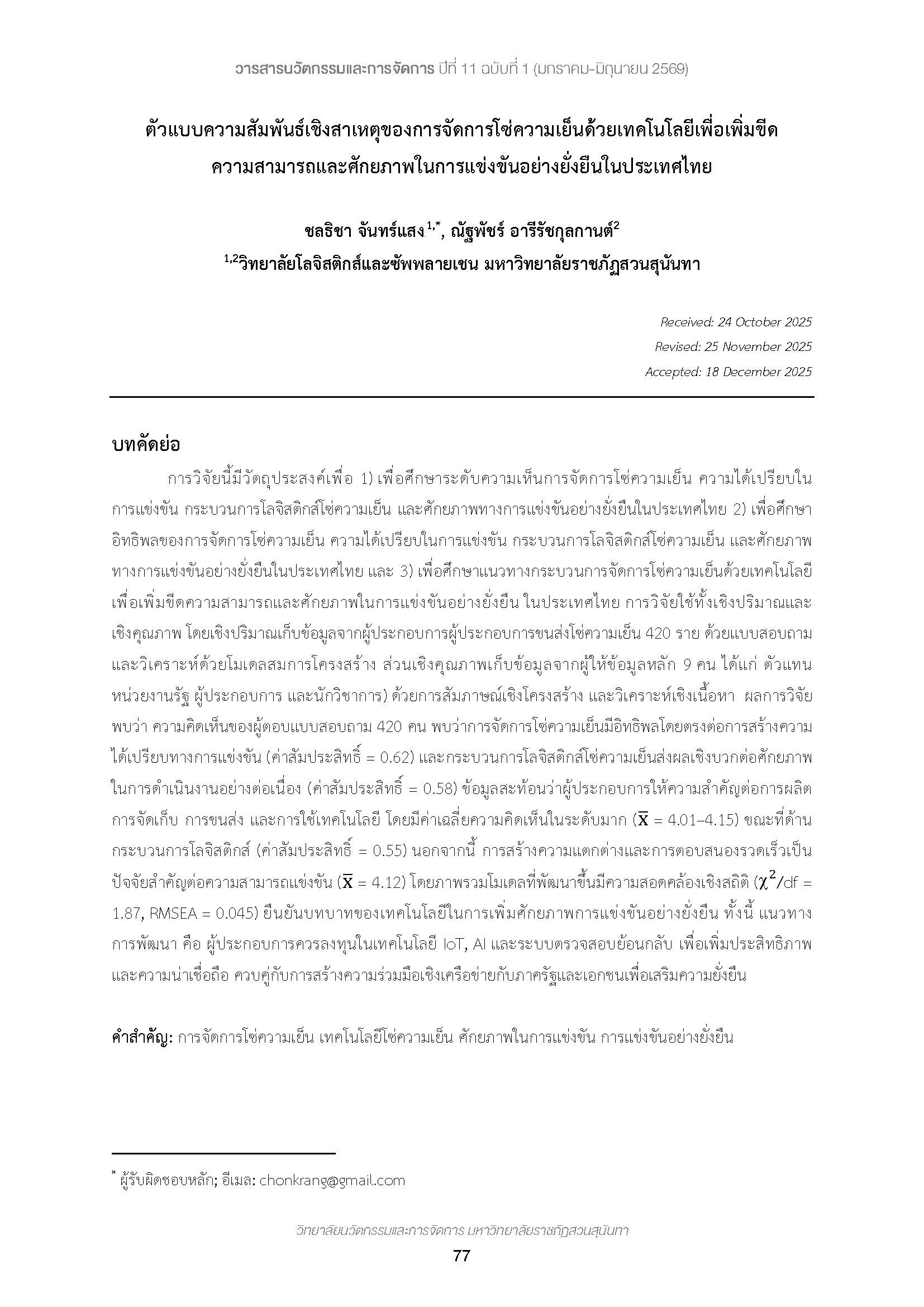
การวิจัยนี้มีวัตถุประสงค์เพื่อ 1) เพื่อศึกษาระดับความเห็นการจัดการโซ่ความเย็น ความได้เปรียบใน การแข่งขัน กระบวนการโลจิสติกส์โซ่ความเย็น และศักยภาพทางการแข่งขันอย่างยั่งยืนในประเทศไทย 2) เพื่อศึกษาอิทธิพลของการจัดการโซ่ความเย็น ความได้เปรียบในการแข่งขัน กระบวนการโลจิสติกส์โซ่ความเย็น และศักยภาพทางการแข่งขันอย่างยั่งยืนในประเทศไทย และ 3) เพื่อศึกษาแนวทางกระบวนการจัดการโซ่ความเย็นด้วยเทคโนโลยีเพื่อเพิ่มขีดความสามารถและศักยภาพในการแข่งขันอย่างยั่งยืน ในประเทศไทย การวิจัยใช้ทั้งเชิงปริมาณและเชิงคุณภาพ โดยเชิงปริมาณเก็บข้อมูลจากผู้ประกอบการผู้ประกอบการขนส่งโซ่ความเย็น 420 ราย ด้วยแบบสอบถามและวิเคราะห์ด้วยโมเดลสมการโครงสร้าง ส่วนเชิงคุณภาพเก็บข้อมูลจากผู้ให้ข้อมูลหลัก 9 คน ได้แก่ ตัวแทนหน่วยงานรัฐ ผู้ประกอบการ และนักวิชาการ) ด้วยการสัมภาษณ์เชิงโครงสร้าง และวิเคราะห์เชิงเนื้อหา ผลการวิจัยพบว่า ความคิดเห็นของผู้ตอบแบบสอบถาม 420 คน พบว่าการจัดการโซ่ความเย็นมีอิทธิพลโดยตรงต่อการสร้างความได้เปรียบทางการแข่งขัน (ค่าสัมประสิทธิ์ = 0.62) และกระบวนการโลจิสติกส์โซ่ความเย็นส่งผลเชิงบวกต่อศักยภาพในการดำเนินงานอย่างต่อเนื่อง (ค่าสัมประสิทธิ์ = 0.58) ข้อมูลสะท้อนว่าผู้ประกอบการให้ความสำคัญต่อการผลิต การจัดเก็บ การขนส่ง และการใช้เทคโนโลยี โดยมีค่าเฉลี่ยความคิดเห็นในระดับมาก ( = 4.01–4.15) ขณะที่ด้านกระบวนการโลจิสติกส์ (ค่าสัมประสิทธิ์ = 0.55) นอกจากนี้ การสร้างความแตกต่างและการตอบสนองรวดเร็วเป็นปัจจัยสำคัญต่อความสามารถแข่งขัน ( = 4.12) โดยภาพรวมโมเดลที่พัฒนาขึ้นมีความสอดคล้องเชิงสถิติ (/df = 1.87, RMSEA = 0.045) ยืนยันบทบาทของเทคโนโลยีในการเพิ่มศักยภาพการแข่งขันอย่างยั่งยืน ทั้งนี้ แนวทางการพัฒนา คือ ผู้ประกอบการควรลงทุนในเทคโนโลยี IoT, AI และระบบตรวจสอบย้อนกลับ เพื่อเพิ่มประสิทธิภาพและความน่าเชื่อถือ ควบคู่กับการสร้างความร่วมมือเชิงเครือข่ายกับภาครัฐและเอกชนเพื่อเสริมความยั่งยืน
เอกสารอ้างอิง
Bhatti., N, Bhatti., S.H., Hussain., W.M.H.W, Khan., J, Sultan., S, and Ferraris., A. (2022). Exploring data-driven innovation: what's missing in the relationship between big data analytics capabilities and supply chain innovation. Journal of Retailing and Consumer Services, 26(60), 1-26.
Barney, J. (1991). Firm resources and sustained competitive advantage. Journal of management, 17(1), 99-120.
Chaudhuri., A, Subramanian., N, and Dora., M. (2022). Circular economy and digital capabilities of SMEs for providing value to customers: Combined resource-based view and ambidexterity perspective. Journal of Business Research, 1(142), 32-44.
Fasihi., M., Moghaddam., R.T., Keshteli., M.H., and Najaf., S.E. (2023). Designing a sustainable fish closed loop supply chain network under uncertainty. Environmental Science and Pollution Research, 30, 90050–90087.
Hair, J. F., Ringle, C. M., and Sarstedt, M. (2011). PLS-SEM: Indeed a silver bullet. Journal of
Marketing theory and Practice, 19(2), 139-152
Hair, J. F. (Jr.), Hult, G. T. M., Ringle, C. M., and Sarstedt, M. (2014). A Primer on Partial Least
Squares Structural Equation Modeling (PLS-SEM). California, CA: Sage Publications
Leng., L, Wang., L, Zhao., Y, and Zuo., O. (2024). Formulation and heuristic method for urban cold-chain logistics systems with path flexibility – The case of China. Expert Systems with Applications, 244, 1-17.
Lam, H. Y., Tang, V., and Wong, L. (2023). Digital transformation for cold chain management in freight forwarding industry. International Journal of Engineering Business Management, 15, 1–17. https://doi.org/10.1177/18479790231160857
Mahaprukphong, J. (2018). Factors influencing the success of refrigerated goods transportation in Thailand. Journal of Logistics Academic, Suan Sunandha Rajabhat University, 5(1), 101–118. (in Thai)
Mentzer, J.T. , DeWitt, W. , Keebler, J.S. , Min, S. , Nix, N.W. , Smith, C.D. and Zacharia, Z.G. 2001. Defining supply chain management. Journal of Business Logistics, 22(2), 1–25.
Office of Logistics System Development Strategy. (2023). Cold chain management: Thai Logistics Statistics. [Online]. Retrieved February 9, 2023, from: https://www.nesdc.go.th/download/ document/logistic/Thailand%20Logistics%20Action%20Plan% 202023-2027%20(Public%20Version).pdf (in Thai)
Ongkunnaruk., P. (2019). Supply chain and logistics management of agricultural products under the research project for monitoring, evaluation, and policy recommendations on production, trade, and investment restructuring. Bangkok: Thailand Development Research Institute. (in Thai)
Pongsuphat., W. (2020). Cold chain management in Thailand’s seafood industry. Agricultural Research and Development Journal, 10(2), 45–58. (in Thai)
Porter, Michael E., (1980). Competitive Strategic Technique for Analyzing Industrial and
Competitors. The Five Force. Free Press. New York.
Sultana., S, Akter., S, and Kyriazis., E. (2022). How data-driven innovation capability is shaping the future of market agility and competitive performance. Technological Forecasting and Social Change, 174(5), 8-21.
SuriyaWong, T., Wetchprasert, W. and Suksang-arom, W. (2020). The causal relationship of e-service quality and customer experience on customer satisfaction and loyalty in online fashion retail business. Ubon Ratchathani University Journal of Management Sciences, 11(2), 118–139. (in Thai)
Shui, W., and Li, M. (2020). Integrated pricing and distribution planning for community group purchase of fresh agricultural products. Sci. Program, 2020, 1–15. doi: 10.1155/2020/8839398
Turan, C., and Ozturkoglu, Y. (2021). A conceptual framework model for an effective cold food chain management in sustainability environment. ResearchGate. [Online]. Retrieved from: https://www.researchgate.net/publication/353464353_A_conceptual_framework_model_for_an_effective_cold_food_chain_management_in_sustainability_environment
Wang, S. (2022). Study on Cold Chain Logistics Operation and Risk Control of Fresh e-Commerce Products. Hindawi Advances in Multimedia, 1, 1-11.
Wamba, S.F., Rameshwar, A.D., Gunasekaran, A., and Akter, S. (2022). The performance effects of big data analytics and supply chain ambidexterity: The moderating effect of environmental dynamism. International Journal of Production Economics, 1(22), 1-13.
Zhou, J., Wei, J., Yang, T., Zhang, P., Liu, F., and Chen, J. (2021). Seepage channel development in the crown pillar: insights from induced microseismicity. Int. J. Rock Mech. Min. Sci. 145:104851. doi: 10.1016/j.ijrmms.2021.104851
ดาวน์โหลด
เผยแพร่แล้ว
รูปแบบการอ้างอิง
ฉบับ
ประเภทบทความ
สัญญาอนุญาต
ลิขสิทธิ์ (c) 2026 วารสารนวัตกรรมและการจัดการ

อนุญาตภายใต้เงื่อนไข Creative Commons Attribution-NonCommercial-NoDerivatives 4.0 International License.
โปรดดูที่จริยธรรมการตีพิมพ์ https://so03.tci-thaijo.org/index.php/journalcim/Ethics



