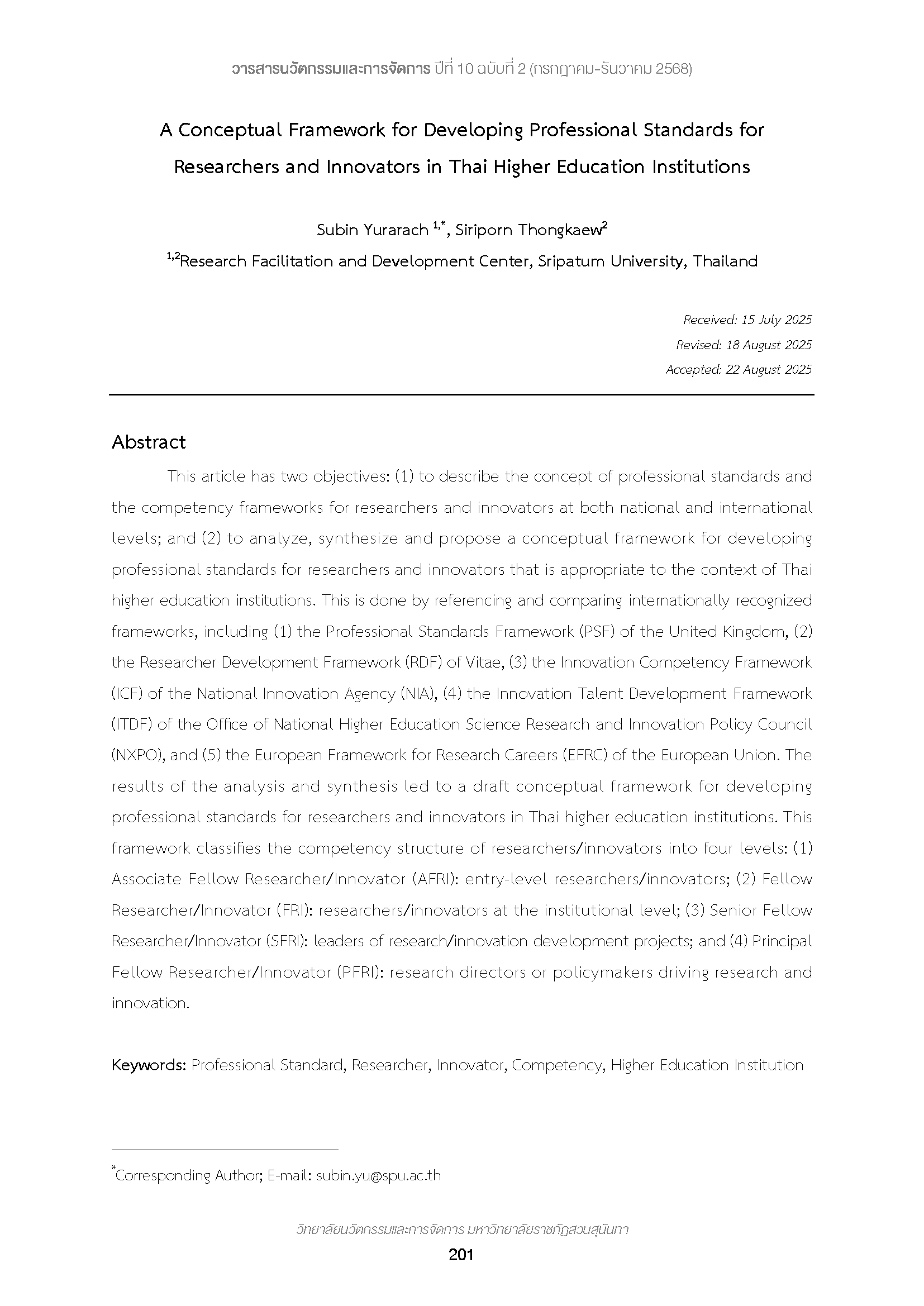
A Conceptual Framework for Developing Professional Standards for Researchers and Innovators in Thai Higher Education Institutions
Keywords:
Professional Standard, Researcher, Innovator, Competency, Higher Education InstitutionAbstract
This article has two objectives: (1) to describe the concept of professional standards and the competency frameworks for researchers and innovators at both national and international levels; and (2) to analyze, synthesize and propose a conceptual framework for developing professional standards for researchers and innovators that is appropriate to the context of Thai higher education institutions. This is done by referencing and comparing internationally recognized frameworks, including (1) the Professional Standards Framework (PSF) of the United Kingdom, (2) the Researcher Development Framework (RDF) of Vitae, (3) the Innovation Competency Framework (ICF) of the National Innovation Agency (NIA), (4) the Innovation Talent Development Framework (ITDF) of the Office of National Higher Education Science Research and Innovation Policy Council (NXPO), and (5) the European Framework for Research Careers (EFRC) of the European Union. The results of the analysis and synthesis led to a draft conceptual framework for developing professional standards for researchers and innovators in Thai higher education institutions. This framework classifies the competency structure of researchers/innovators into four levels: (1) Associate Fellow Researcher/Innovator (AFRI): entry-level researchers/innovators; (2) Fellow Researcher/Innovator (FRI): researchers/innovators at the institutional level; (3) Senior Fellow Researcher/Innovator (SFRI): leaders of research/innovation development projects; and (4) Principal Fellow Researcher/Innovator (PFRI): research directors or policymakers driving research and innovation.
References
Advance HE. (2023). Professional Standards Framework. [Online]. Retrieved from: https://www.advance-he.ac.uk
ASEAN. (2022). ASEAN Young Scientist Network Annual Report.
Boyatzis, R. E. (2008). Competencies in the 21st century. Journal of Management Development, 27(1), 5–12. https://doi.org/10.1108/02621710810840730
Chiang Mai University. (2022). CMU Researcher Development Model. (in Thai)
Eraut, M. (1994). Developing professional knowledge and competence. London: RoutledgeFalmer.
European Commission. (2011). Towards a European Framework for Research Careers. Brussels: European Commission.
Khon Kaen University, Division of Research and Graduate Studies. (2024). KKU Researcher Incubation Program: Individual Mentor–Mentee Guidelines. Khon Kaen: Unpublished report. (in Thai)
Knight, P. T. (2015). Assessment for Learning in Higher Education. Routledge.
National Innovation Agency (NIA). (2022). Innovation Competency Framework. Bangkok: NIA. (in Thai)
National Research Council of Thailand (NRCT). (2022). Core Competencies for Postdoctoral Scholars.
NXPO. (2021). Innovation Talent Development Framework. Bangkok: Office of National Higher Education Science Research and Innovation Policy Council. (in Thai)
NXPO. (2023). Thailand Research and Innovation Utilization Survey 2023. Office of National Higher Education Science Research and Innovation Policy Council (NXPO). [Online]. Retrieved from: https://www.nxpo.or.th
Office of the Permanent Secretary, Ministry of Higher Education, Science, Research and Innovation. (2022a). Thailand Research and Development Statistics Report. Bangkok: Office of the Permanent Secretary, MHESI. (in Thai)
Office of the Permanent Secretary, Ministry of Higher Education, Science, Research and Innovation. (2022b). Performance Report on Higher Education, Science, Research and Innovation. Bangkok: Office of the Permanent Secretary, MHESI. (in Thai)
Office of the Science Promotion Commission. (2023a). Thailand Research and Innovation Utilization Overview Report. Bangkok: Office of the Science Promotion Commission. (in Thai)
Office of the Permanent Secretary, Ministry of Higher Education, Science, Research and Innovation. (2023b). Survey of Thai Researchers’ Opinions on the Research and Innovation Human Resource Development System. Bangkok: Office of the Permanent Secretary, MHESI. (in Thai)
Parntong, S. (2020). Development of a researcher competency model for Rajabhat University. Thesis of the Degree of Doctoral Program. Bangkok: Chandrakasem Rajabhat University. (in Thai)
Suthammanon, K., et al. (2023). Designing strategic career pathways: A competency based career path framework at Panyapiwat Institute of Management. KUEY Journal, 30(5), 489–504.
UNESCO. (2022). Higher Education in the Sustainable Development Goals. Paris: UNESCO.
University of Sheffield. (2021). RDF Planner Tool Guide.
Vitae. (2011). Researcher Development Framework. Cambridge: Vitae. [Online]. Retrieved 23 March 2025 from: https://www.vitae.ac.uk/researcher-development-framework
Yurarach, S., and Thongkaew, S. (2025). New researcher development project at Sripatum University. SPU Research Bulletin, 10(2), 20–25. (in Thai)
Downloads
Published
How to Cite
Issue
Section
License
Copyright (c) 2025 Journal of Innovation and Management

This work is licensed under a Creative Commons Attribution-NonCommercial-NoDerivatives 4.0 International License.
See Publication Ethics https://so03.tci-thaijo.org/index.php/journalcim/Ethics



