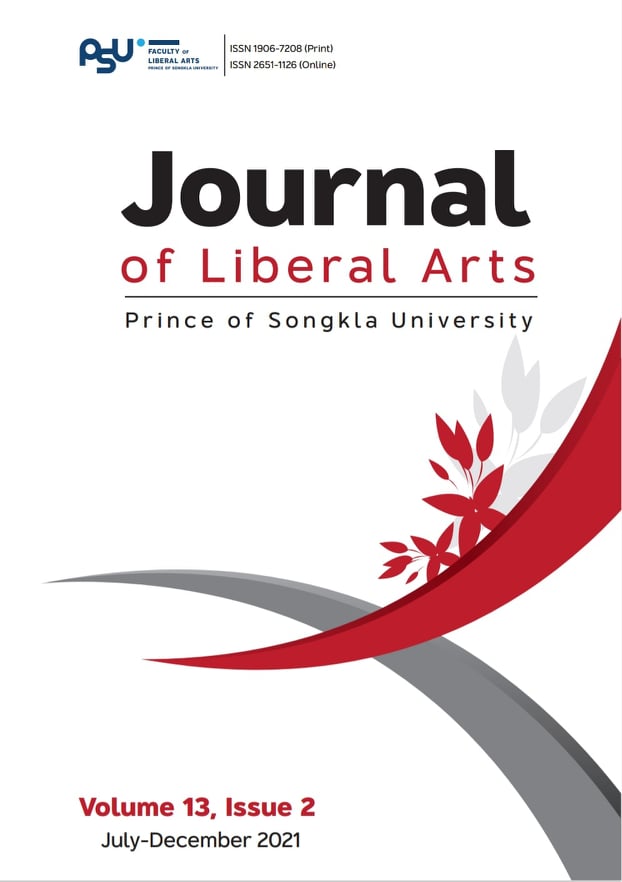
ผลการรับรู้ความสามารถของตนเองและความเป็นอิสระในการสอนสำหรับนักศึกษาฝึกสอนวิชาภาษาอังกฤษชาวไทย ที่มีต่อการสอนออนไลน์ในช่วงสถานการณ์ การแพร่ระบาดของโควิด 19
DOI:
https://doi.org/10.14456/jlapsu.2021.5คำสำคัญ:
การรับรู้ความสามารถของตนเอง, การสอนออนไลน์, ความเป็นอิสระของครู, นักศึกษาฝึกสอน, สถานการณ์การแพร่ระบาดของโควิด 19บทคัดย่อ
การแพร่ระบาดของโควิด 19 ได้เปลี่ยนรูปแบบการสอนในห้องเรียนมาเป็นการสอนในรูปแบบออนไลน์ครูชาวไทยส่วนใหญ่โดยเฉพาะนักศึกษาฝึกสอนขาดประสบการณ์การสอนในรูปแบบออนไลน์ซึ่งอาจส่งผลกระทบต่อความสามารถและความมั่นใจในการสอนเมื่อได้รับมอบหมายให้สอนคอร์สออนไลน์ การวิจัยนี้เป็นการศึกษาการรับรู้ความสามารถของตนเองและความเป็นอิสระของครูว่าส่งผลต่อการสอนในช่วงสถานการณ์การแพร่ระบาดของโควิด 19 มากน้อยเพียงใดโดยใช้กรอบแนวคิดการวิจัย ซึ่งปรับจากแนวคิดการรับรู้ความสามารถของตนเองของแบนดูรา (2540) และแนวคิดเกี่ยวกับอิสระในการสอนของครูโดยปรับจากแนวคิดของแมคแกรธ (2543) และ สมิธ (2546) ผู้เข้าร่วมในงานวิจัยชิ้นนี้เป็นนักศึกษาฝึกสอน สาขาวิชาการสอนภาษาอังกฤษ จำนวน 7 ราย ซึ่งสอนในโรงเรียนระดับมัธยมศึกษาในจังหวัดปัตตานี เป็นการวิจัยเชิงคุณภาพแบบกรณีศึกษาที่เก็บข้อมูลจากหลากหลายแหล่ง เช่น การสัมภาษณ์
แบบกึ่งโครงสร้าง สมุดบันทึกการสอนและแผนการจัดการเรียนรู้เพื่อศึกษาการรับรู้ความสามารถของตนเอง และความเป็นอิสระของครูในการสอนชั้นเรียนออนไลน์ ผลการวิจัยพบว่าผู้เข้าร่วมมีการรับรู้ความสามารถของตนเองในระดับปานกลางเนื่องจากมีประสบการณ์ในการสอนออนไลน์ที่จำกัดและมีความเป็นอิสระในการจัดการเรียนการสอนค่อนข้างน้อยเนื่องจากมีข้อจำกัดหลายประการที่มีผลต่อแนวทางการสอนออนไลน์
เอกสารอ้างอิง
Atmojo, A. E. P., & Nugroho, A. (2020). EFL classes must go online! Teaching activities and challenges during COVID-19 pandemic in Indonesia. Register Journal, 13(1), 49-76. https://www.researchgate.net/publication/341750033_EFL_
Classes_Must_Go_Online_Teaching_Activities_and_Challenges_during_COVID-19_Pandemic_in_Indonesia
Bandura, A. (1977). Self-efficacy: Toward a unifying theory of behavioral change. Psychological Review, 84(2), 191-215. https://doi.org/10.1037/0033-295X.84.2.191
Bandera, A. (1986). Social foundations of thought and action. Englewood Cliffs.
Bandura, A. (1997). Self efficacy: The exercise of control. W H. Freeman & Company.
Benson, P. (2000). Autonomy as a learners’ and teachers’ right. In B. Sinclair, I McGrath & T. Lamb (Eds.), Learner autonomy, teacher autonomy: Future directions (pp. 111-117). Longman.
Benson, P. (2013). Teaching and researching: Autonomy in language learning. Routledge.
Fajardo Castañeda, J. A., & Miranda Montenegro, I. R. (2015). The paradox of the practicum: Affinity to and resistance towards teaching. Íkala, Revista de Lenguaje y Cultura, 20(3), 239-341. http://www.scielo.org.co/scielo.php?pid=S0123-34322015000300004&script=sci_arttext&tlng=pt
Ferrier-Kerr, J. L. (2009). Establishing professional relationships in practicum settings. Teaching and Teacher Education, 25(6), 790-797. https://doi.org/10.1016/j.tate.2009.01.001
Gupta, A., & Pathania, P. (2021). To study the impact of Google Classroom as a platform of learning and collaboration at the teacher education level. Education and Information Technologies, 26(1), 843-857.https://doi.org/10.1007/s10639-020-10294-1
Johnson, D. (2010). Learning to teach: The influence of a university-school partnership project on pre-service elementary teachers’ efficacy for literacy instruction. Reading Horizons, 50(1), 23-48.https://core.ac.uk/down
load/pdf/144155181.pdf
Kaur, A., Hashim, R. A., & Noman, M. (2014). Teacher autonomy support: Does it hinder motivation among Thai students? Malaysian Journal of Learning and Instruction, 11, 171-189.
http://www.e-journal.uum.edu.my/index.php/mjli/article/view/7670/807
Kawinkoonlasate, P. (2020). Online language learning for Thai EFL learners: An analysis of effective alternative learning methods in response to the COVID-19 outbreak. English Language Teaching, 13(12), 15-26. https://files.eric.ed.gov/fulltext/EJ1279886.pdf
Lamb, T., & Reinders, H. (Eds.). (2008). Learner and teacher autonomy: Concepts, realities, and responses (Vol. 1). John Benjamins.
Little, D. (1995). Learning as dialogue: The dependence of learner autonomy on teacher autonomy. System, 23(2), 175-181. https://doi.org/10.1016/0346-251X(95)00006-6
Ma, K., Chutiyami, M., Zhang, Y., & Nicoll, S. (2021). Online teaching self-efficacy during COVID-19: Changes, its associated factors and moderators. Education and Information Technologies, 1-23. https://doi.org/10.1007/s10639-021-10486-3
Martinez, H. (2008). The subjective theories of student teachers: Implications for teacher education and research on learner autonomy. In T. Lamb & H. Reinders (Eds.), Learner and teacher autonomy: Concepts, realities, and responses (Vol. 1, pp. 103-124). John Benjamins.
McGrath, I. (2000). Teacher autonomy. In B. Sinclair, I McGrath, & T. Lamb (Eds.), Learner autonomy, teacher autonomy: Future directions (Vol. 1, pp. 100-110). Longman.
Milner, H. R. (2002). A case study of an experienced English teacher’s self-efficacy and persistence through “crisis” situations: Theoretical and practical considerations. The High School Journal, 86(1), 28-35. https://
www.jstor.org/stable/40364343
Mills, N. (2011). Teaching assistants’ self‐efficacy in teaching literature: Sources, personal assessments, and consequences. The Modern Language Journal, 95(1), 61-80. https://doi.org/10.1111/j.1540-4781.2010.01145.x
Moradkhani, S., Raygan, A., & Moein, M. S. (2017). Iranian EFL teachers’ reflective practices and self-efficacy: Exploring possible relationships. System, 65, 1-14. https://doi.org/10.1016/j. system.2016.12.011
Morris, D. B., & Usher, E. L. (2011). Developing teaching self-efficacy in research institutions: A study of award-winning professors. Contemporary Educational Psychology, 36(3), 232-245. https://doi.org/10.1016/j.
cedpsych.2010.10.005
O’Connor, C., & Joffe, H. (2020). Intercoder reliability in qualitative research: Debates and practical guidelines. International Journal of Qualitative Methods, 19, 1-13. https://doi.org/10.1177/1609406919899220
Ramos, R. C. (2006). Considerations on the role of teacher autonomy. Colombian Applied Linguistics Journal, (8), 183-202. https://doi.org/10.14483/22487085.10510
Rovinelli, R. J., & Hambleton, R. K. (1977). On the use of content specialists in the assessment of criterion-referenced test item validity. Dutch Journal of Educational Research, (2), 49-60. https://files.eric.ed.gov/
fulltext/ED121845.pdf
Smith, R. C. (2000). Starting with ourselves: Teacher-learner autonomy in language learning. In B. Sinclair, I McGrath & T. Lamb (Eds.), Learner autonomy, teacher autonomy: Future directions (pp. 89-99). Longman.
Smith, R. C. (2003). Teacher education for teacher-learner autonomy. Symposium for Language Teacher Educators: Papers from Three IALS Symposia. http://homepages.warwick.ac.uk/~elsdr/Teacher_autonomy.pdf
Trent, J. (2013). From learner to teacher: Practice, language, and identity in a teaching practicum. Asia-Pacific Journal of Teacher Education, 41(4), 426-440. https://doi.org/10.1080/1359866X.2013.838621
Tschannen-Moran, M., Hoy, A. W., & Hoy, W. K. (1998). Teacher efficacy: Its meaning and measure. Review of Educational Research, 68(2), 202-248. https://doi.org/10.3102/00346543068002202
Turner, R. C., & Carlson, L. (2003). Indexes of item-objective congruence for multidimensional items. International Journal of Testing, 3(2), 163-171. https://doi.org/10.1207/S15327574IJT0302_5
White, C. (2007). Innovation and identity in distance language learning and teaching. International Journal of Innovation in Language Learning and Teaching, 1(1), 97-110. https://doi.org/10.2167/illt45.0
Wyatt, M. (2013). Overcoming low self-efficacy beliefs in teaching English to young learners. International Journal of Qualitative Studies in Education, 26(2), 238-255.https://doi.org/10.1080/09518398.2011.605082
Xu, Y., & Wong, H. (2011). School-based curriculum development in China: Policy analysis, theoretical controversy, and practical exploration. Chinese Education & Society, 44(4), 44-63. https://doi.org/10.2753/CED1061-1932440403
ดาวน์โหลด
เผยแพร่แล้ว
รูปแบบการอ้างอิง
ฉบับ
ประเภทบทความ
สัญญาอนุญาต
ลิขสิทธิ์ (c) 2021 Varis Jeh-Awae, Pamararat Wiriyakarun

อนุญาตภายใต้เงื่อนไข Creative Commons Attribution-NonCommercial-NoDerivatives 4.0 International License.
ลิขสิทธิ์บทความเป็นของผู้เขียน แต่วารสารศิลปศาสตร์ มหาวิทยาลัยสงขลานครินทร์ ขอสงวนสิทธิ์ในการเป็นผู้ตีพิมพ์เผยแพร่เป็นครั้งแรก