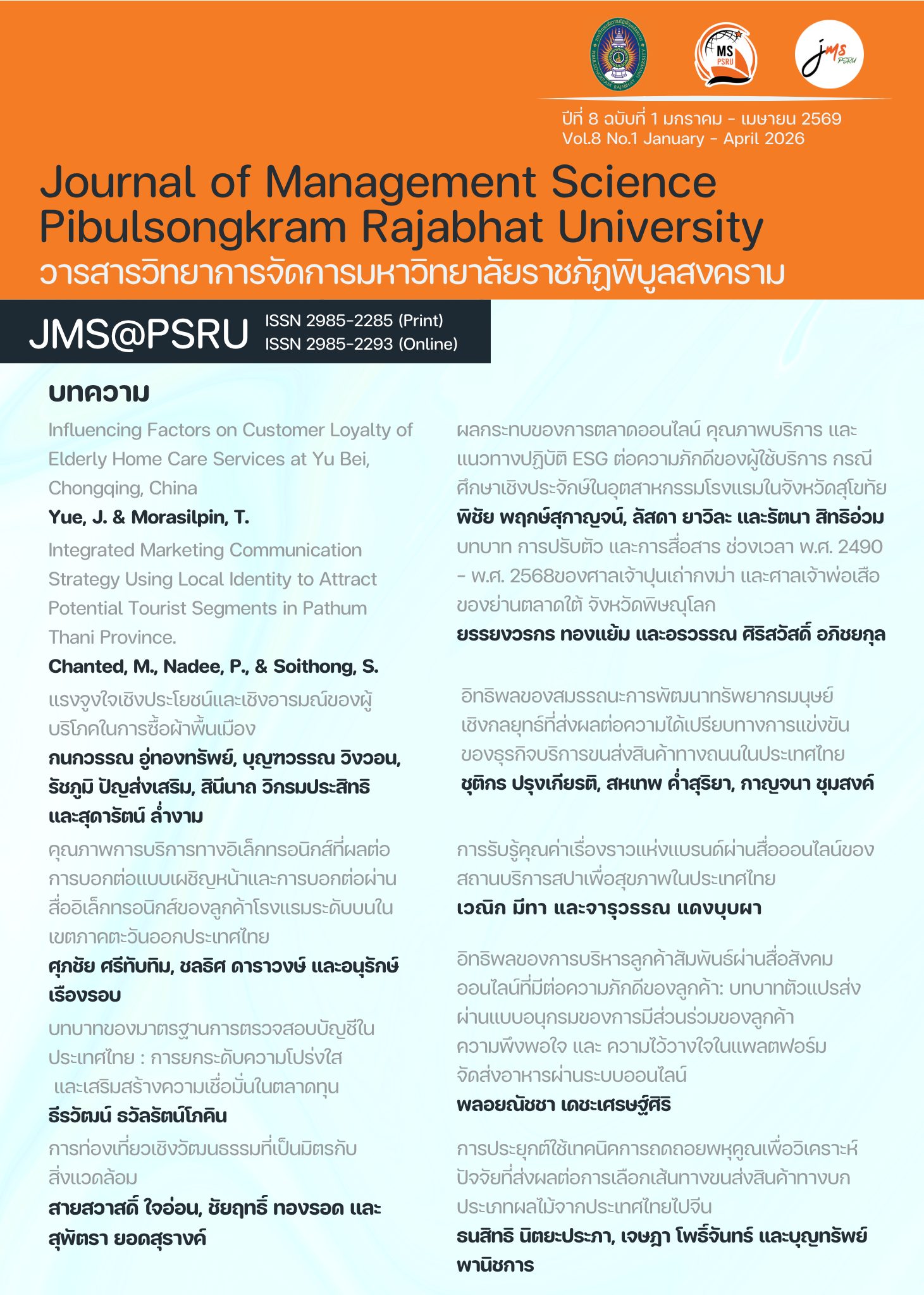
Perceived Brand Story Value through Online Medas of Health Spa Customers in Thailand
Keywords:
Perceived Value, Brand Story, Online Media, Health Spas, ThailandAbstract
This study aims to examine the patterns of communication and brand story perception of health spa services through online media during and after the crisis situation in Thailand. A qualitative research approach was employed by collecting the data from official websites, Facebook pages, and customer reviews on platforms such as Tripadvisor, Google Review, Facebook Review, and Gowabi. The data were analyzed using thematic analysis to identify key communication strategies that influence brand perception. The findings reveal that online communication of health spa focused on four major dimensions: personnel characteristics, service packages, spa products and treatments, and physical features of service locations. Brand storytelling was presented in three forms: first, communicating impressive features such as atmosphere, equipment, and service quality; second, communicating brand promises and values through logos, slogans, service quality, and brand image; and third, communicating experiential values perceived directly by customers. In terms of brand story perception, the clients perceived the value through three dimensions: external value, derived from sensory experiences of sight, sound, smell, taste, and touch from both media and direct service experiences; internal value, reflected in emotional impressions toward personnel, service design, facilities, and pricing; and spiritual value connecting the brand story to deeper perceptions of wellness, relaxation, and holistic experiences.
References
โชน พีระวัฒน์. (2564). เทคนิคการสร้าง Story Branding เพื่อเพิ่มยอดขายให้กับสินค้า. สืบค้น 16 กุมภาพันธ์ 2567, จาก https://www.thaiprint.org/2020/04/vol125/knowledge125-03/.
ถนอมรัตน์ ทองแจ้ง. (2564). รูปแบบการสื่อสารการตลาดออนไลน์ของธุรกิจนวดเพื่อสุขภาพและแนวทางการสื่อสารการตลาดดิจิทัลที่มีประสิทธิผลสำหรับกลุ่ม Millennial ในกรุงเทพมหานคร : กรณีศึกษา นัทธลีญานวดเพื่อสุขภาพ (วิทยานิพนธ์ปริญญามหาบัณฑิต). กรุงเทพฯ: มหาวิทยาลัยกรุงเทพ.
เบญจวรรณ ศฤงคาร และ สันติกร ภมรปฐมกุล. (2563). การศึกษาความแตกต่างระหว่างคุณลักษณะของผู้ประกอบการกับมาตรฐานการให้บริการของธุรกิจสปาในเขตกรุงเทพมหานครและปริมณฑล. วารสารเครือข่ายส่งเสริมการวิจัยทางมนุษยศาสตร์และสังคมศาสตร์, 3(2), 43-55.
มนัสนันท์ เม่งก่วง และ ธิดาสวรรค์ อินสูนย์. (2565). การจัดโปรโมชั่นสปาเพื่อเพิ่มยอดขายและความพึงพอใจของลูกค้าโรงแรมฮิลตัน หัวหิน รีสอร์ทแอนด์สปา. วารสารวิชาการวิทยาลัยสันตพล, 8(1), 58-68.
ศมน พรหมหิตาทร. (2560). ปัจจัยที่ส่งผลต่อความพึงพอใจในการใช้บริการสปาเพื่อสุขภาพประเภท Day spa ของผู้ใช้บริการในเขตกรุงเทพมหานครและปริมณฑล (วิทยานิพนธ์ปริญญามหาบัณฑิต). กรุงเทพฯ:มหาวิทยาลัยธรรมศาสตร์.
ศรีดารา ติเพียร. (2565). การศึกษาองค์ประกอบเชิงพื้นที่ของสถานประกอบการธุรกิจนวดและสปาภายใต้ภาวะวิกฤติโควิด 19 กรณีศึกษาเดย์สปาในกรุงเทพมหานคร. วารสารศิลปกรรมศาสตร์วิชาการ วิจัย และงานสร้างสรรค์, 9(1), 79-99.
ศศิประภา พรหมทอง. (2561). การศึกษาคุณภาพการให้บริการที่ส่งผลต่อความจงรักภักดีการใช้บริการธุรกิจสปาในจังหวัดอุดรธานี. วารสารวิจัยรำไพพรรณี, 12(3), 99-107.
ศิริวรรณ วรรณศิริ. (2564). การจัดการเชิงกลยุทธ์ของธุรกิจสปาไทยและนวดเพื่อสุขภาพช่วงเวลาวิกฤตโควิด (วิทยานิพนธ์ปริญญามหาบัณฑิต). นครปฐม: มหาวิทยาลัยมหิดล.
สุนันท์ นิลพวง. (2557). ความคาดหวังและการรับรู้คุณภาพของผู้โดยสารที่มีต่อการให้บริการรถโดยสารสถานีขนส่งสายใต้. วารสารวิทยาการจัดการ มหาวิทยาลัยราชภัฏนครปฐม, 1(2), 96-109.
เวณิก มีทา. (2567). การรับรู้คุณค่าเรื่องราวแห่งเเบรนด์ของสปาเพื่อสุขภาพผ่านสื่อออนไลน์ (วิทยานิพนธ์รปริญญามหาบัณฑิต). พิษณุโลก: มหาวิทยาลัยนเรศวร.
Aaker, D. A. (1996). Building Strong Brands. United Kingdom: CPI Mackays.
Aaker, D. A., Kumar, V., Leone, R. P., & Day, G. S. (2016). Marketing Research (12 th ed.). New Jersey: Wiley.
Breazeale, M. (2020). Retail atmospherics and branding: The role of sensory marketing. Journal of Retailing and Consumer Services, 54, 102–109.
Brodie, R. J., Hollebeek, L. D., Juric, B., & Ilic, A. (2013). Customer engagement: Conceptual domain, fundamental propositions, and implications for research. Journal of Service Research, 14(3), 252-271.
Citruslabs. (2024). Leveraging Clinical Trials for Health Claims Substantiation: Maximizing Benefits for Your Brand. Retrieved May 6, 2024, from https://www.citruslabs.com/post/leveraging-clinical-trials-for-health-claims-substantiation-maximizing-benefits-for-your-brand
De Vries, L., Peluso, A. M., Romani, S., Leeflang, P. S., & Marcati, A. (2017). Explaining consumer brand-related activities on social media: An investigation of the different roles of self-expression and socializing motivations. Computers in Human Behavior, 75, 272–282.
Duncan, T. & Moriarty, S. E. (1998). A Communication-Based Marketing Model for Managing Relationships. Journal of Marketing, 62(2), 1–13.
Escalas, J. E. (2004). Narrative processing: Building consumer connections to brands. Journal of Consumer Psychology, 14(1-2), 168-180.
Evans, N. H., Phua, J., Lim, J., & Jun, H. (2017). Disclosing Instagram influencer advertising: The effects of disclosure language on advertising recognition, attitudes, and behavioral intent. Journal of Interactive Advertising, 17(2), 138–149.
Fog, K., Budtz, C., & Yakaboylu, B. (2010). Storytelling: Branding in practice. Swaziland: Springer.
Gensler, S., Völckner, F., Liu-Thompkins, Y., & Wiertz, C. (2013). Managing brands in the social media environment. Journal of Interactive Marketing, 27(4), 242-256.
GWI. (2024). THE SPA Industry. Retrieved March 6, 2024, from https://globalwellnessinstitute.org/what-is-wellness/spaindustry/#:~:text=In%20addition%20to%20spa%20and%20body%20treat
ments%2C,medicine%2C%20preventive%20or%20curative%20medical%20services%2C%20etc.
Holbrook, M. B. (1999). Consumer value: A framework for analysis and research. United Kingdom: Routledge.
Hollebeek, L. & Macky, K. (2019). Digital Content Marketing's Role in Fostering Consumer Engagement, Trust, and Value: Framework, Fundamental Propositions, and Implications. Journal of Interactive Marketing, 45, 27-41.
Hwang, K. & Zhang, Q. (2018). Influence of parasocial relationship between digital celebrities and their followers on followers’ purchase and electronic word-of-mouth intentions, and persuasion knowledge. Computers in Human Behavior, 87, 155–173.
Kaplan, A. M. & Haenlein, M. (2010). Users of the world, unite! The challenges and opportunities of Social Media. Business Horizons, 53(1), 59-68.
Keller, K. L. (2003). Strategic brand management: Building, measuring, and managing brand equity. United Kingdom: Pearson.
Keller, K. L. (2013). Strategic Brand Management: Building, Measuring, and Managing Brand Equity (4th ed.). United Kingdom: Pearson.
Kotler, P. & Keller, K. L. (2016). Marketing management (15th ed.). United Kingdom: Pearson.
Kumar, R., Laskar, M. A., Hewaidy, I. F., Barakat, M. A. (2019). Modified Adsorbents for Removal of Heavy Metals from Aqueous Environment: A Review. Earth Systems and Environment, 3, 83-93.
Lou, C. & Yuan, S. (2019). Influencer Marketing: How Message Value and Credibility Affect Consumer Trust of Branded Content on Social Media. Journal of Interactive Advertising, 19, 58-73.
Pham, P. & Gammoh, B. (2015). Characteristics of social-media marketing strategy and customer-based brand equity outcomes: A conceptual model. International Journal of Internet Marketing and Advertising, 9(4), 321-337.
Pine, B. J. & Gilmore, J. H. (1998). The experience economy: Work is theatre & every business a stage. Harvard Business Review, 76(4), 97-105.
Pulizzi, J. (2012). The Rise of Storytelling as the New Marketing. Publishing Research Quarterly, 28, 116-123.
https://doi.org/10.1007/s12109-012-9264-5
Zimmermann, S., Dauter, J., & Gewald, H. (2024). Promoting Sports and Wellness with Social Media Advertising – An Analysis of Different Marketing Channels. Procedia Computer Science, 231, 311-316.
Zeithaml, V. A. (1988). Consumer perceptions of price, quality, and value: A means-end model and synthesis of evidence. Journal of Marketing, 52(3), 2-22.
Schmitt, B. H. (1999). Experiential marketing. Journal of Marketing Management, 15(1-3), 53-67.
Schultz, D. E. & Kitchen, P. J. (2000). Communicating Globally: An Integrated Marketing Approach. United Kingdom: Palgrave Macmillan.
Sheth, J. (2020). Impact of Covid-19 on consumer behavior: Will the old habits return or die? Journal of Business Research, 117, 280-283.
World Health Organization. (2020). Coronavirus disease (COVID-19) pandemic. Retrieved March 6,
, from https://www.who.int/emergencies/diseases/novel-coronavirus-2019World Health Organization.
Yim, M. Y.-C., Chu, S.-C., & Sauer, P. L. (2017). Is augmented reality technology an effective tool for e-commerce? An interactivity and vividness perspective. Journal of Interactive Marketing, 39, 89–103.
Downloads
Published
How to Cite
Issue
Section
License
Copyright (c) 2026 Faculty of Management Science Pibulsongkram Rajabhat University

This work is licensed under a Creative Commons Attribution-NonCommercial-NoDerivatives 4.0 International License.
บทความที่ได้รับการตีพิมพ์ในวารสารวิทยาการจัดการมหาวิทยาลัยราชภัฏพิบูลสงคราม เป็นลิขสิทธิ์ของมหาวิทยาลัยราชภัฎพิบูลสงคราม
บทความที่ลงพิมพ์ใน วารสารวิทยาการจัดการมหาวิทยาลัยราชภัฎพิบูลสงคราม ถือว่าเป็นความเห็นส่วนตัวของผู้เขียนคณะบรรณาธิการไม่จำเป็นต้องเห็นด้วย ผู้เขียนต้องรับผิดชอบต่อบทความของตนเอง


